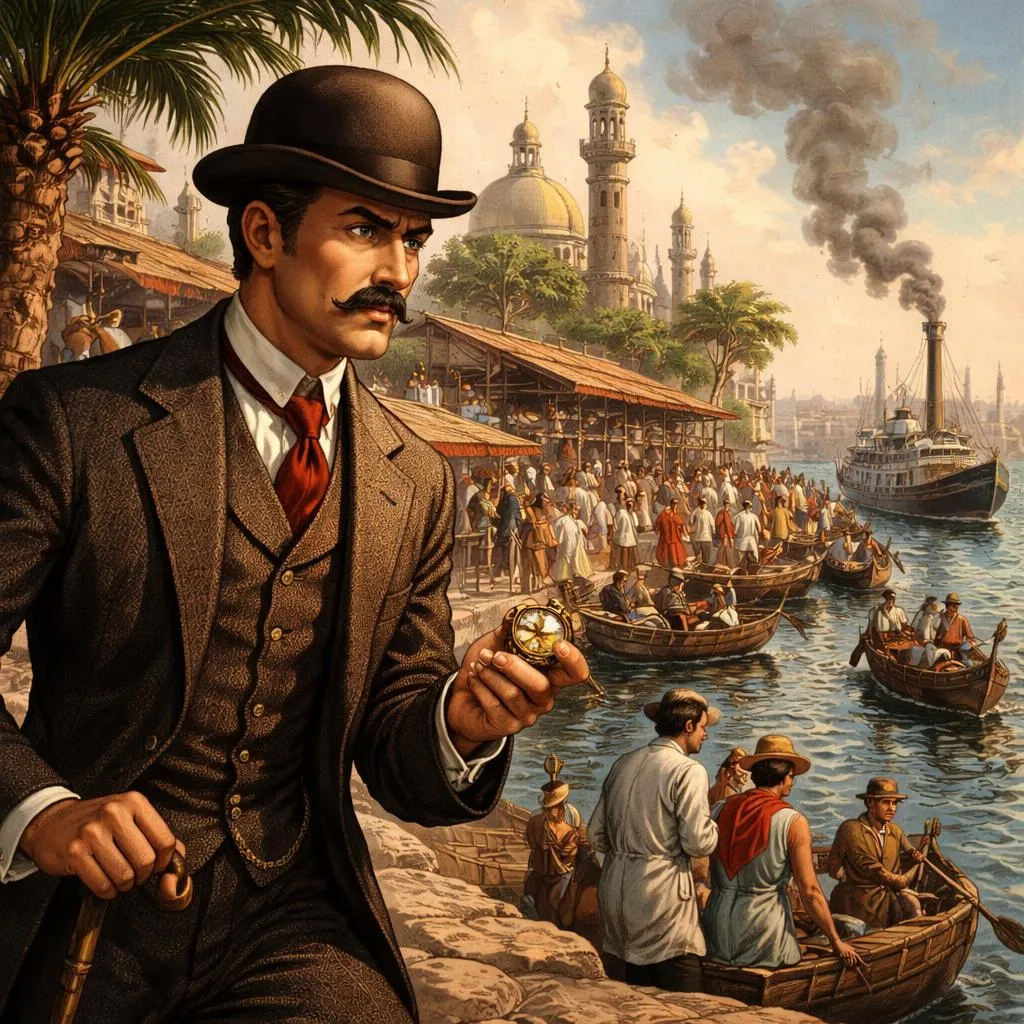

The circumstances under which this telegraphic dispatch about Phileas Fogg was sent were as follows:
The steamer Mongolia, belonging to the Peninsular and Oriental Company, built of iron, of two thousand eight hundred tons burden, and five hundred horse–power, was due at eleven o'clock a.m. on Wednesday, the 9th of October, at Suez. The Mongolia plied regularly between Brindisi and Bombay via the Suez Canal, and was one of the fastest steamers belonging to the company, always making more than ten knots an hour between Brindisi and Suez, and nine and a half between Suez and Bombay.
Two men were promenading up and down the wharves, among the crowd of natives and strangers who were sojourning at this once straggling village—now, thanks to the enterprise of M. Lesseps, a fast–growing town. One was the British consul at Suez, who, despite the prophecies of the English Government, and the unfavourable predictions of Stephenson, was in the habit of seeing, from his office window, English ships daily passing to and fro on the great canal, by which the old roundabout route from England to India by the Cape of Good Hope was abridged by at least a half. The other was a small, slight–built personage, with a nervous, intelligent face, and bright eyes peering out from under eyebrows which he was incessantly twitching. He was just now manifesting unmistakable signs of impatience, nervously pacing up and down, and unable to stand still for a moment. This was Fix, one of the detectives who had been dispatched from England in search of the bank robber; it was his task to narrowly watch every passenger who arrived at Suez, and to follow up all who seemed to be suspicious characters, or bore a resemblance to the description of the criminal, which he had received two days before from the police headquarters at London. The detective was evidently inspired by the hope of obtaining the splendid reward which would be the prize of success, and awaited with a feverish impatience, easy to understand, the arrival of the steamer Mongolia.
"So you say, consul," asked he for the twentieth time, "that this steamer is never behind time?"
"No, Mr. Fix," replied the consul. "She was bespoken yesterday at Port Said, and the rest of the way is of no account to such a craft. I repeat that the Mongolia has been in advance of the time required by the company's regulations, and gained the prize awarded for excess of speed."
"Does she come directly from Brindisi?"
"Directly from Brindisi; she takes on the Indian mails there, and she left there Saturday at five p.m. Have patience, Mr. Fix; she will not be late. But really, I don't see how, from the description you have, you will be able to recognise your man, even if he is on board the Mongolia."
"A man rather feels the presence of these fellows, consul, than recognises them. You must have a scent for them, and a scent is like a sixth sense which combines hearing, seeing, and smelling. I've arrested more than one of these gentlemen in my time, and, if my thief is on board, I'll answer for it; he'll not slip through my fingers."
"I hope so, Mr. Fix, for it was a heavy robbery."
"A magnificent robbery, consul; fifty–five thousand pounds! We don't often have such windfalls. Burglars are getting to be so contemptible nowadays! A fellow gets hung for a handful of shillings!"
"Mr. Fix," said the consul, "I like your way of talking, and hope you'll succeed; but I fear you will find it far from easy. Don't you see, the description which you have there has a singular resemblance to an honest man?"
"Consul," remarked the detective, dogmatically, "great robbers always resemble honest folks. Fellows who have rascally faces have only one course to take, and that is to remain honest; otherwise they would be arrested off–hand. The artistic thing is, to unmask honest countenances; it's no light task, I admit, but a real art."
Mr. Fix evidently was not wanting in a tinge of self–conceit.
Little by little the scene on the quay became more animated; sailors of various nations, merchants, ship–brokers, porters, fellahs, bustled to and fro as if the steamer were immediately expected. The weather was clear, and slightly chilly. The minarets of the town loomed above the houses in the pale rays of the sun. A jetty pier, some two thousand yards along, extended into the roadstead. A number of fishing–smacks and coasting boats, some retaining the fantastic fashion of ancient galleys, were discernible on the Red Sea.
As he passed among the busy crowd, Fix, according to habit, scrutinised the passers–by with a keen, rapid glance.
It was now half–past ten.
"The steamer doesn't come!" he exclaimed, as the port clock struck.
"She can't be far off now," returned his companion.
"How long will she stop at Suez?"
"Four hours; long enough to get in her coal. It is thirteen hundred and ten miles from Suez to Aden, at the other end of the Red Sea, and she has to take in a fresh coal supply."
"And does she go from Suez directly to Bombay?"
"Without putting in anywhere."
"Good!" said Fix. "If the robber is on board he will no doubt get off at Suez, so as to reach the Dutch or French colonies in Asia by some other route. He ought to know that he would not be safe an hour in India, which is English soil."
"Unless," objected the consul, "he is exceptionally shrewd. An English criminal, you know, is always better concealed in London than anywhere else."
This observation furnished the detective food for thought, and meanwhile the consul went away to his office. Fix, left alone, was more impatient than ever, having a presentiment that the robber was on board the Mongolia. If he had indeed left London intending to reach the New World, he would naturally take the route via India, which was less watched and more difficult to watch than that of the Atlantic. But Fix's reflections were soon interrupted by a succession of sharp whistles, which announced the arrival of the Mongolia. The porters and fellahs rushed down the quay, and a dozen boats pushed off from the shore to go and meet the steamer. Soon her gigantic hull appeared passing along between the banks, and eleven o'clock struck as she anchored in the road. She brought an unusual number of passengers, some of whom remained on deck to scan the picturesque panorama of the town, while the greater part disembarked in the boats, and landed on the quay.
Fix took up a position, and carefully examined each face and figure which made its appearance. Presently one of the passengers, after vigorously pushing his way through the importunate crowd of porters, came up to him and politely asked if he could point out the English consulate, at the same time showing a passport which he wished to have visaed. Fix instinctively took the passport, and with a rapid glance read the description of its bearer. An involuntary motion of surprise nearly escaped him, for the description in the passport was identical with that of the bank robber which he had received from Scotland Yard.
"Is this your passport?" asked he.
"No, it's my master's."
"And your master is—"
"He stayed on board."
"But he must go to the consul's in person, so as to establish his identity."
"Oh, is that necessary?"
"Quite indispensable."
"And where is the consulate?"
"There, on the corner of the square," said Fix, pointing to a house two hundred steps off.
"I'll go and fetch my master, who won't be much pleased, however, to be disturbed."
The passenger bowed to Fix, and returned to the steamer.
Hintergrund und Einführung des Autors
Dieser Auszug stammt aus dem klassischen Abenteuerroman Reise um die Erde in 80 Tagen, geschrieben vom französischen Autor Jules Verne im Jahr 1873. Verne ist als einer der Pioniere der Science-Fiction- und Abenteuerliteratur bekannt. Seine Werke verbinden oft detailliertes wissenschaftliches Wissen mit spannendem Geschichtenerzählen und inspirieren Generationen von Lesern, die Welt zu erkunden und neue Möglichkeiten zu imaginieren. Reise um die Erde in 80 Tagen fängt den Geist der Faszination des 19. Jahrhunderts für Reisen, Technologie und Erkundung ein, konzentriert auf die kühne Reise von Phileas Fogg, einem akribischen englischen Gentleman, der darauf wettet, dass er die Welt in nur achtzig Tagen umrunden kann.
Detaillierte Interpretation und Bedeutung der Geschichte
In dieser Passage sehen wir, wie der Detektiv Fix ängstlich auf die Ankunft des Dampfers Mongolia am Suezkanal wartet, in der Hoffnung, einen Bankräuber zu fassen, der sich an Bord befinden soll. Die Szene ist lebendig und geschäftig und zeigt die Bedeutung des Suezkanals als strategischen Punkt, der Europa und Asien verbindet. Der Dialog zwischen Fix und dem britischen Konsul hebt Themen wie Verdacht, Identität und die Herausforderung hervor, Wahrheit von Schein zu unterscheiden. Fix' Glaube, dass große Kriminelle oft wie ehrliche Menschen aussehen, fügt der Geschichte eine Schicht von Ironie und Komplexität hinzu und erinnert die Leser daran, dass der Schein trügen kann.
Dieser Teil der Geschichte bereitet die Bühne für die Spannung und Intrige, die folgen werden, wenn sich Phileas Foggs Reise entfaltet. Er spiegelt auch die technologischen Fortschritte der Ära wider – Dampfschiffe, Telegrafen und globale Kommunikation –, die eine solche Reise ermöglichten und die Fantasie der Leser weltweit beflügelten.
Lektionen und Erkenntnisse für Schüler
-
Kritisches Denken und Wahrnehmung: Fix' Schwierigkeit, den Kriminellen aufgrund seines Aussehens zu identifizieren, lehrt uns, dass wir Menschen nicht nur danach beurteilen sollten, wie sie aussehen. Stattdessen sollten wir kritische Denkfähigkeiten entwickeln und tiefer in Fakten und Verhaltensweisen eintauchen, bevor wir uns eine Meinung bilden.
-
Geduld und Beobachtung: Fix' Warten und sorgfältige Überprüfung der Passagiere zeigen die Bedeutung von Geduld und Liebe zum Detail – Fähigkeiten, die sowohl im akademischen Studium als auch im Alltag wertvoll sind.
-
Mut und Entschlossenheit: Phileas Foggs Reise, die in dieser Passage angedeutet wird, ist ein Beweis für menschlichen Mut und Entschlossenheit. Die Schüler können lernen, sich ehrgeizige Ziele zu setzen und diese mit Ausdauer zu verfolgen, auch wenn sie mit Unsicherheiten konfrontiert sind.
-
Der Wert von Technologie und Innovation: Der Roman feiert die Macht neuer Technologien wie Dampfschiffe und Telegrafen und ermutigt die Schüler, den wissenschaftlichen Fortschritt und seine Auswirkungen auf die Gesellschaft zu schätzen.
Anwendungen im Leben, beim Lernen und in sozialen Situationen
-
Beim Lernen: So wie Fix sorgfältig Hinweise analysiert, sollten die Schüler starke Beobachtungs- und Analysefähigkeiten entwickeln, um Probleme zu lösen und komplexe Themen zu verstehen.
-
In sozialen Interaktionen: Die Geschichte warnt davor, voreilige Urteile über andere zu fällen. Die Schüler können Empathie und Aufgeschlossenheit üben, indem sie Menschen jenseits des ersten Eindrucks kennenlernen.
-
In der persönlichen Entwicklung: Der Abenteuergeist und die Widerstandsfähigkeit, die Fogg zeigt, ermutigen die Schüler, Herausforderungen anzunehmen und unter Druck ruhig zu bleiben, Eigenschaften, die ihnen bei Prüfungen, Projekten und zukünftigen Karrieren helfen werden.
Positive Werte aus der Geschichte kultivieren
-
Ehrlichkeit und Integrität: Trotz des Verdachts des Detektivs feiert der Roman letztendlich Ehrlichkeit. Die Schüler sollten danach streben, in ihren Handlungen vertrauenswürdig und aufrichtig zu sein.
-
Neugier und Aufgeschlossenheit: Vernes Werk inspiriert Neugier auf die Welt. Die Schüler können die Liebe zum Lernen kultivieren, indem sie neue Kulturen, Wissenschaften und Ideen erforschen.
-
Ausdauer: Foggs unerschütterliches Engagement für sein Ziel lehrt die Bedeutung von Ausdauer, auch wenn Hindernisse auftreten.
Fazit
Reise um die Welt in achtzig Tagen ist mehr als nur ein aufregendes Abenteuer; es ist eine reiche Quelle von Lektionen über die menschliche Natur, Technologie und den Geist der Erkundung. Indem sie diese Geschichte lesen und darüber nachdenken, können die Schüler wertvolle Fähigkeiten und Einstellungen entwickeln, die ihnen in der Schule und im Leben zugute kommen werden. Die Neugier, Geduld und Entschlossenheit, die in dem Roman veranschaulicht werden, zu verinnerlichen, kann jungen Lesern helfen, zu nachdenklichen, mutigen und aufgeschlossenen Menschen zu werden, die bereit sind, ihre eigenen Reisen in der Welt zu meistern.
