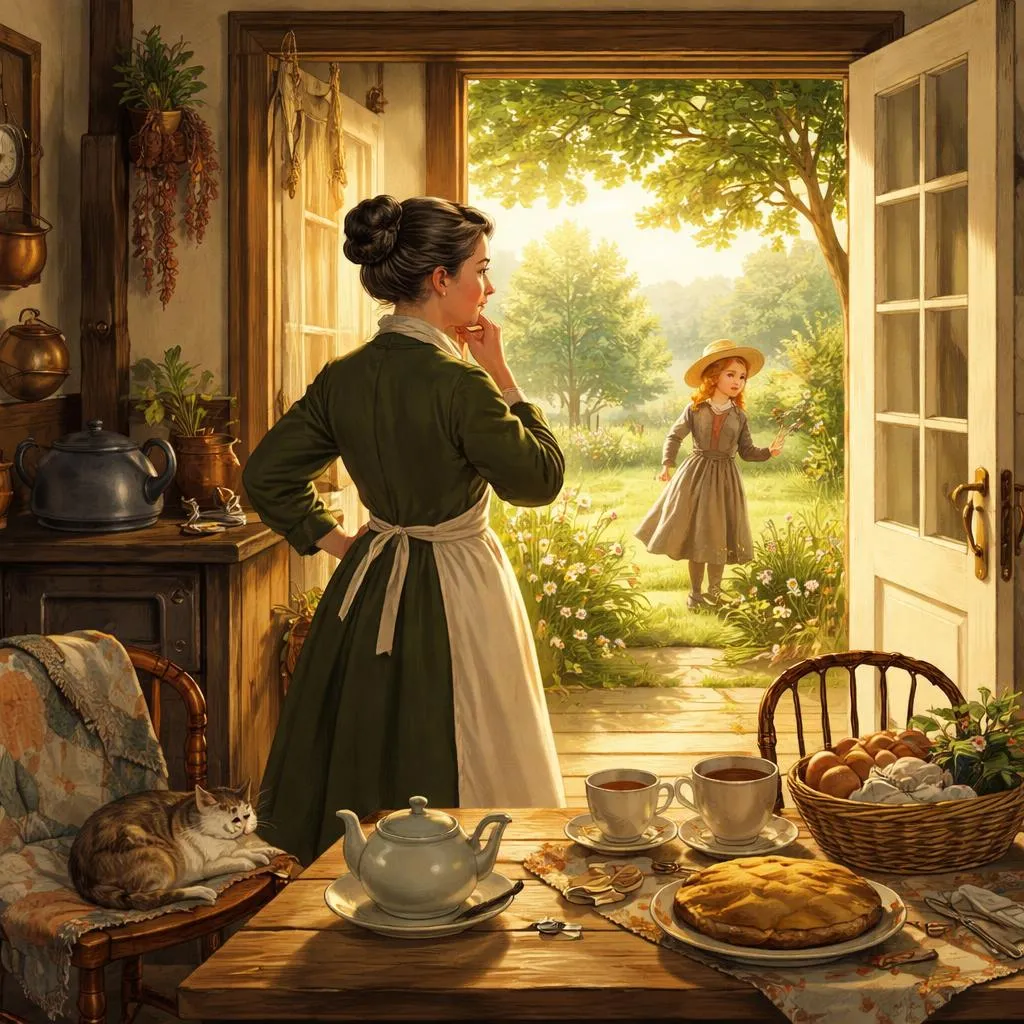

Get there they did, however, in due season. Mrs. Spencer lived in a big yellow house at White Sands Cove, and she came to the door with surprise and welcome mingled on her benevolent face.
“Dear, dear,” she exclaimed, “you’re the last folks I was looking for today, but I’m real glad to see you. You’ll put your horse in? And how are you, Anne?”
“I’m as well as can be expected, thank you,” said Anne smilelessly. A blight seemed to have descended on her.
“I suppose we’ll stay a little while to rest the mare,” said Marilla, “but I promised Matthew I’d be home early. The fact is, Mrs. Spencer, there’s been a queer mistake somewhere, and I’ve come over to see where it is. We send word, Matthew and I, for you to bring us a boy from the asylum. We told your brother Robert to tell you we wanted a boy ten or eleven years old.”
“Marilla Cuthbert, you don’t say so!” said Mrs. Spencer in distress. “Why, Robert sent word down by his daughter Nancy and she said you wanted a girl—didn’t she Flora Jane?” appealing to her daughter who had come out to the steps.
“She certainly did, Miss Cuthbert,” corroborated Flora Jane earnestly.
“I’m dreadful sorry,” said Mrs. Spencer. “It’s too bad; but it certainly wasn’t my fault, you see, Miss Cuthbert. I did the best I could and I thought I was following your instructions. Nancy is a terrible flighty thing. I’ve often had to scold her well for her heedlessness.”
“It was our own fault,” said Marilla resignedly. “We should have come to you ourselves and not left an important message to be passed along by word of mouth in that fashion. Anyhow, the mistake has been made and the only thing to do is to set it right. Can we send the child back to the asylum? I suppose they’ll take her back, won’t they?”
“I suppose so,” said Mrs. Spencer thoughtfully, “but I don’t think it will be necessary to send her back. Mrs. Peter Blewett was up here yesterday, and she was saying to me how much she wished she’d sent by me for a little girl to help her. Mrs. Peter has a large family, you know, and she finds it hard to get help. Anne will be the very girl for you. I call it positively providential.”
Marilla did not look as if she thought Providence had much to do with the matter. Here was an unexpectedly good chance to get this unwelcome orphan off her hands, and she did not even feel grateful for it.
She knew Mrs. Peter Blewett only by sight as a small, shrewish-faced woman without an ounce of superfluous flesh on her bones. But she had heard of her. “A terrible worker and driver,” Mrs. Peter was said to be; and discharged servant girls told fearsome tales of her temper and stinginess, and her family of pert, quarrelsome children. Marilla felt a qualm of conscience at the thought of handing Anne over to her tender mercies.
“Well, I’ll go in and we’ll talk the matter over,” she said.
“And if there isn’t Mrs. Peter coming up the lane this blessed minute!” exclaimed Mrs. Spencer, bustling her guests through the hall into the parlor, where a deadly chill struck on them as if the air had been strained so long through dark green, closely drawn blinds that it had lost every particle of warmth it had ever possessed. “That is real lucky, for we can settle the matter right away. Take the armchair, Miss Cuthbert. Anne, you sit here on the ottoman and don’t wiggle. Let me take your hats. Flora Jane, go out and put the kettle on. Good afternoon, Mrs. Blewett. We were just saying how fortunate it was you happened along. Let me introduce you two ladies. Mrs. Blewett, Miss Cuthbert. Please excuse me for just a moment. I forgot to tell Flora Jane to take the buns out of the oven.”
Mrs. Spencer whisked away, after pulling up the blinds. Anne sitting mutely on the ottoman, with her hands clasped tightly in her lap, stared at Mrs Blewett as one fascinated. Was she to be given into the keeping of this sharp-faced, sharp-eyed woman? She felt a lump coming up in her throat and her eyes smarted painfully. She was beginning to be afraid she couldn’t keep the tears back when Mrs. Spencer returned, flushed and beaming, quite capable of taking any and every difficulty, physical, mental or spiritual, into consideration and settling it out of hand.
“It seems there’s been a mistake about this little girl, Mrs. Blewett,” she said. “I was under the impression that Mr. and Miss Cuthbert wanted a little girl to adopt. I was certainly told so. But it seems it was a boy they wanted. So if you’re still of the same mind you were yesterday, I think she’ll be just the thing for you.”
Mrs. Blewett darted her eyes over Anne from head to foot.
“How old are you and what’s your name?” she demanded.
“Anne Shirley,” faltered the shrinking child, not daring to make any stipulations regarding the spelling thereof, “and I’m eleven years old.”
“Humph! You don’t look as if there was much to you. But you’re wiry. I don’t know but the wiry ones are the best after all. Well, if I take you you’ll have to be a good girl, you know—good and smart and respectful. I’ll expect you to earn your keep, and no mistake about that. Yes, I suppose I might as well take her off your hands, Miss Cuthbert. The baby’s awful fractious, and I’m clean worn out attending to him. If you like I can take her right home now.”
Marilla looked at Anne and softened at sight of the child’s pale face with its look of mute misery—the misery of a helpless little creature who finds itself once more caught in the trap from which it had escaped. Marilla felt an uncomfortable conviction that, if she denied the appeal of that look, it would haunt her to her dying day. More-over, she did not fancy Mrs. Blewett. To hand a sensitive, “highstrung” child over to such a woman! No, she could not take the responsibility of doing that!
“Well, I don’t know,” she said slowly. “I didn’t say that Matthew and I had absolutely decided that we wouldn’t keep her. In fact I may say that Matthew is disposed to keep her. I just came over to find out how the mistake had occurred. I think I’d better take her home again and talk it over with Matthew. I feel that I oughtn’t to decide on anything without consulting him. If we make up our mind not to keep her we’ll bring or send her over to you tomorrow night. If we don’t you may know that she is going to stay with us. Will that suit you, Mrs. Blewett?”
“I suppose it’ll have to,” said Mrs. Blewett ungraciously.
During Marilla’s speech a sunrise had been dawning on Anne’s face. First the look of despair faded out; then came a faint flush of hope; here eyes grew deep and bright as morning stars. The child was quite transfigured; and, a moment later, when Mrs. Spencer and Mrs. Blewett went out in quest of a recipe the latter had come to borrow she sprang up and flew across the room to Marilla.
“Oh, Miss Cuthbert, did you really say that perhaps you would let me stay at Green Gables?” she said, in a breathless whisper, as if speaking aloud might shatter the glorious possibility. “Did you really say it? Or did I only imagine that you did?”
“I think you’d better learn to control that imagination of yours, Anne, if you can’t distinguish between what is real and what isn’t,” said Marilla crossly. “Yes, you did hear me say just that and no more. It isn’t decided yet and perhaps we will conclude to let Mrs. Blewett take you after all. She certainly needs you much more than I do.”
“I’d rather go back to the asylum than go to live with her,” said Anne passionately. “She looks exactly like a—like a gimlet.”
Marilla smothered a smile under the conviction that Anne must be reproved for such a speech.
“A little girl like you should be ashamed of talking so about a lady and a stranger,” she said severely. “Go back and sit down quietly and hold your tongue and behave as a good girl should.”
“I’ll try to do and be anything you want me, if you’ll only keep me,” said Anne, returning meekly to her ottoman.
When they arrived back at Green Gables that evening Matthew met them in the lane. Marilla from afar had noted him prowling along it and guessed his motive. She was prepared for the relief she read in his face when he saw that she had at least brought back Anne back with her. But she said nothing, to him, relative to the affair, until they were both out in the yard behind the barn milking the cows. Then she briefly told him Anne’s history and the result of the interview with Mrs. Spencer.
“I wouldn’t give a dog I liked to that Blewett woman,” said Matthew with unusual vim.
“I don’t fancy her style myself,” admitted Marilla, “but it’s that or keeping her ourselves, Matthew. And since you seem to want her, I suppose I’m willing—or have to be. I’ve been thinking over the idea until I’ve got kind of used to it. It seems a sort of duty. I’ve never brought up a child, especially a girl, and I dare say I’ll make a terrible mess of it. But I’ll do my best. So far as I’m concerned, Matthew, she may stay.”
Matthew’s shy face was a glow of delight.
“Well now, I reckoned you’d come to see it in that light, Marilla,” he said. “She’s such an interesting little thing.”
“It’d be more to the point if you could say she was a useful little thing,” retorted Marilla, “but I’ll make it my business to see she’s trained to be that. And mind, Matthew, you’re not to go interfering with my methods. Perhaps an old maid doesn’t know much about bringing up a child, but I guess she knows more than an old bachelor. So you just leave me to manage her. When I fail it’ll be time enough to put your oar in.”
“There, there, Marilla, you can have your own way,” said Matthew reassuringly. “Only be as good and kind to her as you can without spoiling her. I kind of think she’s one of the sort you can do anything with if you only get her to love you.”
Marilla sniffed, to express her contempt for Matthew’s opinions concerning anything feminine, and walked off to the dairy with the pails.
“I won’t tell her tonight that she can stay,” she reflected, as she strained the milk into the creamers. “She’d be so excited that she wouldn’t sleep a wink. Marilla Cuthbert, you’re fairly in for it. Did you ever suppose you’d see the day when you’d be adopting an orphan girl? It’s surprising enough; but not so surprising as that Matthew should be at the bottom of it, him that always seemed to have such a mortal dread of little girls. Anyhow, we’ve decided on the experiment and goodness only knows what will come of it.”
Hintergrund und Einführung der Autorin
Dieser Auszug stammt aus Anne auf Green Gables, einem klassischen Roman der kanadischen Autorin Lucy Maud Montgomery, der erstmals 1908 veröffentlicht wurde. Die Geschichte spielt im fiktiven Dorf Avonlea auf Prince Edward Island, Kanada, und folgt den Abenteuern von Anne Shirley, einem fantasievollen und temperamentvollen Waisenmädchen, das irrtümlich geschickt wurde, um bei Marilla und Matthew Cuthbert zu leben, einem Bruder und einer Schwester, die beabsichtigt hatten, einen Jungen zu adoptieren, um bei ihrer Farm zu helfen.
Lucy Maud Montgomery schrieb diesen beliebten Roman, inspiriert von ihrer eigenen Kindheit und der natürlichen Schönheit von Prince Edward Island. Ihre lebendigen Beschreibungen und die reiche Charakterentwicklung haben Anne auf Green Gables zu einem zeitlosen Werk gemacht, das von Lesern weltweit geschätzt wird.
Detaillierte Interpretation und Bedeutung
Diese Passage fängt einen entscheidenden Moment in der Geschichte ein, in dem die Cuthberts die Verwechslung bei ihrer Adoptionsanfrage entdecken und Anne zum ersten Mal treffen. Sie hebt Themen wie Missverständnisse, unerwartete Herausforderungen und den Beginn einer transformierenden Beziehung hervor. Marillas anfängliches Zögern und Annes Verletzlichkeit bilden die Grundlage für das Wachstum und das gegenseitige Verständnis, das sich im Laufe des Romans entwickeln wird.
Die Geschichte erforscht die Bedeutung von Familie, Zugehörigkeit und Akzeptanz. Annes fantasievoller Geist und ihre Widerstandsfähigkeit scheinen trotz ihrer schwierigen Vergangenheit durch, und die allmähliche Akzeptanz durch die Cuthberts spiegelt die Kraft der Liebe und Geduld wider.
Lektionen und Erkenntnisse für Schüler
-
Das Unerwartete annehmen: Das Leben bringt oft Überraschungen und Fehler mit sich, ähnlich wie die Verwechslung in dieser Geschichte. Zu lernen, sich anzupassen und das Gute in unerwarteten Situationen zu finden, ist eine wertvolle Fähigkeit.
-
Mitgefühl und Verständnis: Marillas innerer Konflikt, Anne wegzuschicken oder sie zu behalten, lehrt die Leser Empathie und die Bedeutung, über den ersten Eindruck hinauszuschauen.
-
Widerstandsfähigkeit und Hoffnung: Annes hoffnungsvolle Reaktion, selbst im Unglück, zeigt die Stärke einer positiven Einstellung und die Kraft der Hoffnung.
-
Kommunikation ist wichtig: Die Verwirrung entstand zum Teil aufgrund schlechter Kommunikation. Dies erinnert die Schüler daran, in ihren Interaktionen klar und direkt zu sein, um Missverständnisse zu vermeiden.
Anwendung im täglichen Leben
-
In der Schule: Wenn Schüler mit unerwarteten Herausforderungen oder Veränderungen konfrontiert werden, können sie sich an Annes Widerstandsfähigkeit erinnern und positiv bleiben. Sie können auch eine klare Kommunikation mit Lehrern und Klassenkameraden üben.
-
In sozialen Umgebungen: Freundlichkeit gegenüber neuen oder anderen Menschen zu zeigen, wie Marilla es schließlich tut, hilft beim Aufbau von integrativen Freundschaften und Gemeinschaften.
-
Zu Hause: Das Verständnis der Gefühle der Familienmitglieder und die Geduld, auch wenn die Situationen schwierig sind, stärkt die Familienbande.
Positive Eigenschaften aus der Geschichte kultivieren
-
Fantasie und Kreativität: Annes lebhafte Fantasie ist eine Quelle der Freude und Stärke. Die Schüler sollten ermutigt werden, ihre Kreativität durch Lesen, Schreiben und künstlerische Aktivitäten zu fördern.
-
Freundlichkeit und Geduld: Marillas endgültige Akzeptanz von Anne zeigt, dass Geduld und Freundlichkeit Beziehungen zum Besseren verändern können. Das Üben dieser Eigenschaften hilft beim Knüpfen und Halten von Freundschaften.
-
Verantwortung und Wachstum: Annes Versprechen, „alles zu sein, was du willst“, spiegelt die Bereitschaft wider, zu wachsen und zu lernen. Die Schüler können diese Denkweise annehmen, um sich selbst zu verbessern und Herausforderungen zu meistern.
Reflexion und Wertschätzung
Anne auf Green Gables ist mehr als nur eine Geschichte über ein Waisenmädchen; es ist eine Feier des menschlichen Geistes, des Wachstums und der unerwarteten Freuden, die das Leben bringen kann. Schüler, die diese Passage lesen, können die Tiefe des Charakters und die emotionale Reise, die Anne und die Cuthberts vor sich haben, wertschätzen. Sie ermutigt die Leser, über das Äußere hinauszuschauen, Veränderungen anzunehmen und an die Möglichkeit eines Neuanfangs zu glauben.
Indem sich die Schüler mit dieser Geschichte auseinandersetzen, genießen sie nicht nur eine reichhaltige Erzählung, sondern gewinnen auch Einblicke in Empathie, Widerstandsfähigkeit und den Wert von Familie und Freundschaft – Lektionen, die für ihre persönliche Entwicklung und ihre sozialen Interaktionen unerlässlich sind.
