
In the stillness and the darkness, realization soon began to supplement knowledge. The mere knowledge of a fact is pale; but when you come to realize your fact, it takes on color. It is all the difference between hearing of a man being stabbed to the heart, and seeing it done. In the stillness and the darkness, the knowledge that I was in deadly danger took to itself deeper and deeper meaning all the time; a something which was realization crept inch by inch through my veins and turned me cold.
But it is a blessed provision of nature that at times like these, as soon as a man’s mercury has got down to a certain point there comes a revulsion, and he rallies. Hope springs up, and cheerfulness along with it, and then he is in good shape to do something for himself, if anything can be done. When my rally came, it came with a bound. I said to myself that my eclipse would be sure to save me, and make me the greatest man in the kingdom besides; and straightway my mercury went up to the top of the tube, and my solicitudes all vanished. I was as happy a man as there was in the world. I was even impatient for to-morrow to come, I so wanted to gather in that great triumph and be the center of all the nation’s wonder and reverence. Besides, in a business way it would be the making of me; I knew that.
Meantime there was one thing which had got pushed into the background of my mind. That was the half-conviction that when the nature of my proposed calamity should be reported to those superstitious people, it would have such an effect that they would want to compromise. So, by and by when I heard footsteps coming, that thought was recalled to me, and I said to myself, “As sure as anything, it’s the compromise. Well, if it is good, all right, I will accept; but if it isn’t, I mean to stand my ground and play my hand for all it is worth.”
The door opened, and some men-at-arms appeared. The leader said:
“The stake is ready. Come!”
The stake! The strength went out of me, and I almost fell down. It is hard to get one’s breath at such a time, such lumps come into one’s throat, and such gaspings; but as soon as I could speak, I said:
“But this is a mistake—the execution is to-morrow.”
“Order changed; been set forward a day. Haste thee!”
I was lost. There was no help for me. I was dazed, stupefied; I had no command over myself, I only wandered purposely about, like one out of his mind; so the soldiers took hold of me, and pulled me along with them, out of the cell and along the maze of underground corridors, and finally into the fierce glare of daylight and the upper world. As we stepped into the vast enclosed court of the castle I got a shock; for the first thing I saw was the stake, standing in the center, and near it the piled fagots and a monk. On all four sides of the court the seated multitudes rose rank above rank, forming sloping terraces that were rich with color. The king and the queen sat in their thrones, the most conspicuous figures there, of course.
To note all this, occupied but a second. The next second Clarence had slipped from some place of concealment and was pouring news into my ear, his eyes beaming with triumph and gladness. He said:
“Tis through me the change was wrought! And main hard have I worked to do it, too. But when I revealed to them the calamity in store, and saw how mighty was the terror it did engender, then saw I also that this was the time to strike! Wherefore I diligently pretended, unto this and that and the other one, that your power against the sun could not reach its full until the morrow; and so if any would save the sun and the world, you must be slain to-day, while your enchantments are but in the weaving and lack potency. Odsbodikins, it was but a dull lie, a most indifferent invention, but you should have seen them seize it and swallow it, in the frenzy of their fright, as it were salvation sent from heaven; and all the while was I laughing in my sleeve the one moment, to see them so cheaply deceived, and glorifying God the next, that He was content to let the meanest of His creatures be His instrument to the saving of thy life. Ah how happy has the matter sped! You will not need to do the sun a real hurt—ah, forget not that, on your soul forget it not! Only make a little darkness—only the littlest little darkness, mind, and cease with that. It will be sufficient. They will see that I spoke falsely,—being ignorant, as they will fancy —and with the falling of the first shadow of that darkness you shall see them go mad with fear; and they will set you free and make you great! Go to thy triumph, now! But remember—ah, good friend, I implore thee remember my supplication, and do the blessed sun no hurt. For my sake, thy true friend.”
I choked out some words through my grief and misery; as much as to say I would spare the sun; for which the lad’s eyes paid me back with such deep and loving gratitude that I had not the heart to tell him his good-hearted foolishness had ruined me and sent me to my death.
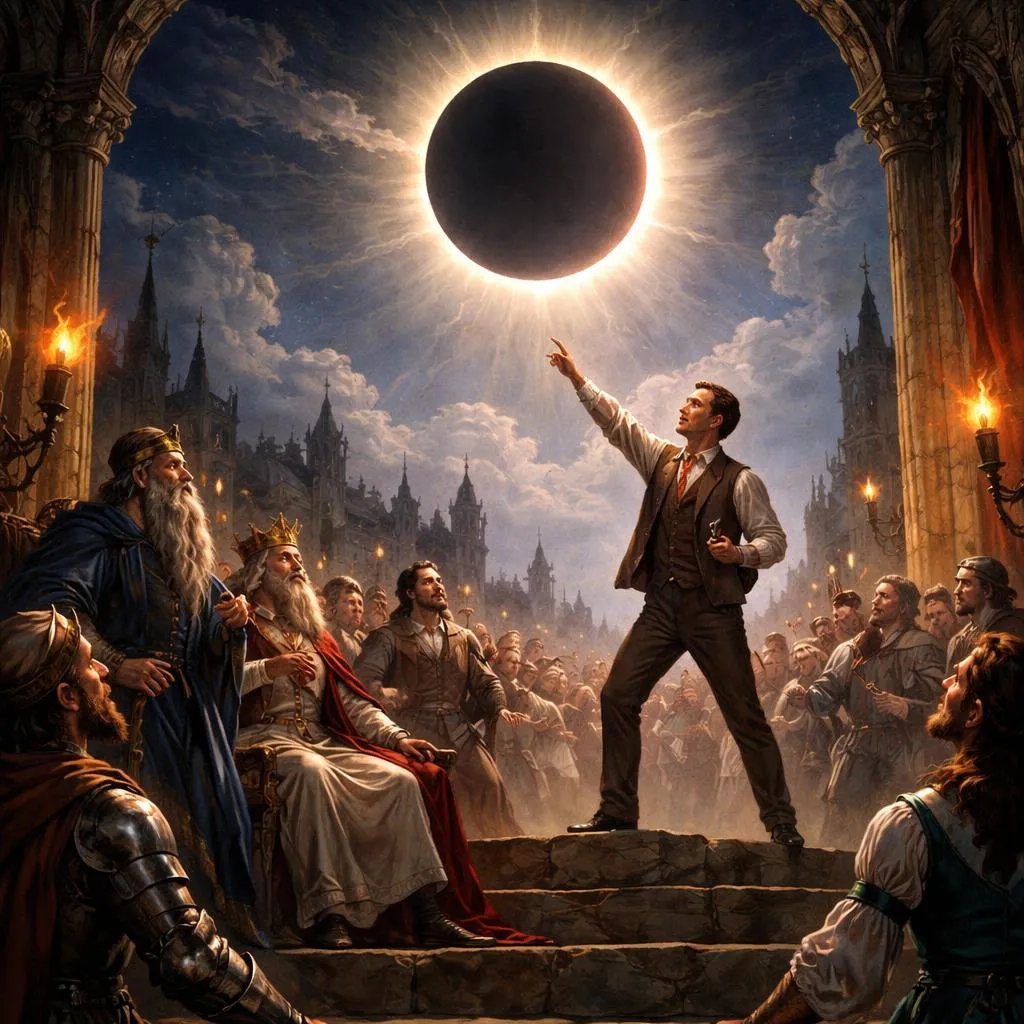
As the soldiers assisted me across the court the stillness was so profound that if I had been blindfold I should have supposed I was in a solitude instead of walled in by four thousand people. There was not a movement perceptible in those masses of humanity; they were as rigid as stone images, and as pale; and dread sat upon every countenance. This hush continued while I was being chained to the stake; it still continued while the fagots were carefully and tediously piled about my ankles, my knees, my thighs, my body. Then there was a pause, and a deeper hush, if possible, and a man knelt down at my feet with a blazing torch; the multitude strained forward, gazing, and parting slightly from their seats without knowing it; the monk raised his hands above my head, and his eyes toward the blue sky, and began some words in Latin; in this attitude he droned on and on, a little while, and then stopped. I waited two or three moments; then looked up; he was standing there petrified. With a common impulse the multitude rose slowly up and stared into the sky. I followed their eyes, as sure as guns, there was my eclipse beginning! The life went boiling through my veins; I was a new man! The rim of black spread slowly into the sun’s disk, my heart beat higher and higher, and still the assemblage and the priest stared into the sky, motionless. I knew that this gaze would be turned upon me, next. When it was, I was ready. I was in one of the most grand attitudes I ever struck, with my arm stretched up pointing to the sun. It was a noble effect. You could see the shudder sweep the mass like a wave. Two shouts rang out, one close upon the heels of the other:
“Apply the torch!”
“I forbid it!”
The one was from Merlin, the other from the king. Merlin started from his place—to apply the torch himself, I judged. I said:
“Stay where you are. If any man moves—even the king—before I give him leave, I will blast him with thunder, I will consume him with lightnings!”
The multitude sank meekly into their seats, and I was just expecting they would. Merlin hesitated a moment or two, and I was on pins and needles during that little while. Then he sat down, and I took a good breath; for I knew I was master of the situation now. The king said:
“Be merciful, fair sir, and essay no further in this perilous matter, lest disaster follow. It was reported to us that your powers could not attain unto their full strength until the morrow; but—”
“Your Majesty thinks the report may have been a lie? It was a lie.”
That made an immense effect; up went appealing hands everywhere, and the king was assailed with a storm of supplications that I might be bought off at any price, and the calamity stayed. The king was eager to comply. He said:
“Name any terms, reverend sir, even to the halving of my kingdom; but banish this calamity, spare the sun!”
My fortune was made. I would have taken him up in a minute, but I couldn’t stop an eclipse; the thing was out of the question. So I asked time to consider. The king said:
“How long—ah, how long, good sir? Be merciful; look, it groweth darker, moment by moment. Prithee how long?”
“Not long. Half an hour—maybe an hour.”
There were a thousand pathetic protests, but I couldn’t shorten up any, for I couldn’t remember how long a total eclipse lasts. I was in a puzzled condition, anyway, and wanted to think. Something was wrong about that eclipse, and the fact was very unsettling. If this wasn’t the one I was after, how was I to tell whether this was the sixth century, or nothing but a dream? Dear me, if I could only prove it was the latter! Here was a glad new hope. If the boy was right about the date, and this was surely the 20th, it wasn’t the sixth century. I reached for the monk’s sleeve, in considerable excitement, and asked him what day of the month it was.
Hang him, he said it was the twenty-first ! It made me turn cold to hear him. I begged him not to make any mistake about it; but he was sure; he knew it was the 21st. So, that feather-headed boy had botched things again! The time of the day was right for the eclipse; I had seen that for myself, in the beginning, by the dial that was near by. Yes, I was in King Arthur’s court, and I might as well make the most out of it I could.
The darkness was steadily growing, the people becoming more and more distressed. I now said:
“I have reflected, Sir King. For a lesson, I will let this darkness proceed, and spread night in the world; but whether I blot out the sun for good, or restore it, shall rest with you. These are the terms, to wit: You shall remain king over all your dominions, and receive all the glories and honors that belong to the kingship; but you shall appoint me your perpetual minister and executive, and give me for my services one per cent of such actual increase of revenue over and above its present amount as I may succeed in creating for the state. If I can’t live on that, I sha’n’t ask anybody to give me a lift. Is it satisfactory?”
There was a prodigious roar of applause, and out of the midst of it the king’s voice rose, saying:
“Away with his bonds, and set him free! and do him homage, high and low, rich and poor, for he is become the king’s right hand, is clothed with power and authority, and his seat is upon the highest step of the throne! Now sweep away this creeping night, and bring the light and cheer again, that all the world may bless thee.”
But I said:
“That a common man should be shamed before the world, is nothing; but it were dishonor to the king if any that saw his minister naked should not also see him delivered from his shame. If I might ask that my clothes be brought again—”
“They are not meet,” the king broke in. “Fetch raiment of another sort; clothe him like a prince!”
My idea worked. I wanted to keep things as they were till the eclipse was total, otherwise they would be trying again to get me to dismiss the darkness, and of course I couldn’t do it. Sending for the clothes gained some delay, but not enough. So I had to make another excuse. I said it would be but natural if the king should change his mind and repent to some extent of what he had done under excitement; therefore I would let the darkness grow a while, and if at the end of a reasonable time the king had kept his mind the same, the darkness should be dismissed. Neither the king nor anybody else was satisfied with that arrangement, but I had to stick to my point.
It grew darker and darker and blacker and blacker, while I struggled with those awkward sixth-century clothes. It got to be pitch dark, at last, and the multitude groaned with horror to feel the cold uncanny night breezes fan through the place and see the stars come out and twinkle in the sky. At last the eclipse was total, and I was very glad of it, but everybody else was in misery; which was quite natural. I said:
“The king, by his silence, still stands to the terms.” Then I lifted up my hands—stood just so a moment—then I said, with the most awful solemnity: “Let the enchantment dissolve and pass harmless away!”
There was no response, for a moment, in that deep darkness and that graveyard hush. But when the silver rim of the sun pushed itself out, a moment or two later, the assemblage broke loose with a vast shout and came pouring down like a deluge to smother me with blessings and gratitude; and Clarence was not the last of the wash, to be sure.
Hintergrund und Einführung des Autors
Diese dramatische Passage stammt aus Mark Twains Roman "Ein Yankee am Hofe des König Artus", der erstmals 1889 veröffentlicht wurde. Twain, einer der größten amerikanischen Autoren und Humoristen, ist bekannt für seinen scharfen Witz und seine scharfsinnigen Sozialkommentare. In diesem Roman vermischt Twain Fantasie, Satire und historische Fiktion, indem er einen amerikanischen Ingenieur aus dem 19. Jahrhundert in die legendäre Ära von König Artus zurückschickt. Die Geschichte erforscht Themen wie Wissenschaft versus Aberglaube, Fortschritt versus Tradition und individuellen Mut angesichts überwältigender Widrigkeiten.
Überblick über die Geschichte und Interpretation
Der Auszug fängt einen angespannten Moment ein, in dem der Protagonist der Hinrichtung durch Verbrennen auf dem Scheiterhaufen gegenübersteht, nur um sein Wissen über eine Sonnenfinsternis zu nutzen, um sich selbst zu retten und Macht zu erlangen. Diese Szene verdeutlicht den Zusammenstoß zwischen mittelalterlichem Aberglauben und modernem wissenschaftlichem Verständnis. Die geschickte Manipulation der Sonnenfinsternis durch den Protagonisten überzeugt die verängstigte Menge davon, dass er übernatürliche Kräfte besitzt. Sie offenbart auch Themen wie Hoffnung, Widerstandsfähigkeit und die Macht des Wissens, das Schicksal zu verändern.
Die Geschichte kritisiert blinden Glauben und die Gefahren der Unwissenheit, während sie menschlichen Einfallsreichtum und rationales Denken feiert. Twain verwendet Humor und Ironie, um die Absurdität von Aberglauben und das Potenzial für Fortschritt aufzudecken, wenn die Vernunft siegt.
Lektionen und Erkenntnisse für Schüler
-
Die Macht des Wissens und der Wissenschaft: Das Überleben des Protagonisten hängt von seinem Verständnis der Astronomie ab. Dies lehrt die Schüler die Bedeutung von Bildung und wissenschaftlicher Kompetenz. Wissen kann Einzelpersonen befähigen, Probleme zu lösen und Herausforderungen zu meistern.
-
Mut und Widerstandsfähigkeit: Selbst angesichts des Todes findet der Protagonist Hoffnung und mobilisiert seinen Geist. Dies zeigt den Wert von mentaler Stärke und Optimismus in schwierigen Zeiten.
-
Kritisches Denken: Die Geschichte ermutigt dazu, Überzeugungen und Traditionen zu hinterfragen, anstatt sie blind zu akzeptieren. Die Schüler lernen, kritisch über die Welt um sie herum nachzudenken.
-
Ethik und Verantwortung: Der Protagonist wird von seinem Freund Clarence aufgefordert, der Sonne keinen Schaden zuzufügen, was den ethischen Gebrauch von Macht und Wissen symbolisiert. Dies erinnert die Schüler daran, dass mit großer Macht auch große Verantwortung einhergeht.
Anwendung im täglichen Leben
-
Im Lernen: Die Schüler können dazu inspiriert werden, Wissen leidenschaftlich zu verfolgen und es weise einzusetzen. Das Verständnis von Wissenschaft und Geschichte hilft, die Welt zu verstehen und Angst zu vermeiden, die auf Unwissenheit beruht.
-
In sozialen Situationen: Die Geschichte fördert Empathie und das Eintreten für die Wahrheit, auch wenn sie unpopulär ist. Sie zeigt auch, wie Kommunikation und Überzeugungskraft mächtige Werkzeuge sein können.
-
In der persönlichen Entwicklung: Die Reise des Protagonisten lehrt Widerstandsfähigkeit – das Überwinden von Rückschlägen und das Aufrechterhalten der Hoffnung kann den Schülern helfen, ihre eigenen Herausforderungen zu meistern.
Wie man positive Eigenschaften aus der Geschichte kultiviert
-
Neugier: Ermutigen Sie dazu, Fragen zu stellen und neue Ideen zu erforschen, so wie der Protagonist sein Wissen nutzt, um sich in einer fremden Welt zurechtzufinden.
-
Tapferkeit: Üben Sie, sich Schritt für Schritt Ihren Ängsten zu stellen, und bauen Sie Selbstvertrauen auf, um schwierige Situationen zu bewältigen.
-
Integrität: Verwenden Sie Wissen und Fähigkeiten zum Guten, respektieren Sie andere und handeln Sie verantwortungsbewusst.
-
Kritisches Denken: Lernen Sie, Informationen sorgfältig zu analysieren und Dinge nicht für bare Münze zu nehmen.
Fazit
Mark Twains "Ein Yankee am Hofe des König Artus" ist mehr als ein unterhaltsames Abenteuer; es ist eine reiche Quelle von Lektionen über Wissen, Mut und Ethik. Für Schüler und junge Leser bietet es Inspiration, Bildung zu schätzen, unabhängig zu denken und mit Freundlichkeit und Verantwortung zu handeln. Durch diese Geschichte können sie lernen, ihre eigenen Herausforderungen mit Weisheit und Hoffnung zu meistern, so wie der Protagonist es in einer Welt der Dunkelheit und des Aberglaubens tat.
