
As we drove along, my spirits revived again, and I turned, with pleasure, to the contemplation of the new life upon which I was entering. But though it was not far past the middle of September, the heavy clouds and strong north–easterly wind combined to render the day extremely cold and dreary; and the journey seemed a very long one, for, as Smith observed, the roads were ‘very heavy’; and certainly, his horse was very heavy too: it crawled up the hills, and crept down them, and only condescended to shake its sides in a trot where the road was at a dead level or a very gentle slope, which was rarely the case in those rugged regions; so that it was nearly one o’clock before we reached the place of our destination. Yet, after all, when we entered the lofty iron gateway, when we drove softly up the smooth, well–rolled carriage–road, with the green lawn on each side, studded with young trees, and approached the new but stately mansion of Wellwood, rising above its mushroom poplar–groves, my heart failed me, and I wished it were a mile or two farther off. For the first time in my life I must stand alone: there was no retreating now. I must enter that house, and introduce myself among its strange inhabitants. But how was it to be done? True, I was near nineteen; but, thanks to my retired life and the protecting care of my mother and sister, I well knew that many a girl of fifteen, or under, was gifted with a more womanly address, and greater ease and self–possession, than I was. Yet, if Mrs. Bloomfield were a kind, motherly woman, I might do very well, after all; and the children, of course, I should soon be at ease with them—and Mr. Bloomfield, I hoped, I should have but little to do with.
‘Be calm, be calm, whatever happens,’ I said within myself; and truly I kept this resolution so well, and was so fully occupied in steadying my nerves and stifling the rebellious flutter of my heart, that when I was admitted into the hall and ushered into the presence of Mrs. Bloomfield, I almost forgot to answer her polite salutation; and it afterwards struck me, that the little I did say was spoken in the tone of one half–dead or half–asleep. The lady, too, was somewhat chilly in her manner, as I discovered when I had time to reflect. She was a tall, spare, stately woman, with thick black hair, cold grey eyes, and extremely sallow complexion.
With due politeness, however, she showed me my bedroom, and left me there to take a little refreshment. I was somewhat dismayed at my appearance on looking in the glass: the cold wind had swelled and reddened my hands, uncurled and entangled my hair, and dyed my face of a pale purple; add to this my collar was horridly crumpled, my frock splashed with mud, my feet clad in stout new boots, and as the trunks were not brought up, there was no remedy; so having smoothed my hair as well as I could, and repeatedly twitched my obdurate collar, I proceeded to clomp down the two flights of stairs, philosophizing as I went; and with some difficulty found my way into the room where Mrs. Bloomfield awaited me.
She led me into the dining–room, where the family luncheon had been laid out. Some beefsteaks and half–cold potatoes were set before me; and while I dined upon these, she sat opposite, watching me (as I thought) and endeavouring to sustain something like a conversation—consisting chiefly of a succession of commonplace remarks, expressed with frigid formality: but this might be more my fault than hers, for I really could NOT converse. In fact, my attention was almost wholly absorbed in my dinner: not from ravenous appetite, but from distress at the toughness of the beefsteaks, and the numbness of my hands, almost palsied by their five–hours’ exposure to the bitter wind. I would gladly have eaten the potatoes and let the meat alone, but having got a large piece of the latter on to my plate, I could not be so impolite as to leave it; so, after many awkward and unsuccessful attempts to cut it with the knife, or tear it with the fork, or pull it asunder between them, sensible that the awful lady was a spectator to the whole transaction, I at last desperately grasped the knife and fork in my fists, like a child of two years old, and fell to work with all the little strength I possessed. But this needed some apology—with a feeble attempt at a laugh, I said, ‘My hands are so benumbed with the cold that I can scarcely handle my knife and fork.’
‘I daresay you would find it cold,’ replied she with a cool, immutable gravity that did not serve to reassure me.
When the ceremony was concluded, she led me into the sitting–room again, where she rang and sent for the children.
‘You will find them not very far advanced in their attainments,’ said she, ‘for I have had so little time to attend to their education myself, and we have thought them too young for a governess till now; but I think they are clever children, and very apt to learn, especially the little boy; he is, I think, the flower of the flock—a generous, noble–spirited boy, one to be led, but not driven, and remarkable for always speaking the truth. He seems to scorn deception’ (this was good news). ‘His sister Mary Ann will require watching,’ continued she, ‘but she is a very good girl upon the whole; though I wish her to be kept out of the nursery as much as possible, as she is now almost six years old, and might acquire bad habits from the nurses. I have ordered her crib to be placed in your room, and if you will be so kind as to overlook her washing and dressing, and take charge of her clothes, she need have nothing further to do with the nursery maid.’
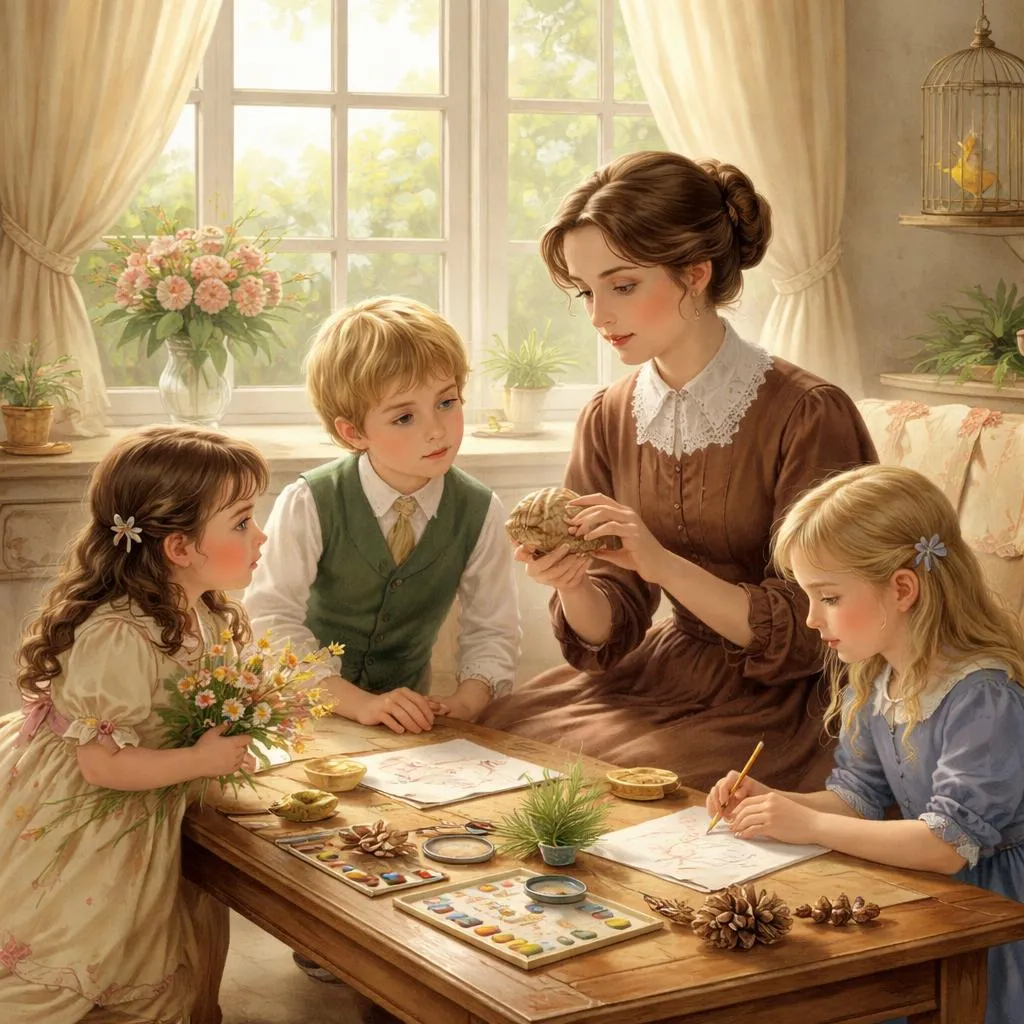
I replied I was quite willing to do so; and at that moment my young pupils entered the apartment, with their two younger sisters. Master Tom Bloomfield was a well–grown boy of seven, with a somewhat wiry frame, flaxen hair, blue eyes, small turned–up nose, and fair complexion. Mary Ann was a tall girl too, somewhat dark like her mother, but with a round full face and a high colour in her cheeks. The second sister was Fanny, a very pretty little girl; Mrs. Bloomfield assured me she was a remarkably gentle child, and required encouragement: she had not learned anything yet; but in a few days, she would be four years old, and then she might take her first lesson in the alphabet, and be promoted to the schoolroom. The remaining one was Harriet, a little broad, fat, merry, playful thing of scarcely two, that I coveted more than all the rest—but with her I had nothing to do.
I talked to my little pupils as well as I could, and tried to render myself agreeable; but with little success I fear, for their mother’s presence kept me under an unpleasant restraint. They, however, were remarkably free from shyness. They seemed bold, lively children, and I hoped I should soon be on friendly terms with them—the little boy especially, of whom I had heard such a favourable character from his mamma. In Mary Ann there was a certain affected simper, and a craving for notice, that I was sorry to observe. But her brother claimed all my attention to himself; he stood bolt upright between me and the fire, with his hands behind his back, talking away like an orator, occasionally interrupting his discourse with a sharp reproof to his sisters when they made too much noise.
‘Oh, Tom, what a darling you are!’ exclaimed his mother. ‘Come and kiss dear mamma; and then won’t you show Miss Grey your schoolroom, and your nice new books?’
‘I won’t kiss YOU, mamma; but I WILL show Miss Grey my schoolroom, and my new books.’
‘And MY schoolroom, and MY new books, Tom,’ said Mary Ann. ‘They’re mine too.’
‘They’re MINE,’ replied he decisively. ‘Come along, Miss Grey— I’ll escort you.’
When the room and books had been shown, with some bickerings between the brother and sister that I did my utmost to appease or mitigate, Mary Ann brought me her doll, and began to be very loquacious on the subject of its fine clothes, its bed, its chest of drawers, and other appurtenances; but Tom told her to hold her clamour, that Miss Grey might see his rocking–horse, which, with a most important bustle, he dragged forth from its corner into the middle of the room, loudly calling on me to attend to it. Then, ordering his sister to hold the reins, he mounted, and made me stand for ten minutes, watching how manfully he used his whip and spurs. Meantime, however, I admired Mary Ann’s pretty doll, and all its possessions; and then told Master Tom he was a capital rider, but I hoped he would not use his whip and spurs so much when he rode a real pony.
‘Oh, yes, I will!’ said he, laying on with redoubled ardour. ‘I’ll cut into him like smoke! Eeh! my word! but he shall sweat for it.’
This was very shocking; but I hoped in time to be able to work a reformation.
‘Now you must put on your bonnet and shawl,’ said the little hero, ‘and I’ll show you my garden.’
‘And MINE,’ said Mary Ann.
Tom lifted his fist with a menacing gesture; she uttered a loud, shrill scream, ran to the other side of me, and made a face at him.
‘Surely, Tom, you would not strike your sister! I hope I shall NEVER see you do that.’
‘You will sometimes: I’m obliged to do it now and then to keep her in order.’
‘But it is not your business to keep her in order, you know—that is for—’
‘Well, now go and put on your bonnet.’
‘I don’t know—it is so very cloudy and cold, it seems likely to rain;—and you know I have had a long drive.’
‘No matter—you MUST come; I shall allow of no excuses,’ replied the consequential little gentleman. And, as it was the first day of our acquaintance, I thought I might as well indulge him. It was too cold for Mary Ann to venture, so she stayed with her mamma, to the great relief of her brother, who liked to have me all to himself.
The garden was a large one, and tastefully laid out; besides several splendid dahlias, there were some other fine flowers still in bloom: but my companion would not give me time to examine them: I must go with him, across the wet grass, to a remote sequestered corner, the most important place in the grounds, because it contained HIS garden. There were two round beds, stocked with a variety of plants. In one there was a pretty little rose–tree. I paused to admire its lovely blossoms.
‘Oh, never mind that!’ said he, contemptuously. ‘That’s only Mary Ann’s garden; look, THIS is mine.’
After I had observed every flower, and listened to a disquisition on every plant, I was permitted to depart; but first, with great pomp, he plucked a polyanthus and presented it to me, as one conferring a prodigious favour. I observed, on the grass about his garden, certain apparatus of sticks and corn, and asked what they were.
‘Traps for birds.’
‘Why do you catch them?’
‘Papa says they do harm.’
‘And what do you do with them when you catch them?’
‘Different things. Sometimes I give them to the cat; sometimes I cut them in pieces with my penknife; but the next, I mean to roast alive.’
‘And why do you mean to do such a horrible thing?’
‘For two reasons: first, to see how long it will live—and then, to see what it will taste like.’
‘But don’t you know it is extremely wicked to do such things? Remember, the birds can feel as well as you; and think, how would you like it yourself?’
‘Oh, that’s nothing! I’m not a bird, and I can’t feel what I do to them.’
‘But you will have to feel it some time, Tom: you have heard where wicked people go to when they die; and if you don’t leave off torturing innocent birds, remember, you will have to go there, and suffer just what you have made them suffer.’
‘Oh, pooh! I shan’t. Papa knows how I treat them, and he never blames me for it: he says it is just what HE used to do when HE was a boy. Last summer, he gave me a nest full of young sparrows, and he saw me pulling off their legs and wings, and heads, and never said anything; except that they were nasty things, and I must not let them soil my trousers: end Uncle Robson was there too, and he laughed, and said I was a fine boy.’
‘But what would your mamma say?’
‘Oh, she doesn’t care! she says it’s a pity to kill the pretty singing birds, but the naughty sparrows, and mice, and rats, I may do what I like with. So now, Miss Grey, you see it is NOT wicked.’
‘I still think it is, Tom; and perhaps your papa and mamma would think so too, if they thought much about it. However,’ I internally added, ‘they may say what they please, but I am determined you shall do nothing of the kind, as long as I have power to prevent it.’
He next took me across the lawn to see his mole–traps, and then into the stack–yard to see his weasel–traps: one of which, to his great joy, contained a dead weasel; and then into the stable to see, not the fine carriage–horses, but a little rough colt, which he informed me had been bred on purpose for him, and he was to ride it as soon as it was properly trained. I tried to amuse the little fellow, and listened to all his chatter as complacently as I could; for I thought if he had any affections at all, I would endeavour to win them; and then, in time, I might be able to show him the error of his ways: but I looked in vain for that generous, noble spirit his mother talked of; though I could see he was not without a certain degree of quickness and penetration, when he chose to exert it.
When we re–entered the house it was nearly tea–time. Master Tom told me that, as papa was from home, he and I and Mary Ann were to have tea with mamma, for a treat; for, on such occasions, she always dined at luncheon–time with them, instead of at six o’clock. Soon after tea, Mary Ann went to bed, but Tom favoured us with his company and conversation till eight. After he was gone, Mrs. Bloomfield further enlightened me on the subject of her children’s dispositions and acquirements, and on what they were to learn, and how they were to be managed, and cautioned me to mention their defects to no one but herself. My mother had warned me before to mention them as little as possible to HER, for people did not like to be told of their children’s faults, and so I concluded I was to keep silence on them altogether. About half–past nine, Mrs. Bloomfield invited me to partake of a frugal supper of cold meat and bread. I was glad when that was over, and she took her bedroom candlestick and retired to rest; for though I wished to be pleased with her, her company was extremely irksome to me; and I could not help feeling that she was cold, grave, and forbidding—the very opposite of the kind, warm–hearted matron my hopes had depicted her to be.
Hintergrund und Einführung in die Autorin
Dieser Abschnitt stammt aus einem klassischen Roman, der die Herausforderungen beim Eintritt in eine neue Lebensphase untersucht, insbesondere aus der Sicht einer jungen Gouvernante, die in einem neuen Haushalt ankommt. Die Geschichte spielt in einer ländlichen, etwas abgelegenen Umgebung und spiegelt die sozialen und kulturellen Normen des 19. Jahrhunderts wider. Die Autorin, eine scharfe Beobachterin der menschlichen Natur und der sozialen Dynamik, verwendet detaillierte Beschreibungen und Dialoge, um ein lebendiges Bild der inneren Kämpfe der Protagonistin und der komplexen Beziehungen, denen sie begegnet, zu zeichnen.
Die Autorin ist bekannt für ihre aufschlussreiche Darstellung von Charakteren, insbesondere junger Frauen, die sich mit gesellschaftlichen Erwartungen und persönlichem Wachstum auseinandersetzen. Ihre Werke beleuchten oft Themen wie Widerstandsfähigkeit, Moral und die Bedeutung von Empathie und Verständnis in menschlichen Interaktionen.
Detaillierte Interpretation und Bedeutung
Diese Geschichte fängt anschaulich die emotionalen Turbulenzen ein, die entstehen, wenn man in eine unbekannte Umgebung eintritt, und den Mut, den es braucht, um sich der Ungewissheit allein zu stellen. Die Reflexionen der Protagonistin offenbaren ihre Verletzlichkeit und Entschlossenheit, was sie zu einer nachvollziehbaren Figur für Leser macht, die ähnliche Übergänge erlebt haben. Das kalte, trostlose Wetter und die langsame, beschwerliche Reise symbolisieren die Hindernisse, die sie überwinden muss, sowohl äußerlich als auch in sich selbst.
Mrs. Bloomfields kaltes Auftreten und die unterschiedlichen Persönlichkeiten der Kinder führen die sozialen Herausforderungen ein, mit denen sich die Gouvernante auseinandersetzen muss. Der Kontrast zwischen den hoffnungsvollen Erwartungen und der Realität des Haushaltslebens hebt Themen wie Anpassung und Ausdauer hervor. Die Kinder, insbesondere Tom, verkörpern Unschuld, gemischt mit beunruhigendem Verhalten, was die Leser dazu anregt, die Komplexität der Erziehung und der moralischen Bildung zu betrachten.
Die Erzählung wirft auch wichtige ethische Fragen auf, wie z. B. den Umgang mit Tieren und die Entwicklung von Empathie. Toms grausame Absichten gegenüber Vögeln und die sanften Ermahnungen der Gouvernante ermutigen die Leser, über Freundlichkeit und Verantwortung nachzudenken.
Lektionen und Erkenntnisse für Schüler
-
Mut in neuen Situationen: Die Erfahrung der Protagonistin lehrt die Schüler den Wert von Mut, wenn sie sich neuen Umgebungen stellen, sei es eine neue Schule, eine neue Stadt oder eine neue soziale Gruppe. Es ist normal, nervös zu sein, aber sich den Herausforderungen direkt zu stellen, ist ein wesentlicher Bestandteil des Wachstums.
-
Empathie und Freundlichkeit: Die Geschichte betont die Bedeutung des Verständnisses der Gefühle anderer, einschließlich der Tiere. Die Schüler können lernen, mitfühlender und verantwortungsbewusster in ihrem Handeln zu sein und zu erkennen, dass alle Lebewesen Respekt verdienen.
-
Selbstreflexion und Verbesserung: Das Bewusstsein der Gouvernante für ihre eigenen Unzulänglichkeiten und ihr Wunsch, sich sozial und emotional zu verbessern, ermutigen die Schüler, sich mit Selbstreflexion zu beschäftigen und nach persönlicher Entwicklung zu streben.
-
Umgang mit schwierigen Menschen: Die Kälte von Mrs. Bloomfield und das herausfordernde Verhalten von Tom zeigen, dass sich nicht jeder leicht verstehen wird. Die Schüler können Strategien für Geduld, Diplomatie und die Wahrung ihrer eigenen Integrität in schwierigen sozialen Situationen erlernen.
-
Moralische Verantwortung: Die Geschichte lädt junge Leser ein, über Richtig und Falsch nachzudenken, insbesondere im Kontext von Erziehung und Einfluss. Sie ermutigt dazu, für das Richtige einzustehen, auch wenn es unpopulär oder schwierig ist.
Anwendung dieser Lektionen im Leben
-
In der Schule: Beim Start einer neuen Klasse oder beim Beitritt zu einer neuen Gruppe können sich die Schüler an den Mut der Gouvernante erinnern und versuchen, offen und geduldig mit anderen umzugehen. Sie können auch Freundlichkeit üben und sich gegen Mobbing oder Grausamkeit stellen.
-
In sozialen Umgebungen: Das Verständnis, dass Menschen unterschiedliche Persönlichkeiten und Hintergründe haben, hilft den Schülern, Empathie und bessere Kommunikationsfähigkeiten zu entwickeln. Sie können lernen, soziale Herausforderungen mit Anmut zu meistern.
-
Im persönlichen Wachstum: Die Reflexion über das eigene Verhalten und das Streben nach Verbesserung ist ein lebenslanger Prozess. Die Schüler können Tagebücher führen oder mit vertrauenswürdigen Erwachsenen über ihre Gefühle und Erfahrungen sprechen.
-
Bei der Fürsorge für andere: Ob es sich um Haustiere, Klassenkameraden oder Familienmitglieder handelt, Freundlichkeit und Verantwortung zu zeigen, ist entscheidend. Die Botschaft der Geschichte über Empathie gegenüber Tieren kann auf alle Beziehungen ausgedehnt werden.
Positive Eigenschaften kultivieren
Um die positiven Eigenschaften zu entwickeln, die in der Geschichte gezeigt oder gewünscht werden, können die Schüler:
- Achtsamkeit praktizieren, um Nervosität und Stress zu bewältigen.
- Rollenspiele oder Diskussionen über ethische Dilemmata durchführen, um das moralische Denken zu stärken.
- Sich ehrenamtlich engagieren oder an Aktivitäten teilnehmen, bei denen es um die Fürsorge für andere geht.
- Viel lesen, um verschiedene Perspektiven und menschliche Erfahrungen zu verstehen.
- Mentoring oder Anleitung von Lehrern, Familienangehörigen oder Beratern suchen, um Selbstvertrauen und soziale Fähigkeiten aufzubauen.
Dieser Abschnitt und seine Themen bieten reichhaltiges Material für Reflexion und Diskussion und helfen jungen Lesern, nicht nur akademisch, sondern auch emotional und ethisch zu wachsen.
