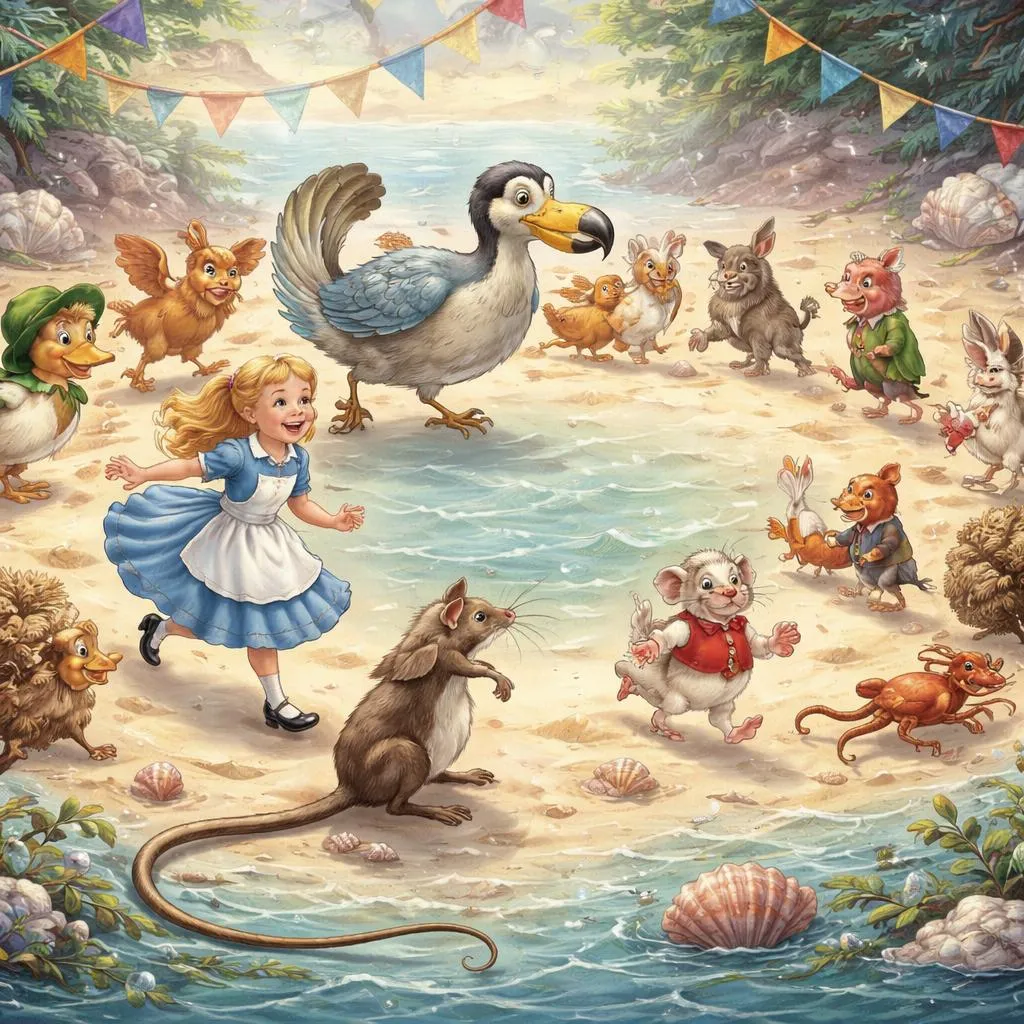

They were indeed a queer–looking party that assembled on the bank—the birds with draggled feathers, the animals with their fur clinging close to them, and all dripping wet, cross, and uncomfortable.
The first question of course was, how to get dry again: they had a consultation about this, and after a few minutes it seemed quite natural to Alice to find herself talking familiarly with them, as if she had known them all her life. Indeed, she had quite a long argument with the Lory, who at last turned sulky, and would only say, 'I am older than you, and must know better'; and this Alice would not allow without knowing how old it was, and, as the Lory positively refused to tell its age, there was no more to be said.
At last the Mouse, who seemed to be a person of authority among them, called out, 'Sit down, all of you, and listen to me! I'LL soon make you dry enough!' They all sat down at once, in a large ring, with the Mouse in the middle. Alice kept her eyes anxiously fixed on it, for she felt sure she would catch a bad cold if she did not get dry very soon.
'Ahem!' said the Mouse with an important air, 'are you all ready? This is the driest thing I know. Silence all round, if you please! "William the Conqueror, whose cause was favoured by the pope, was soon submitted to by the English, who wanted leaders, and had been of late much accustomed to usurpation and conquest. Edwin and Morcar, the earls of Mercia and Northumbria—"'
'Ugh!' said the Lory, with a shiver.
'I beg your pardon!' said the Mouse, frowning, but very politely: 'Did you speak?'
'Not I!' said the Lory hastily.
'I thought you did,' said the Mouse. '—I proceed. "Edwin and Morcar, the earls of Mercia and Northumbria, declared for him: and even Stigand, the patriotic archbishop of Canterbury, found it advisable—"'
'Found WHAT?' said the Duck.
'Found IT,' the Mouse replied rather crossly: 'of course you know what "it" means.'
'I know what "it" means well enough, when I find a thing,' said the Duck: 'it's generally a frog or a worm. The question is, what did the archbishop find?'
The Mouse did not notice this question, but hurriedly went on, '"—found it advisable to go with Edgar Atheling to meet William and offer him the crown. William's conduct at first was moderate. But the insolence of his Normans—" How are you getting on now, my dear?' it continued, turning to Alice as it spoke.
'As wet as ever,' said Alice in a melancholy tone: 'it doesn't seem to dry me at all.'
'In that case,' said the Dodo solemnly, rising to its feet, 'I move that the meeting adjourn, for the immediate adoption of more energetic remedies—'
'Speak English!' said the Eaglet. 'I don't know the meaning of half those long words, and, what's more, I don't believe you do either!' And the Eaglet bent down its head to hide a smile: some of the other birds tittered audibly.
'What I was going to say,' said the Dodo in an offended tone, 'was, that the best thing to get us dry would be a Caucus–race.'
'What IS a Caucus–race?' said Alice; not that she wanted much to know, but the Dodo had paused as if it thought that SOMEBODY ought to speak, and no one else seemed inclined to say anything.
'Why,' said the Dodo, 'the best way to explain it is to do it.' (And, as you might like to try the thing yourself, some winter day, I will tell you how the Dodo managed it.)
First it marked out a race–course, in a sort of circle, ('the exact shape doesn't matter,' it said,) and then all the party were placed along the course, here and there. There was no 'One, two, three, and away,' but they began running when they liked, and left off when they liked, so that it was not easy to know when the race was over. However, when they had been running half an hour or so, and were quite dry again, the Dodo suddenly called out 'The race is over!' and they all crowded round it, panting, and asking, 'But who has won?'
This question the Dodo could not answer without a great deal of thought, and it sat for a long time with one finger pressed upon its forehead (the position in which you usually see Shakespeare, in the pictures of him), while the rest waited in silence. At last the Dodo said, 'EVERYBODY has won, and all must have prizes.'
'But who is to give the prizes?' quite a chorus of voices asked.
'Why, SHE, of course,' said the Dodo, pointing to Alice with one finger; and the whole party at once crowded round her, calling out in a confused way, 'Prizes! Prizes!'
Alice had no idea what to do, and in despair she put her hand in her pocket, and pulled out a box of comfits, (luckily the salt water had not got into it), and handed them round as prizes. There was exactly one a–piece all round.
'But she must have a prize herself, you know,' said the Mouse.
'Of course,' the Dodo replied very gravely. 'What else have you got in your pocket?' he went on, turning to Alice.
'Only a thimble,' said Alice sadly.
'Hand it over here,' said the Dodo.
Then they all crowded round her once more, while the Dodo solemnly presented the thimble, saying 'We beg your acceptance of this elegant thimble'; and, when it had finished this short speech, they all cheered.
Alice thought the whole thing very absurd, but they all looked so grave that she did not dare to laugh; and, as she could not think of anything to say, she simply bowed, and took the thimble, looking as solemn as she could.
The next thing was to eat the comfits: this caused some noise and confusion, as the large birds complained that they could not taste theirs, and the small ones choked and had to be patted on the back. However, it was over at last, and they sat down again in a ring, and begged the Mouse to tell them something more.
'You promised to tell me your history, you know,' said Alice, 'and why it is you hate—C and D,' she added in a whisper, half afraid that it would be offended again.
'Mine is a long and a sad tale!' said the Mouse, turning to Alice, and sighing.
'It IS a long tail, certainly,' said Alice, looking down with wonder at the Mouse's tail; 'but why do you call it sad?' And she kept on puzzling about it while the Mouse was speaking, so that her idea of the tale was something like this:—
'Fury said to a mouse, That he met in the house, "Let us both go to law: I will prosecute YOU.—Come, I'll take no denial; We must have a trial: For really this morning I've nothing to do." Said the mouse to the cur, "Such a trial, dear Sir, With no jury or judge, would be wasting our breath." "I'll be judge, I'll be jury," Said cunning old Fury: "I'll try the whole cause, and condemn you to death."'
'You are not attending!' said the Mouse to Alice severely. 'What are you thinking of?'
'I beg your pardon,' said Alice very humbly: 'you had got to the fifth bend, I think?'
'I had NOT!' cried the Mouse, sharply and very angrily.
'A knot!' said Alice, always ready to make herself useful, and looking anxiously about her. 'Oh, do let me help to undo it!'
'I shall do nothing of the sort,' said the Mouse, getting up and walking away. 'You insult me by talking such nonsense!'
'I didn't mean it!' pleaded poor Alice. 'But you're so easily offended, you know!'
The Mouse only growled in reply.
'Please come back and finish your story!' Alice called after it; and the others all joined in chorus, 'Yes, please do!' but the Mouse only shook its head impatiently, and walked a little quicker.
'What a pity it wouldn't stay!' sighed the Lory, as soon as it was quite out of sight; and an old Crab took the opportunity of saying to her daughter 'Ah, my dear! Let this be a lesson to you never to lose YOUR temper!' 'Hold your tongue, Ma!' said the young Crab, a little snappishly. 'You're enough to try the patience of an oyster!'
'I wish I had our Dinah here, I know I do!' said Alice aloud, addressing nobody in particular. 'She'd soon fetch it back!'
'And who is Dinah, if I might venture to ask the question?' said the Lory.
Alice replied eagerly, for she was always ready to talk about her pet: 'Dinah's our cat. And she's such a capital one for catching mice you can't think! And oh, I wish you could see her after the birds! Why, she'll eat a little bird as soon as look at it!'
This speech caused a remarkable sensation among the party. Some of the birds hurried off at once: one old Magpie began wrapping itself up very carefully, remarking, 'I really must be getting home; the night–air doesn't suit my throat!' and a Canary called out in a trembling voice to its children, 'Come away, my dears! It's high time you were all in bed!' On various pretexts they all moved off, and Alice was soon left alone.
'I wish I hadn't mentioned Dinah!' she said to herself in a melancholy tone. 'Nobody seems to like her, down here, and I'm sure she's the best cat in the world! Oh, my dear Dinah! I wonder if I shall ever see you any more!' And here poor Alice began to cry again, for she felt very lonely and low–spirited. In a little while, however, she again heard a little pattering of footsteps in the distance, and she looked up eagerly, half hoping that the Mouse had changed his mind, and was coming back to finish his story.
Hintergrund und Einführung des Autors
Dieser Auszug stammt aus Alice im Wunderland, einem klassischen Roman von Lewis Carroll, dem Pseudonym von Charles Lutwidge Dodgson, der erstmals 1865 veröffentlicht wurde. Carroll war ein Mathematiker, Logiker und Schriftsteller, der für seinen spielerischen Umgang mit Sprache und Logikrätseln bekannt war. Die Geschichte folgt einem jungen Mädchen namens Alice, das in ein Kaninchenloch fällt und in eine fantastische Welt voller seltsamer Kreaturen und skurriler Abenteuer gerät.
Detaillierte Interpretation und Bedeutung
In dieser Passage versammeln sich Alice und eine Gruppe nasser, zerzauster Tiere und Vögel an einem Flussufer, nachdem sie ins Wasser gefallen sind. Die Charaktere führen eine humorvolle und unsinnige Diskussion über Geschichte und Politik, die sich schnell in ein skurriles „Kaukasus-Rennen“ verwandelt – ein Rennen ohne klare Regeln oder Gewinner, das die Absurdität bestimmter sozialer oder politischer Prozesse symbolisiert. Der Versuch der Maus, eine Geschichte zu erzählen, wird durch Alices Neugier und Missverständnisse unterbrochen, was die spielerische Verwirrung veranschaulicht, die sich durch das gesamte Buch zieht.
Diese Szene unterstreicht Carrolls Verwendung von Satire und Absurdität, um sich über die Formalitäten und Konventionen der viktorianischen Gesellschaft lustig zu machen. Das Verhalten der Tiere spiegelt menschliche Eigenschaften wie Sturheit, Ungeduld und den Wunsch nach Ordnung wider, jedoch auf eine verdrehte, unlogische Weise. Alices Interaktionen zeigen ihre Unschuld und Neugier sowie ihre Versuche, sich in einer verwirrenden Welt zurechtzufinden.
Lektionen und Erkenntnisse für Kinder und Schüler
-
Neugier und kritisches Denken: Alices fragende Haltung ermutigt junge Leser, neugierig zu sein und Informationen kritisch zu hinterfragen. Sie stellt die Behauptung des Lorys in Frage, es besser zu wissen, nur weil er älter ist, und hinterfragt die Geschichte der Maus, was zeigt, dass es in Ordnung ist, Fragen zu stellen und nach Verständnis zu suchen.
-
Der Wert der Vorstellungskraft: Die fantastische Umgebung und die Charaktere laden die Leser ein, ihre Fantasie zu nutzen, was für Kreativität und Problemlösung im wirklichen Leben unerlässlich ist.
-
Verständnis von Absurdität und Humor: Das Erkennen von Humor und Unsinn kann Kindern helfen, eine flexible Denkweise zu entwickeln und zu lernen, mit verwirrenden oder frustrierenden Situationen umzugehen, indem sie sie aus einer anderen Perspektive betrachten.
-
Soziale Interaktion und Empathie: Die Geschichte zeigt verschiedene Persönlichkeiten und wie sie interagieren – manche sind mürrisch, manche stolz, manche schüchtern. Das Verständnis dieser Eigenschaften kann Kindern helfen, Empathie und bessere soziale Fähigkeiten zu entwickeln.
-
Geduld und Selbstbeherrschung: Die Irritation der Maus und der Rat der alten Krabbe, nicht die Fassung zu verlieren, lehren Kinder die Bedeutung von Geduld und dem Umgang mit Emotionen in sozialen Situationen.
Anwendung dieser Lektionen im täglichen Leben
-
Im Lernen: Schüler können Alices Neugier nachahmen, indem sie im Unterricht Fragen stellen und Informationen nicht blind akzeptieren. Sie können auch ihre Fantasie nutzen, um Schreib-, Kunst- und Problemlösungsaufgaben zu verbessern.
-
In sozialen Situationen: Das Erkennen verschiedener Persönlichkeiten hilft beim Knüpfen von Freundschaften und bei der Lösung von Konflikten. Kinder können lernen, geduldig und respektvoll zu sein, auch wenn sich andere anders verhalten.
-
In der emotionalen Entwicklung: Zu verstehen, dass es normal ist, sich manchmal verwirrt oder frustriert zu fühlen, und dass Humor oder eine neue Perspektive helfen können, ist eine wertvolle emotionale Fähigkeit.
Förderung positiven Verhaltens aus der Geschichte
- Sei neugierig: Sei wie Alice immer bereit, die Welt um dich herum zu erforschen und zu hinterfragen.
- Bleibe aufgeschlossen: Akzeptiere, dass nicht alles sofort Sinn ergibt; manchmal sind Dinge einfach albern oder seltsam.
- Übe Freundlichkeit: Versuche, verständnisvoll und geduldig zu sein, auch wenn andere mürrisch oder schwierig sind.
- Nutze deine Fantasie: Lass dich von deiner Kreativität beim Lernen und Spielen leiten.
- Umgang mit Emotionen: Lerne, dich zu beherrschen und Gefühle ruhig auszudrücken.
Indem Kinder und Jugendliche Alice im Wunderland lesen, genießen sie nicht nur eine magische Geschichte, sondern gewinnen auch wertvolle Einblicke in die menschliche Natur, soziale Interaktion und die Kraft der Fantasie, die ihr persönliches und akademisches Leben bereichern können.
