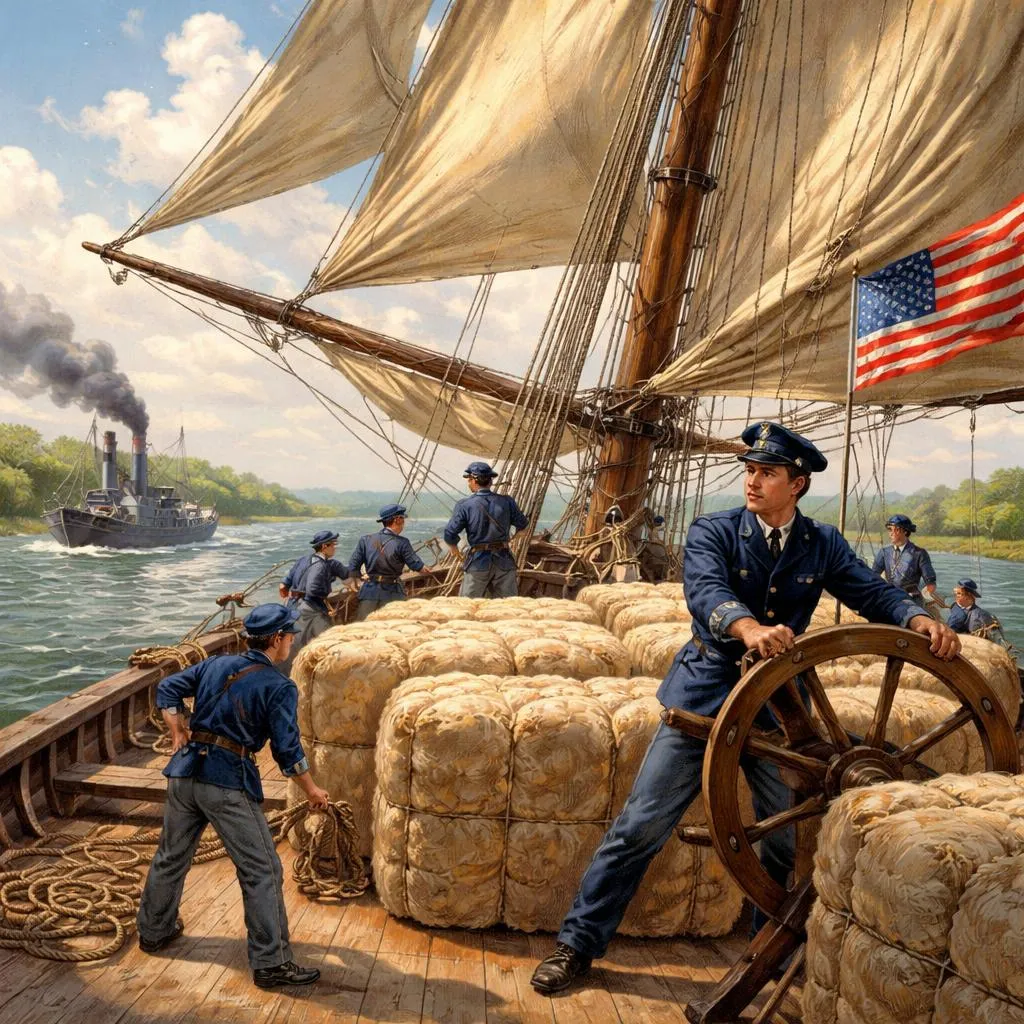

Probably some, if not all, of the six men in the deck-house of the West Wind were in the habit of taking intoxicating liquors when they were ashore, and when it was served out on board of the ship in conformity with the rules and traditions of the navy. The commander and his executive officer labored for the promotion of total abstinence among the officers and crew. More than the usual proportion of the men commuted their “grog ration” for money, through the influence of the principal officers.
While the commander of the present expedition accepted the aid of the powerful ally, “apple-jack,” in the service of his country, drinking freely appeared to him to be about the same thing as going over to the enemy; and he could not permit his men to turn traitors involuntarily, when he knew they would not do so of their own free will and accord. He had settled the liquor question to his own satisfaction in the deck-house, returning the bottle to French.
When Graines went below, a minute or two later than Captain Sullendine, he saw his new superior in the act of tossing off another glass of whiskey, as he concluded it was from the label on the bottle which stood on the cabin table. He had been considerably exhilarated before, and he was in a fair way to strengthen the ally of the loyalists by carrying his powerful influence to the head of the commander of the intending blockade-runner. The captain seated himself at the table, and Christy saw that he had a flat bottle in his breast-pocket.
“Now, Mr. Balker, we had better seal up the bargain we’ve made with forty drops from this bottle,” said he, as he poured out a glass for himself, regardless of the fact that he had just indulged; and at the same time he pushed the bottle and another glass towards the new mate.
Graines covered the lower part of the glass with his hand, and poured a few drops into it. Putting some water with it from the pitcher, he raised the tumbler in imitation of the captain.
“Here’s success to the right side,” added the master, as he drank off the contents of the glass.
“I drink that toast with all my mind, heart, and soul,” added the engineer, with decided emphasis, though he knew that “the right side” did not always convey the same idea.
“Help yourself, Mr.— I’ve forgot your name, Second Mate,” he added as he moved towards the companion ladder.
“Jerry Sandman, sir, and I will help myself to what I want,” replied Christy.
“That’s right, Mr. Sandman; make yourself at home in this cabin. I must go on deck and take a look at the Tallahatchie,” added the master as he went up the ladder, followed by Graines.
The lieutenant helped himself to a glass of water, after rinsing the tumbler, for that was what he wanted. Sopsy the cook immediately appeared, bearing a tray on which were several dishes of eatables, bread and ham being the principal. The bottle was in his way; and after he had drunk off half a tumblerful of its contents, he removed it to the pantry. He proceeded to set the table.
“Oft in der chizzly night, ’fore slumber’s yoke hab tooken me,’ hummed Sopsy as he worked at the table.
“Where is this schooner bound, Sopsy?” asked Christy.
“Bound to dat boon whar no trab’ler returns,” replied the cook, pausing in his occupation and staring the second mate full in the face.
“That bourn is Nassau, I reckon,” laughed the lieutenant.
“I s’pose she’s gwine dar if she don’t go to dat boon where no trab’lers come back agin,” answered Sopsy seriously. “Be you Meth’dis’ o’ Bab’tis’, Massa Mate?”
“Both, Sopsy.”
“Can’t be bof, Massa.”
“Then I’m either one you like.”
“That ain’t right, Massa Secon’ Mate, ’cordin’ as you was brung up,’ said the cook, shaking his head violently, as though he utterly disapproved of the mate’s theology.
“I’m a theosophist, Sopsy.”
“A seehossofist!” exclaimed the cook, dropping a plate in his astonishment. “We don’t hab none o’ dem on shore in de Souf. I reckon dey libs in de water.”
“No; they live on the mountains.”
“We hain’t got no mount’ns down here, and dat’s de reason we don’t hab none on ’em,” added Sopsy as he went to the pantry; but presently returned with a plate of pickles in one hand and the whiskey bottle in the other. “Does dem sea-hosses drink whisker, Massa Secon’ Mate?”
“They never drink a drop of it.”
“Dis colored pusson ain’t no sea-hoss, and he do drink whiskey when he kin git it,” added the cook; and he half filled a tumbler with the contents of the bottle, and drank it off at a single gulp.
He had hardly placed it on the table in the middle of the dishes before the captain came below. His first step was to take a liberal potation from the bottle. As he raised it to the swinging lamp, he discovered that the fluid had been freely expended in his absence.
“You’ve punished this bottle all it deserves,” said he when he perceived that its level had been considerably lowered, and he did not ask the new officer to join him. “That’s all right, Mr. Sandman; but I don’t want you to take more than you can manage to-night, for we have a big job on our hands, and we want our heads where we shall be able to find them. Now go on deck, and learn what you can about the vessel, for we hain’t got but half an hour more before the Tallahatchie goes to sea. We may have lots of music after we get outside; but I reckon our steamer can outsail anything the Yankees have got on the blockade. Don’t drink no more, Mr. Sandman; and when we git to Nassau you can have a reg’lar blowout.”
“I won’t touch another drop before we get out of the bay, Cap’n Sullendine,” protested Christy, without betraying the misdemeanor of the cook, as doubtless it was.
“That’s right, Mr. Sandman; we must all have our heads on our shoulders to-night,” said the captain, as he drank off the potion he had prepared.
Christy wished to hold the commander to his own advice; but that would have been fighting on the wrong side for him, and Sopsy escaped a reprimand, if not a kick or two, by his forbearance. By this time the bottle was nearly empty; but the skipper put it under lock and key in a closet, which seemed to be well filled with others like it. Christy went on deck, in obedience to the order he had received, and found the engineer on the quarter-deck buried in the fog, which was just then more dense than at any time before.
“The captain’s pretty well set ’up,’ isn’t he Christy?” said Graines in a low tone.
“About half seas over; but he knows what he is about, though he took another heavy potion just now,” replied the lieutenant.
“All right; I think we can manage this craft very well without him,” added Graines with a smile, which could not be seen in the darkness.
But the conversation was interrupted at this point by the appearance of the cook, whose legs were more tangled up by his tipples than his master’s. He delivered the request of Captain Sullendine that they should come into the cabin, and partake of the lunch which had been set out for them. As they moved towards the companion, they saw Sopsy creep over to the alley where Bokes had been sleeping, and take up the bottle of apple-jack Christy had given him, and drink from it. It was evident to them that the cook could not be much longer in condition for any duty.
The two mates went below as invited, and found the captain at the table. He had brought out the bottle of whiskey, and was eating of the dishes before him, but plainly with little relish.
“Have another little drink, Mr. Balker; but I think Mr. Sandman had better not take anymore,” said the master, whose speech was rather thick by this time.
“Thank you, Captain Sullendine; I will do a little in that way, for we are likely to have a very damp night of it,” replied Graines, as he helped himself, though he did not take ten drops.
“A little does one good; but it don’t do to take too much when we have very important business on our hands. After that one, Mr. Balker, I advise you not to take any more till we get clear of the blockaders,” added the skipper, as he emptied the bottle into his glass.
The ham on the table was of excellent quality, and the two mates ate heartily of it, with the ship-bread. The last dose the captain had taken appeared to cap the climax, and he could no longer eat, or talk so as to be clearly understood. When the mates had finished their lunch, they saw that the skipper had dropped asleep in his chair. They rose from their places, and rattled the stools. The noise roused the sleeper, and he sprang to his feet with a violent start.
“What’s time’z it, Mr. Zbalker?” he demanded, catching hold of the table to avoid falling on the cabin floor.
He seemed to be conscious that he was not presenting a perfectly regular appearance to his new officers; and he dropped into his chair, making a ludicrous effort to stiffen his muscles and put on his dignity, but it was a failure.
“Quarter-past two, Captain Sullendine,” replied Graines in answer to the question.
“Most an hour more ’fore we git started,” stammered the invalid. “I didn’t sleep none last night, I’m sleepy. I’m go’n to turn in for half an hour, ’n then I’ll be on deck ready for busi— ready for buzness.”
Graines assisted him to his stateroom, for he could not walk, and he was afraid he would fall and hurt himself. He helped him into his berth, and arranged him so that he could sleep it off, and he did not care if he did not do so before the next day. He waited till he had dropped off into a deep slumber, and then joined Christy in the cabin.
“If I had not been a temperance man before, I should be now,” said the lieutenant. “It is just as well that the captain is clean over the bay, for we might have been obliged to shoot him if he had been sober.”
“But we could have taken possession of the vessel in spite of him, if the steamer had not interfered,” replied Graines, as he led the way to the deck. “I don’t see that we have anything to do but wait for the moving of the waters, or for the moving of the steamer. I suppose our men are all right forward.”
“I have no doubt of it, though I have not seen them lately. I gave one of the bottles of apple-jack the captain sent forward for them to Bokes, and poured the contents of the other into Mobile Bay. I think we had better go forward and look the vessel over,” said Christy.
They had gone but a few steps before they stumbled over the body of Sopsy, who had evidently succumbed to the quantity of firewater he had consumed. He had assisted Bokes to empty the bottle given to him, and both of them were too far gone to give an alarm if they discovered at any time that something was wrong about the movements of the West Wind.
They found the Belleviters lounging about on the cotton bales, some of them asleep, and others carrying on a conversation in a low tone. They were glad to see their officers, who told them the time for some sort of action was rapidly approaching. Then they went to the bow of the vessel, where they found that she was anchored, though the chain had been hove short. The hawser by which she was to be towed to sea was made fast to the bowsprit bitts, and led to the stern of the steamer, where it was doubtless properly secured.
While they were looking over the bow, a boat approached from the Tallahatchie, and an officer hailed, asking for Captain Sullendine.
“He is in the cabin; I am the mate,” replied the engineer, “and the captain has shipped a new crew, we are all right now.”
“Weigh your anchor at three short whistles,” added the officer.
“Understood, and all right,” said the new mate.
The boat pulled back to the steamer.
Hintergrund und Einführung des Autors
Diese Passage stammt aus einer klassischen maritimen Erzählung, die wahrscheinlich während der Zeit des amerikanischen Bürgerkriegs spielt und sich auf Marineoperationen konzentriert, bei denen es um Blockadebrecher geht – eine riskante, aber lebenswichtige Aktivität, bei der Schiffe versuchten, feindlichen Blockaden zu entgehen, um Nachschub zu liefern. Die Geschichte fängt die Spannung, Kameradschaft und die Herausforderungen ein, denen sich Seeleute bei solchen Missionen stellten.
Der Autor, dessen Identität hier nicht angegeben ist, schreibt mit anschaulichen Details und Realismus und stützt sich dabei auf marinetraditionen und die rauen Realitäten des Lebens auf See. Der Erzählstil und die Sprache deuten auf einen Ursprung im 19. Jahrhundert hin und spiegeln die sozialen und kulturellen Einstellungen der Zeit wider, einschließlich der Abstinenzbewegung und der militärischen Disziplin.
Detaillierte Interpretation und Bedeutung
Die Geschichte erforscht Themen wie Pflicht, Führung und den Kampf zwischen persönlichen Gewohnheiten und beruflichen Verantwortlichkeiten. Kapitän Sullendines komplexe Beziehung zum Alkohol veranschaulicht die Herausforderungen, denen sich Führungskräfte bei der Aufrechterhaltung von Ordnung und Disziplin stellen müssen, insbesondere unter Stressbedingungen. Sein anfängliches Beharren auf Abstinenz steht im Gegensatz zu seinem späteren Genuss und unterstreicht die menschliche Verletzlichkeit.
Die Interaktionen zwischen den Besatzungsmitgliedern offenbaren die soziale Dynamik an Bord eines Schiffes, einschließlich Hierarchie, Kameradschaft und die Auswirkungen persönlicher Entscheidungen auf die Sicherheit der Gruppe und den Erfolg der Mission. Der übermäßige Alkoholkonsum des Kochs Sopsy und seine Folgen unterstreichen die Gefahren des Drogenmissbrauchs, insbesondere in kritischen Rollen.
Die Erzählung berührt auch kulturelle und religiöse Bezüge, wie die Diskussion über Methodisten, Baptisten und Theosophen, was die Charakterentwicklung vertieft und die unterschiedlichen Überzeugungen und Hintergründe der Seeleute widerspiegelt.
Lektionen und Erkenntnisse für Schüler
-
Führung und Verantwortung: Die Geschichte lehrt die Bedeutung von Selbstbeherrschung und Verantwortung, insbesondere für Führungskräfte. Kapitän Sullendines Kampf mit dem Alkohol dient als warnendes Beispiel dafür, wie sich persönliche Schwächen auf andere auswirken können.
-
Teamwork und Vertrauen: Erfolgreiche Missionen hängen von gegenseitigem Vertrauen und Zusammenarbeit ab. Die Bemühungen der Crew, die Situation trotz der Herausforderungen zu bewältigen, zeigen den Wert der Zusammenarbeit.
-
Konsequenzen von Entscheidungen: Die negativen Auswirkungen von übermäßigem Alkoholkonsum auf Leistung und Sicherheit sind deutlich. Die Schüler können lernen, wie wichtig es ist, gesunde Entscheidungen zu treffen und zu verstehen, wie sich Gewohnheiten nicht nur auf sie selbst, sondern auch auf ihre Mitmenschen auswirken.
-
Respekt vor Vielfalt: Der Dialog über religiöse Überzeugungen fördert den Respekt vor unterschiedlichen Perspektiven und Aufgeschlossenheit.
Anwendung im täglichen Leben
-
In der Schule: Die Schüler können die Lektionen der Geschichte anwenden, indem sie Selbstdisziplin üben, insbesondere wenn sie Gruppenzwang oder stressigen Situationen ausgesetzt sind. Führungsrollen in Schulclubs oder -teams erfordern ein gutes Beispiel.
-
In sozialen Umgebungen: Das Verständnis der Auswirkungen des persönlichen Verhaltens auf Freunde und Familie trägt zum Aufbau stärkerer Beziehungen bei. Das Vermeiden schädlicher Gewohnheiten und die Ermutigung anderer, dasselbe zu tun, fördert eine positive Gemeinschaft.
-
Im persönlichen Wachstum: Die Reflexion über die Geschichte fördert das Selbstbewusstsein und das Streben nach gesünderen Lebensstilentscheidungen. Das Erkennen von Schwachstellen und die Suche nach Unterstützung, wenn nötig, ist ein Zeichen von Stärke.
Förderung positiver Werte aus der Geschichte
-
Selbstbeherrschung: Entwicklung von Gewohnheiten der Mäßigung und Zurückhaltung, insbesondere in Bezug auf Substanzen wie Alkohol.
-
Rechenschaftspflicht: Verantwortung für das eigene Handeln und seine Auswirkungen auf andere übernehmen.
-
Empathie: Die Kämpfe anderer verstehen, wie z. B. die des Kapitäns, und Unterstützung anbieten, anstatt zu verurteilen.
-
Kritisches Denken: Traditionen und Normen, wie z. B. die „Grog-Ration“, hinterfragen und fundierte Entscheidungen treffen.
Schlussfolgerung
Diese maritime Erzählung bietet reichhaltiges Material für Reflexion und Lernen. Über ihren historischen Rahmen hinaus vermittelt sie zeitlose Botschaften über Führung, persönliches Verhalten und die Bedeutung kluger Entscheidungen. Schüler, die diese Geschichte lesen, können Einblicke in die menschliche Natur und die soziale Dynamik gewinnen und so in die Lage versetzt werden, ihre eigenen Herausforderungen mit Mut und Integrität zu meistern.
