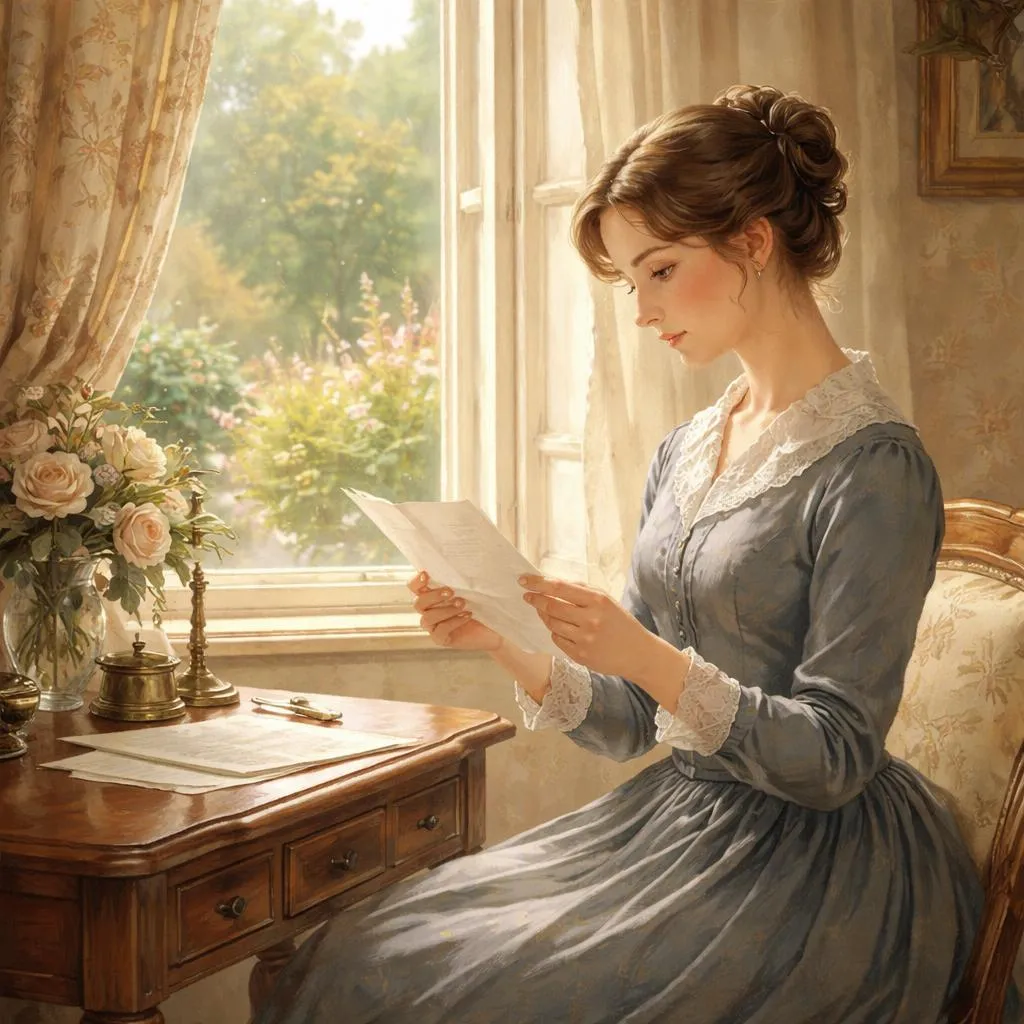

My father’s mortal remains had been consigned to the tomb; and we, with sad faces and sombre garments, sat lingering over the frugal breakfast–table, revolving plans for our future life. My mother’s strong mind had not given way beneath even this affliction: her spirit, though crushed, was not broken. Mary’s wish was that I should go back to Horton Lodge, and that our mother should come and live with her and Mr. Richardson at the vicarage: she affirmed that he wished it no less than herself, and that such an arrangement could not fail to benefit all parties; for my mother’s society and experience would be of inestimable value to them, and they would do all they could to make her happy. But no arguments or entreaties could prevail: my mother was determined not to go. Not that she questioned, for a moment, the kind wishes and intentions of her daughter; but she affirmed that so long as God spared her health and strength, she would make use of them to earn her own livelihood, and be chargeable to no one; whether her dependence would be felt as a burden or not. If she could afford to reside as a lodger in—vicarage, she would choose that house before all others as the place of her abode; but not being so circumstanced, she would never come under its roof, except as an occasional visitor: unless sickness or calamity should render her assistance really needful, or until age or infirmity made her incapable of maintaining herself.
‘No, Mary,’ said she, ‘if Richardson and you have anything to spare, you must lay it aside for your family; and Agnes and I must gather honey for ourselves. Thanks to my having had daughters to educate, I have not forgotten my accomplishments. God willing, I will check this vain repining,’ she said, while the tears coursed one another down her cheeks in spite of her efforts; but she wiped them away, and resolutely shaking back her head, continued, ‘I will exert myself, and look out for a small house, commodiously situated in some populous but healthy district, where we will take a few young ladies to board and educate—if we can get them—and as many day pupils as will come, or as we can manage to instruct. Your father’s relations and old friends will be able to send us some pupils, or to assist us with their recommendations, no doubt: I shall not apply to my own. What say you to it, Agnes? will you be willing to leave your present situation and try?’
‘Quite willing, mamma; and the money I have saved will do to furnish the house. It shall be taken from the bank directly.’
‘When it is wanted: we must get the house, and settle on preliminaries first.’
Mary offered to lend the little she possessed; but my mother declined it, saying that we must begin on an economical plan; and she hoped that the whole or part of mine, added to what we could get by the sale of the furniture, and what little our dear papa had contrived to lay aside for her since the debts were paid, would be sufficient to last us till Christmas; when, it was hoped, something would accrue from our united labours. It was finally settled that this should be our plan; and that inquiries and preparations should immediately be set on foot; and while my mother busied herself with these, I should return to Horton Lodge at the close of my four weeks’ vacation, and give notice for my final departure when things were in train for the speedy commencement of our school.
We were discussing these affairs on the morning I have mentioned, about a fortnight after my father’s death, when a letter was brought in for my mother, on beholding which the colour mounted to her face—lately pale enough with anxious watchings and excessive sorrow. ‘From my father!’ murmured she, as she hastily tore off the cover. It was many years since she had heard from any of her own relations before. Naturally wondering what the letter might contain, I watched her countenance while she read it, and was somewhat surprised to see her bite her lip and knit her brows as if in anger. When she had done, she somewhat irreverently cast it on the table, saying with a scornful smile,—’Your grandpapa has been so kind as to write to me. He says he has no doubt I have long repented of my “unfortunate marriage,” and if I will only acknowledge this, and confess I was wrong in neglecting his advice, and that I have justly suffered for it, he will make a lady of me once again—if that be possible after my long degradation—and remember my girls in his will. Get my desk, Agnes, and send these things away: I will answer the letter directly. But first, as I may be depriving you both of a legacy, it is just that I should tell you what I mean to say. I shall say that he is mistaken in supposing that I can regret the birth of my daughters (who have been the pride of my life, and are likely to be the comfort of my old age), or the thirty years I have passed in the company of my best and dearest friend;—that, had our misfortunes been three times as great as they were (unless they had been of my bringing on), I should still the more rejoice to have shared them with your father, and administered what consolation I was able; and, had his sufferings in illness been ten times what they wore, I could not regret having watched over and laboured to relieve them;—that, if he had married a richer wife, misfortunes and trials would no doubt have come upon him still; while I am egotist enough to imagine that no other woman could have cheered him through them so well: not that I am superior to the rest, but I was made for him, and he for me; and I can no more repent the hours, days, years of happiness we have spent together, and which neither could have had without the other, than I can the privilege of having been his nurse in sickness, and his comfort in affliction.
‘Will this do, children?—or shall I say we are all very sorry for what has happened during the last thirty years, and my daughters wish they had never been born; but since they have had that misfortune, they will be thankful for any trifle their grandpapa will be kind enough to bestow?’
Of course, we both applauded our mother’s resolution; Mary cleared away the breakfast things; I brought the desk; the letter was quickly written and despatched; and, from that day, we heard no more of our grandfather, till we saw his death announced in the newspaper a considerable time after—all his worldly possessions, of course, being left to our wealthy unknown cousins.
Hintergrund und Einführung in die Autorin
Diese Passage stammt aus einem klassischen Roman des 19. Jahrhunderts, der Themen wie Familie, Widerstandsfähigkeit und Unabhängigkeit behandelt. Die Geschichte spielt in einer Zeit, in der die Rollen der Frauen weitgehend auf das Zuhause beschränkt waren und die finanzielle Sicherheit oft von männlichen Verwandten abhing. Die Autorin, eine Frau ihrer Zeit, schrieb mit einem tiefen Verständnis für die Kämpfe, denen sich Frauen stellen mussten, die sich nach dem Verlust ihrer Ehemänner selbst versorgen mussten. Ihre Werke heben oft die Stärke und Würde von Frauen hervor, die trotz Widrigkeiten danach streben, ihren Selbstrespekt zu bewahren und für ihre Familien zu sorgen.
Detaillierte Interpretation und Bedeutung
Die Passage beschreibt eine Familie, die mit dem kürzlichen Tod des Vaters fertig wird. Die Mutter, obwohl zutiefst betrübt, weigert sich, von anderen abhängig zu sein, und zeigt einen starken Willen, sich und ihre Töchter durch Unterrichten zu unterstützen. Diese Entscheidung spiegelt ihren Stolz und ihre Entschlossenheit wider, die Unabhängigkeit zu bewahren, anstatt Almosen anzunehmen oder unter der Kontrolle von Verwandten zu leben, die ihre Entscheidungen nicht unterstützen.
Der Brief des entfremdeten Vaters der Mutter fügt eine Ebene des Familienkonflikts und des sozialen Urteils hinzu und offenbart die Herausforderungen gesellschaftlicher Erwartungen und persönlicher Integrität. Die Antwort der Mutter ist eine kraftvolle Aussage über Selbstwertgefühl und bedingungslose Liebe für ihren verstorbenen Ehemann und ihre Töchter, die die Vorstellung ablehnt, dass sie ihre Lebensentscheidungen bereuen sollte, nur weil sie nicht mit den Ansichten ihres Vaters übereinstimmen.
Lektionen und Erkenntnisse für Schüler
-
Widerstandsfähigkeit in Widrigkeiten: Der Mut der Mutter, sich finanziellen und emotionalen Schwierigkeiten zu stellen, lehrt die Schüler die Bedeutung von Widerstandsfähigkeit. Das Leben kann unerwartete Herausforderungen mit sich bringen, aber die Aufrechterhaltung von Stärke und einer positiven Einstellung kann helfen, Schwierigkeiten zu überwinden.
-
Unabhängigkeit und Selbstständigkeit: Die Geschichte ermutigt junge Leser, Unabhängigkeit und die Fähigkeit, sich durch harte Arbeit und Entschlossenheit selbst zu versorgen, zu schätzen. Sie unterstreicht auch die Würde, die aus ehrlichem Verdienst resultiert.
-
Familie und Loyalität: Trotz äußerem Druck zeigen die Loyalität der Mutter gegenüber ihrer Familie und ihre Weigerung, ihre Vergangenheit zu bereuen, die Bedeutung, zu seinen Lieben zu stehen und persönliche Verpflichtungen zu ehren.
-
Sich gegen sozialen Druck wehren: Die entschiedene Ablehnung des bedingten Angebots ihres Vaters durch die Mutter lehrt die Schüler, für ihre Überzeugungen und Werte einzustehen, auch wenn sie mit Kritik oder Ablehnung von anderen konfrontiert werden.
Anwendung im täglichen Leben
- Im Lernen: Die Schüler können lernen, sich akademischen Herausforderungen mit Entschlossenheit zu stellen, zu verstehen, dass Rückschläge Teil des Wachstums sind und dass Ausdauer zum Erfolg führt.
- In sozialen Situationen: Die Geschichte ermutigt junge Menschen, ihre Familie und Freunde zu unterstützen, loyal zu sein und an ihren Werten festzuhalten, auch wenn andere anderer Meinung sind.
- In der persönlichen Entwicklung: Die Kultivierung von Selbstachtung und Unabhängigkeit ist entscheidend. Die Schüler können üben, Verantwortung für ihre Handlungen und Entscheidungen zu übernehmen, was sie auf das Erwachsenenalter vorbereitet.
Kultivierung von positivem Geist und Verhalten
- Empathie und Mitgefühl: Das Verständnis für die Kämpfe der Mutter hilft den Schülern, Empathie für andere zu entwickeln, die mit Schwierigkeiten konfrontiert sind.
- Stärke und Mut: Das Beispiel der Mutter inspiriert die Schüler, in Widrigkeiten mutig zu sein.
- Selbstachtung: Sich selbst und seine Entscheidungen zu schätzen, ist eine zentrale Botschaft.
- Harte Arbeit: Der Plan, eine Schule zu gründen, zeigt die Bedeutung von Initiative und Anstrengung.
Indem sie über diese Geschichte nachdenken, können die Schüler die Kraft der inneren Stärke und die Bedeutung, sich selbst treu zu bleiben, schätzen, Lektionen, die ihnen ihr ganzes Leben lang nützlich sein werden.
