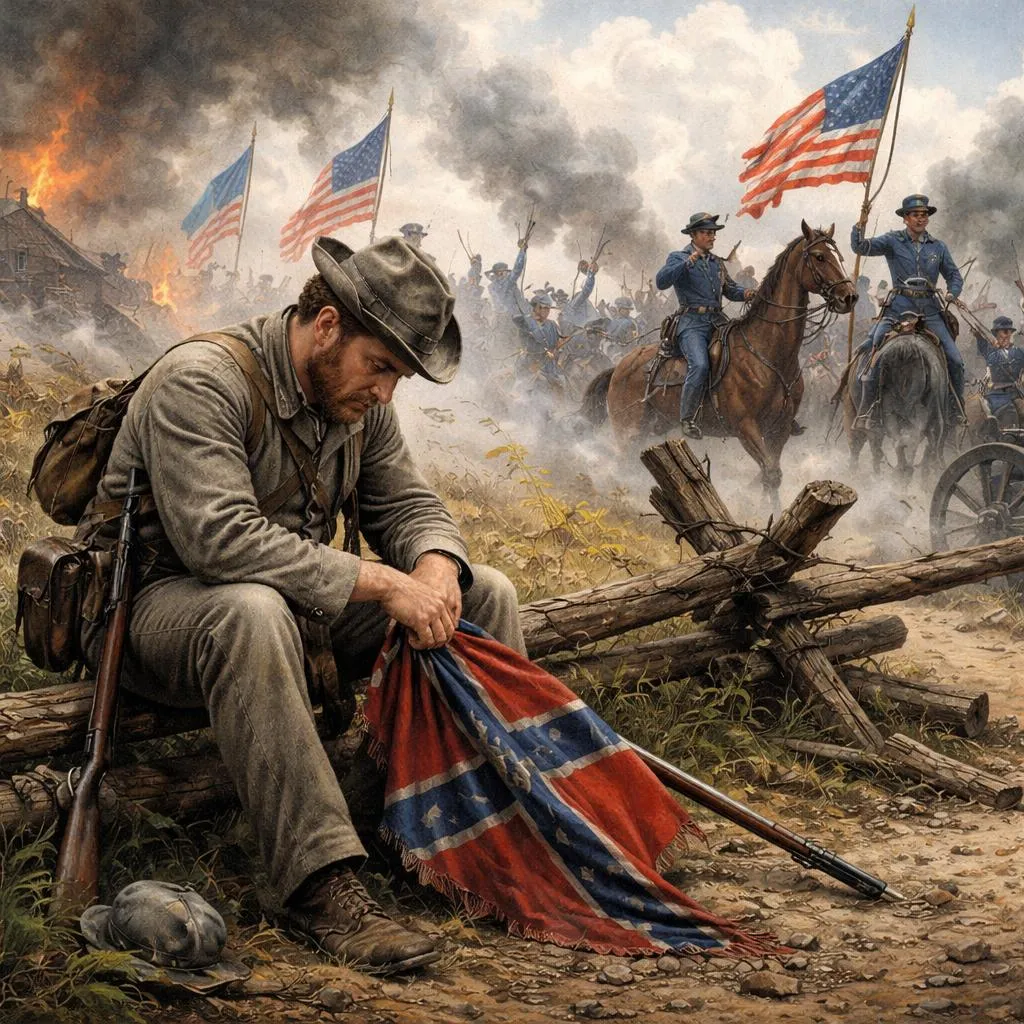

Notwithstanding his military title, Colonel Homer Passford was not a soldier, though he had once been a sort of honorary head of a regiment of militia. His brother, Captain Horatio Passford, Christy’s father, was a millionaire in the tenth degree. More than twenty years before the war he had assisted Homer to all the money he required to buy a plantation in Alabama, near Mobile, where he had prospered exceedingly, though his possessions had never been a tenth part of those of his wealthy brother.
Homer had married in the South, and was the father of a son and daughter, now approaching their maturity, and Corny, the son, was a soldier in the Confederate army. The most affectionate relations had always subsisted between the two families; and before the war the Bellevite had always visited Glenfield, the plantation of the colonel, at least twice a year.
Florry Passford, the captain’s daughter, being somewhat out of health, had passed the winter before the beginning of the war at Glenfield, and was there when the enemy’s guns opened upon Fort Sumter. Captain Passford had not supposed that his brother in Alabama would take part with the South in the Rebellion, and with great difficulty and risk he had gone to Glenfield in the Bellevite, for the purpose of conveying his daughter to his home at Bonnydale on the Hudson, not doubting that Homer and his family would be his passengers on the return to the North.
He was entirely mistaken in regard to the political sentiments of the colonel, and found that he was one of the most devoted and determined advocates of the Southern cause. The southern brother did not conceal his opinions, and it was plain enough to the captain that he was entirely sincere, and believed with all his mind, heart, and soul, that it was his religious, moral, and social duty to espouse what he called his country’s cause; and he had done so with all his influence and his fortune. He had even gone so far in his devotion to his duty as he understood it, as to attempt to hand over the Bellevite, though she was not in Mobile Bay on a warlike mission, to the new government of the South, and had taken part personally in an expedition extended to capture her.
The steam-yacht had been armed at the Bermudas, and fought her way out of the bay; and on her return to New York her owner presented her to the Government of the United States. She had done good service, and Christy had begun his brilliant career as a naval officer in the capacity of a midshipman on board of her. In spite of the hostile political attitude of the brothers to each other, the same affectionate relations had continued between the two families, for each of them believed that social and family ties should not interfere with his patriotic duty to his country.
The commander of the Confederate forces at Hilton Head—one of the highest-toned and most estimable gentlemen one could find in the North or the South—informed the author that his own brother was in command of one of the Federal ships that were bombarding his works. While Commodore Wilkes, of Mason and Slidell memory, was capturing the Southern representatives who had to be given up, his son was in the Confederate navy, and then or later was casting guns at Charlotte for the use of the South: and the writer never met a more reasonable and kindly man. Fortunately our two brothers were not called upon to confront each other as foes on the battlefield or on the sea, though both of them would have done their duty in such positions.
The last time Christy had seen his Uncle Homer was when he was captured on board of the Dornoch with Captain Rombold, as he was endeavoring to obtain a passage to England as a Confederate agent for the purchase of suitable vessels to prey upon the mercantile marine of the United States. He and the commander of the Tallahatchie had been exchanged at about the same time; and they had proceeded to Nassau, where they embarked for England in a cotton steamer. There they had purchased and fitted out the Trafalgar; for the agent’s drafts, in which the last of his fortune had been absorbed, could not be made available to his captors. Colonel Passford had an interview with Captain Rombold after Gill had brought his trunk on board; and it was a very sad occasion to the planter, if not to the naval officer. They had not had an opportunity to consider the disaster that had overtaken the Confederate steamer, which had promised such favorable results for their cause; for the commander had been entirely occupied till he received his wound, and even then he had attended to his duties, for, as before suggested, he was a “last ditch” man. He was not fighting for the South as a mere hireling; for he had married a Southern wife, and she had enlisted all his sympathies in the cause of her people.
“I suppose we have nothing more to hope for, Captain Rombold; and we can only put our trust in the All-Wise and the All-Powerful, who never forsakes his children when they are fighting for right and justice,” said Colonel Passford, after he had condoled with the commander on his wounded condition.
“We shall come out all right in the end, Colonel; don’t be so cast down,” replied the captain.
“I raised the money by mortgaging my plantation and what other property I had left for all the money I could get upon it to a wealthy Englishman, the one who came to Mobile with us from Nassau, to obtain the cargoes for this steamer. I had borrowed all I could before that for the purchase of the Trafalgar; and if the current does not change in our favor soon, I shall be a beggar,” added the colonel bitterly.
“The tide will turn, my good friend; and it would have turned before now if all the planters had been as self-sacrificing as you have,” said the captain.
“Cotton and gold are about the same thing just now; and with the large cargo on board of the West Wind, which I induced my friends to contribute to the good cause, and that in the hold of the Tallahatchie, I was confident that I could purchase the Kilmarnock, which you say is good for eighteen knots an hour. Now the West Wind and the Tallahatchie are both prizes of the enemy, and there is no present hope for us,” continued the colonel; and there was no wonder that he had become pale and thin.
“We are in a bad situation, Colonel Passford, I admit, for both of us are prisoners of war, so that we can do nothing, even if we had the means; but everything will come out right in the end,” replied the wounded officer, though he could not explain in what manner this result was to be achieved.
“Well, Captain Rombold, how are you feeling?” asked Dr. Linscott, darkening the door when the conversation had reached this gloomy point.
“Very comfortable, Doctor,” replied the commander. “My friend is Colonel Passford.”
“Bless me!” exclaimed the surgeon, as he extended his hand to the visitor. “I am very glad to see you, and I hope you are very well. I am happy to inform you that your nephew, who was wounded in the engagement, is doing very well.”
“Yes; I met him on deck,” replied the planter very gloomily.
“What is the matter, Colonel Passford? You look quite pale, and you have lost flesh since I met you last. Can I do anything for you?”
“Nothing, Doctor; I am not very well, though nothing in particular ails me. With your permission I will retire to my stateroom,” said the colonel, as he rose from his seat.
“By the way, Colonel Passford, the captain wished me to ascertain if you have been to breakfast,” added the surgeon, following him out into the cabin.
“I have not, Doctor; but it was because I wanted none, for I do not feel like eating,” replied the pale planter.
“Punch, go to the galley, get a beefsteak, a plate of toast, and a cup of coffee. Set out the captain’s table, and call this gentleman when it is ready.”
“Yes, sir,” replied Punch, who was a very genteel colored person.
The colonel attempted to protest, but the surgeon would not hear him. He remained with the planter, whom he already regarded as a patient, and though he could not say anything to comfort him, he talked him into a pleasanter frame of mind. Punch set the table, and in due time brought the breakfast. The doctor sat down opposite to him at the table, and actually compelled him to eat a tolerably hearty meal. He was decidedly less gloomy when he had finished, and it was plain to his companion that his empty stomach was responsible for a portion of his depression of spirits.
The surgeon had remained on board of the prize till the order to get under way was given, and then Captain Breaker sent for him; but the two medical gentlemen had disposed of most of the wounds among the Confederate crew. As the English engineer had reported, the machinery and boilers of the Tallahatchie were in good condition, and the two steamers went on their course towards the entrance to Mobile Bay, where French had been ordered to anchor the West Wind, at full speed, though neither was driven; but the log showed that they were making about eighteen knots.
After the brief talk with his uncle, Christy had waited for him to return to the deck, as he supposed he would after what the captain had said to him; but he did not appear. In fact, Colonel Passford was too much cast down by the capture of the two vessels, and the loss of his fortune thereby, that he was not disposed to see any person if he could avoid it.
“Don’t you think you had better turn in, Mr. Passford?” asked the commander, as he halted in his walk at the side of the lieutenant.
“I have been waiting here to see my uncle; for I thought, after what you said to him, that he would come back,” added Christy.
“I sent Dr. Linscott down to see him, for he looks so pale and feeble that I thought he must be sick. The surgeon reported to me half an hour ago that he had made him eat his breakfast against his will, and he was feeling better and more cheerful. He thinks your Uncle Homer’s trouble is entirely mental, and he does not feel like seeing any person,” answered the commander.
“What mental trouble can he have?” asked Christy, as he gazed into the face of the captain, wondering if his father’s brother was insane.
“The colonel has shipped a vast amount of cotton intending to use the proceeds of its sale to purchase ships for the Confederacy; and he has lost most of them, for you captured quite a number of them when you were in command of the Bronx. I have no doubt he was interested in the cargoes of the prize and the West Wind; and the capture of these two vessels involves a fearful loss. I believe that is all that ails him,” the captain explained. “Doubtless he feels as kindly towards his nephew as ever before in his life; but he does not care to see him just now.”
Early in the afternoon the Bellevite and her prize came in sight of the West Wind, anchored in accordance with French’s orders, with the Holyoke almost within hail of her; for the captain of the steamer had doubtless considered the possibility of a recapture of the schooner by boats from the shore, if she was left unprotected.
In due time the Bellevite let go her anchor at about a cable’s length from the West Wind, and the prize-master of the Tallahatchie had done the same at an equal distance from the ship. Mr. Graines, who had not met his late associate on shore since he was wounded, came to his side as soon as the steamer had anchored; for both Christy and he were anxious to hear the report of French in regard to the prisoners left in his care.
The anchor of the Bellevite had hardly caught in the sand before a boat put off from the West Wind containing four persons. Two of the ship’s seamen were at the oars, French was in the stern sheets, and the engineer soon recognized Captain Sullendine as the fourth person.
Hintergrund und Kontext der Geschichte
Diese Geschichte spielt während des Amerikanischen Bürgerkriegs, einem Konflikt zwischen den Nordstaaten (Union) und den Südstaaten (Konföderation) von 1861 bis 1865. Der Krieg drehte sich hauptsächlich um die Rechte der Bundesstaaten und die Institution der Sklaverei. Die Erzählung untersucht die geteilten Loyalitäten innerhalb von Familien, wie am Beispiel der Passford-Brüder – einer unterstützt den Norden, der andere den Süden. Diese Teilung spiegelt die realen historischen Spannungen wider, die Familien und Gemeinschaften während des Krieges spalteten.
Die Geschichte beleuchtet auch die Komplexität des Krieges jenseits des Schlachtfelds, einschließlich Spionage, Seekriegsführung und die wirtschaftlichen Kämpfe derjenigen, die die Konföderierten unterstützten. Sie zeigt, wie persönliche Überzeugungen und familiäre Bindungen mit politischen und nationalen Loyalitäten kollidieren können.
Über den Autor
Obwohl der Originaltext den Autor nicht nennt, deuten der Stil und der Inhalt darauf hin, dass er aus der amerikanischen Literatur des 19. Jahrhunderts stammt, die sich auf Themen des Bürgerkriegs konzentriert. Solche Werke zielten oft darauf ab, den Lesern eine differenzierte Sicht auf den Krieg zu vermitteln und menschliche Geschichten über bloße militärische Ereignisse zu betonen. Autoren dieser Ära versuchten, die moralischen und sozialen Dilemmata zu veranschaulichen, mit denen Einzelpersonen konfrontiert waren, die in den Wirren des nationalen Konflikts gefangen waren.
Detaillierte Interpretation und Bedeutung
Die Geschichte offenbart die emotionalen und moralischen Kämpfe von Einzelpersonen während des Bürgerkriegs. Oberst Homer Passford wird als ein Mann dargestellt, der sich der Sache des Südens zutiefst verpflichtet fühlt, bis hin zur Gefährdung seines Vermögens und seiner Freiheit. Sein Bruder, Captain Horatio, repräsentiert die nördliche Perspektive, wohlhabend und einflussreich, aber dennoch familiäre Bindungen aufrechterhaltend, trotz politischer Unterschiede.
Die Erzählung erforscht Themen wie Loyalität, Opferbereitschaft, Ehre und die Kosten des Krieges. Sie zeigt, dass selbst inmitten von Konflikten Familienliebe und Respekt bestehen können, wenn auch angespannt. Die Geschichte berührt auch die psychologische Belastung des Krieges, da das psychische Leid von Oberst Passford nach dem Verlust seiner Investitionen die schwere Last veranschaulicht, die von den am Konflikt Beteiligten jenseits des Schlachtfelds getragen wird.
Lektionen und Erkenntnisse für Schüler
-
Komplexe Loyalitäten verstehen: Die Geschichte lehrt, dass Loyalität nicht immer einfach oder absolut ist. Menschen können widersprüchliche Pflichten haben – gegenüber der Familie, dem Land, den persönlichen Überzeugungen – und diese können zu schwierigen Entscheidungen führen.
-
Die Kosten des Krieges: Über die physischen Gefahren hinaus bringt der Krieg emotionale, finanzielle und psychologische Härten mit sich. Dies zu erkennen, hilft den Schülern, die volle Auswirkung historischer Konflikte zu verstehen.
-
Familie und Vergebung: Trotz gegensätzlicher Seiten hält die Familie Passford an Zuneigung fest. Dies ermutigt die Leser, Familienbande zu schätzen und nach Verständnis zu suchen, auch wenn Meinungsverschiedenheiten auftreten.
-
Mut und Opferbereitschaft: Charaktere wie Oberst Passford und Captain Rombold demonstrieren Mut und Engagement für ihre Anliegen und zeigen, wie wichtig es ist, für seine Überzeugungen einzustehen.
-
Bewusstsein für psychische Gesundheit: Die Darstellung des psychischen Zustands von Oberst Passford in der Geschichte verdeutlicht, wie sich Stress und Verlust auf das Wohlbefinden auswirken, eine wertvolle Lektion in Empathie und Unterstützung für andere.
Anwendungen im täglichen Leben und Lernen
-
In der Schule: Die Schüler können lernen, unterschiedliche Meinungen zu respektieren und zu verstehen, dass der Hintergrund der Menschen ihre Ansichten beeinflusst. Dies fördert Toleranz und Aufgeschlossenheit.
-
In sozialen Umgebungen: Die Geschichte ermutigt dazu, Beziehungen trotz Meinungsverschiedenheiten aufrechtzuerhalten, und lehrt Konfliktlösung und Empathie.
-
Persönliches Wachstum: Das Nachahmen des Mutes und des Engagements der Charaktere kann die Schüler dazu inspirieren, sich ihren Zielen und Werten zu verschreiben, auch wenn sie vor Herausforderungen stehen.
-
Psychische Gesundheit: Das Erkennen von Anzeichen von Stress und die Unterstützung von Freunden oder Familienmitgliedern, die möglicherweise zu kämpfen haben, ist eine wichtige Lebenskompetenz.
Positive Eigenschaften aus der Geschichte kultivieren
-
Empathie: Verstehen und schätzen Sie die Perspektiven anderer, insbesondere bei Konflikten.
-
Resilienz: Lernen Sie, mit Rückschlägen wie dem finanziellen Verlust von Oberst Passford umzugehen.
-
Loyalität: Schätzen und schützen Sie Familie und Freundschaften, auch in schwierigen Zeiten.
-
Integrität: Stehen Sie zu Ihren Prinzipien mit Ehrlichkeit und Engagement.
-
Mitgefühl: Unterstützen Sie diejenigen, die emotional oder körperlich leiden.
Indem sie über diese Themen und Lektionen nachdenken, können die Schüler ein tieferes Verständnis der Geschichte und der menschlichen Natur entwickeln und diese Erkenntnisse auf ihr eigenes Leben anwenden, um persönliches und soziales Wachstum zu erzielen.
