
French ascended the gangway followed by Captain Sullendine. The seaman who had acted as prize-master of the West Wind touched his cap very respectfully to the first officer he met when he came on board. Christy had asked the chief engineer to send Mr. Graines to him, and he was talking to him about the prize and the chief prisoner when French presented himself before them.
“I have come on board to report, sir,” said the prize-master of the West Wind.
“Is all well on board, French?” asked the wounded lieutenant.
“All well now, sir,” replied the seaman, with a suggestive emphasis on the last word. “I am very sorry to learn that you have been wounded, Mr. Passford.”
“Not severely, French,” replied Christy. “I am ready to hear your report.”
“I have something to say about this business, Jerry Sandman,” interposed the captain of the West Wind, whose wrath had suddenly got the better of his judgment, interlarding his brief remark with a couple of ringing oaths.
“I will hear the prize-master first,” replied Christy very quietly.
The discomfited master of the schooner called down a shocking malediction upon the prize-master just as Captain Breaker presented himself before the group assembled at the arm-chair of the lieutenant, and had heard the last oaths of the angry man.
“Who is this man, Mr. Passford?” asked the commander.
“I’ll let you know who I am!” exclaimed Captain Sullendine, with another couplet of oaths.
“I do not permit any profane language on the deck of this ship,” said Captain Breaker. “Pass the word for the master-at-arms,” he added to the nearest officer.
“Oh, you are the cap’n of this hooker,” added the master of the West Wind, this time without any expletives. “I have somethin’ to say to you, Cap’n, and I want to complain of your officers.”
“When you have learned how to behave yourself, I will hear you,” replied the commander, as the master-at-arms, who is the chief of police on board a ship of war, presented himself, touching his cap to the supreme authority of the steamer. “What is the trouble here, Mr. Passford?” asked Captain Breaker in a very gentle tone, in contrast with the quiet sternness with which he had spoken to Captain Sullendine.
“No trouble at all, sir; I was about to hear the report of French, the prize-master of the schooner, when the captain of her interfered,” replied Christy.
“My story comes in before the prize-master’s, as you call him, though he ain’t nothin’ but a common sailor,” interposed Captain Sullendine again.
“Will you be silent?” demanded the commander.
“No, I will not! This is an outrage!” stormed the captain of the West Wind, with a liberal spicing of oaths in his speech.
“Put this man in irons, master-at-arms, and commit him to the brig,” added Captain Breaker.
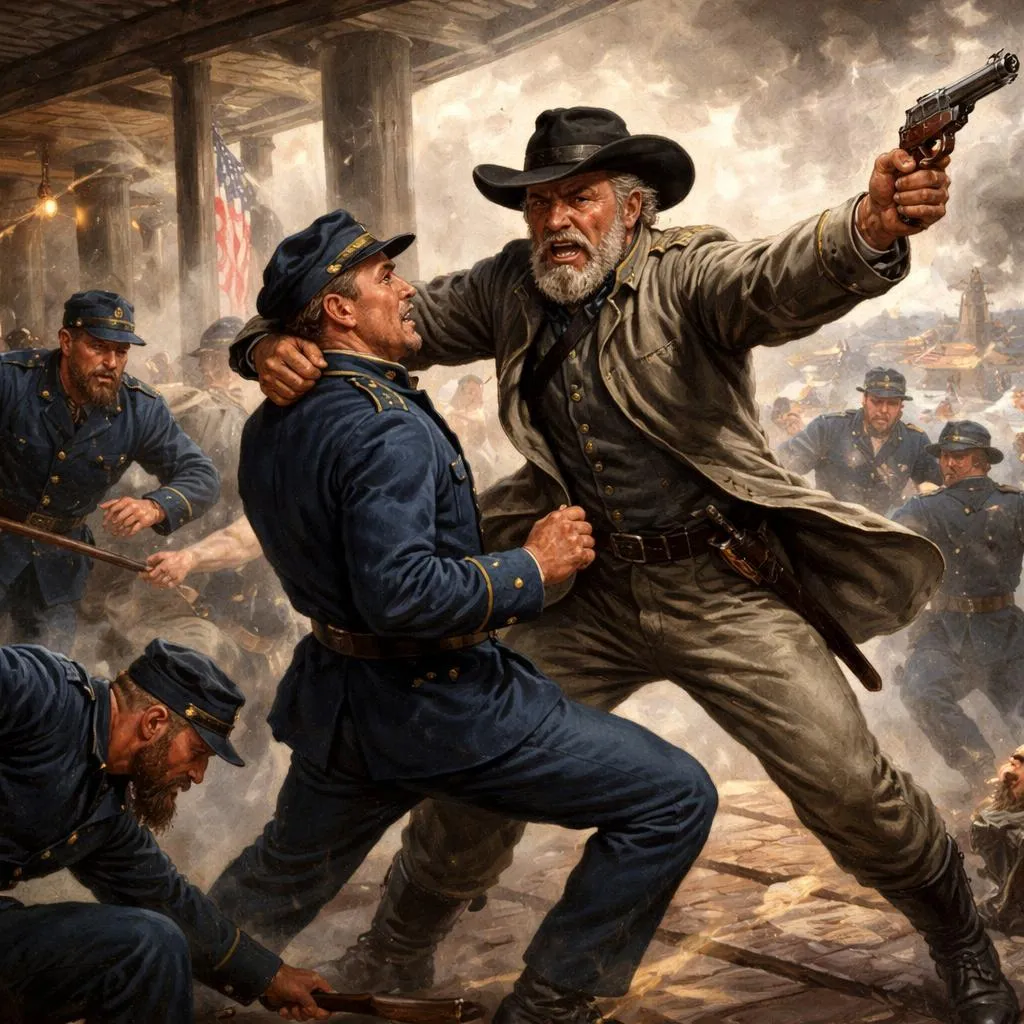
The petty officer called upon the ship’s corporal, whom he had brought with him, and placed his hand on the arm of the rebellious master, who showed fight. A couple of seamen were called to assist the police force, and Captain Sullendine was dragged below with his wrists ironed behind him.
“Now you can proceed, French,” said the captain.
“When I left you, all was quiet on board of the West Wind,” added Christy, beginning to make a slight explanation for the benefit of the commander. “Captain Sullendine was very drunk, asleep in his berth, with the door of his stateroom securely fastened upon him. Bokes the seaman and Sopsy the cook were in the same condition. Go on, French.”
“I picked up the boat you set adrift, Mr. Passford, and then headed for the eastward of Sand Island lighthouse, where you ordered me to anchor. The Holyoke followed the schooner, and came to anchor near the West Wind. She sent a boat on board, and I told my story to the second lieutenant. We did not need any assistance, and he left us.
“About four bells in the forenoon watch I heard a tremendous racket in the cabin, and I went below. Captain Sullendine was doing his best to break down the door of his stateroom, cursing hard enough to make the blood of a Christian run cold. But he had nothing to work with, and I let him kick and pound till he got tired of it. I put Vogel in the cabin to keep watch of him, and went on deck.
“He kept it up for half an hour or more, and then he seemed to have enough of it. Vogel came on deck and told me the prisoner was very humble then, and wanted to come out. I knew you did not mean that I should starve him, and I made Sopsy put his breakfast on the table in the cabin; but I did not do so till I had locked the liquor closet and put the key in my pocket.
“I let him out then, and his first move was to get at his whiskey; but the door was locked. He begged like a child for a drink; but I did not give him a drop. Sopsy and Bokes, who were tied up forward, did the same; but they did not get any. Captain Sullendine ate his breakfast, and I told him his vessel was a prize to the United States steamer Bellevite. Then he was so furious that we had to shut him up in his stateroom again.
“After a while he promised to behave himself, and I let him out again. He declared that his vessel was not a legal prize, and got off a lot of stuff that I did not take any notice of. He wanted to make a protest to the commander of the Bellevite, and when he promised to behave like a gentleman, I let him come on board with me.”
“You acted with very good judgment, French, and Mr. Passford has already commended your good conduct in the expedition last night,” said the commander.
“Thank you, sir,” replied the prize-master, touching his cap, and backing away without another word.
“Loring,” called the captain to the master-at-arms, who had just returned to the quarter-deck, or as near it as etiquette permitted him to go. “How is your prisoner?”
“He broke down completely after he had been in the brig a few minutes, and promised to behave like a gentleman if the commander would hear him.”
“Bring him to the quarter-deck,” added the captain.
In a few minutes, the ship’s corporal conducted him into the presence of the commander. He began with a very lame apology for his previous conduct, and then declared that he was the victim of a “Yankee trick,” and that the West Wind had not been fairly captured.
“Your officers imposed upon me,” he continued. “Mr. Balker and Jerry Sandman”—
“Who are they?” inquired Captain Breaker, interrupting him.
“I was Mr. Balker, engaged as mate of the West Wind, selected for that position by Mr. Passford, while the lieutenant was Jerry Sandman, second mate, which he chose to be himself so that he could be with the men,” interposed Mr. Graines.
“I did not know what their names was, and I reckoned all was honest and square. These men, whoever they were, got me drunk, and got drunk themselves; and while I was taking a nap, waiting for the steamer to get under way, they fastened me into my stateroom so I couldn’t get out.”
“I went through the forms, but I did not take a drop of liquor into my mouth,” said Christy.
“I did not take more than a tablespoonful both on board and at the camp of the runaways,” added Mr. Graines.
“Then you cheated me more’n I thought.”
“Is this all the complaint you have to make, Captain Sullendine?” asked Captain Breaker, turning to the master of the West Wind.
“I reckon that’s enough!” protested the complainant. “I say it was not a fair capture, and you ought to send my vessel back to Mobile Point, where your officers found her.”
“I shall not do that, but I will compromise the matter by sending you to Mobile Point, as I have no further use for you,” replied the commander. “You are a non-combatant, and not a prisoner of war.”
French was ordered to leave Captain Sullendine, Bokes, and Sopsy at the shore where the whaleboat had made a landing, as soon as it was dark. For some reason not apparent, the master of the West Wind protested against this sentence; but no attention was given to his protest. The commander was confident that he had evidence enough to secure the condemnation of the prize, and he regarded such an unreasonable fellow as her late captain as a nuisance. That night the order in regard to him and his companions were carried out.
Captain Breaker asked some questions in regard to French, which Christy and Mr. Graines were able to answer. He was one of those men, of whom there were thousands in the army and navy who had become soldiers and sailors purely from patriotic duty, and at the sacrifice of brighter present prospects. French had been the mate of a large coaster, whose captain had become an ensign in the navy, and he might have had the command of her if he had not shipped as an able seaman in the same service.
He understood navigation, and had been the second mate of an Indiaman. The commander said nothing when he had learned all he could about the prize-master; but it was evident that he had something in view which might be of interest to the subject of his inquiries. He turned his attention to the condition of his first lieutenant then, asking about his arm.
“It does not feel quite so easy as it did,” replied Christy, who had been suffering some pain from his wound for the last two hours, though he was so interested in the proceedings on board, and especially in the report from the West Wind, that he had not been willing to retire to his stateroom.
“Then you must turn in at once, Mr. Passford,” said the commander, with more energy than he had spoken to the lieutenant before. “I am afraid you have delayed it too long.”
“I think not, sir.” replied the wounded officer.
“Mr. Graines shall go with you and assist you,” added the captain. “I will send Dr. Linscott to you as soon as you get into your berth.”
Christy had been sitting so long that he was quite stiff when he attempted to get out of his chair, and the engineer assisted him. He was still very weak, and Mr. Graines supported him, though he presently recovered himself. The ship’s company, by this time relieved of all heavy work, had been observing him with affectionate admiration, and rehearsing the daring exploit in which he had received his wound, gave three rousing cheers as he rose to leave the quarter-deck.
Christy turned his pale face towards them, raised his cap, and bowed to them. Another cheer followed, and then another. The men knew that his prompt action in mounting the mizzen rigging, boarding the Tallahatchie, and firing the thirty-pounder after he had reversed its position, had saved the lives or limbs of a great number of them, and they were extremely grateful to him.
With the assistance of his friend the engineer, Christy was soon between the sheets in his berth. Dr. Linscott came in as soon as he was in his bed, spoke very tenderly to him, and then proceeded to dress his injured arm. He found the member was somewhat swollen, and the patient’s pulse indicated some fever.
“I must send you home, Mr. Passford,” said the surgeon. “You are the hero of the day, you have earned a vacation, and you will need your mother’s care for the next three weeks.”
In spite of Christy’s protest, the doctor insisted, and left him.
Hintergrund und Einführung des Autors
Diese Geschichte ist ein Auszug aus einem maritimen Abenteuerroman, der wahrscheinlich im 19. Jahrhundert spielt, als Seekriege und Kaperfahrten üblich waren. Die Erzählung konzentriert sich auf Marineoffiziere und Seeleute, die an der Eroberung eines Schiffes namens West Wind beteiligt sind. Der Autor, dessen Identität hier nicht angegeben ist, schreibt mit lebendigen Details über das Leben auf See, die Befehlskette und die Spannungen zwischen Kapitänen und Mannschaften in Kriegszeiten. Solche Geschichten waren im 19. und frühen 20. Jahrhundert beliebt und spiegelten die Faszination der Epoche für Seeabenteuer, Ehre und Pflicht wider.
Detaillierte Interpretation und Bedeutung
Die Passage untersucht Themen wie Autorität, Disziplin und Ehre an Bord von Marineschiffen. Die Trunkenheit und der Ungehorsam von Kapitän Sullendine stehen in krassem Gegensatz zur ruhigen, gerechten Führung von Kapitän Breaker und dem pflichtbewussten Verhalten von French und Christy. Die Geschichte unterstreicht die Bedeutung von Ordnung und Respekt vor Regeln für die Aufrechterhaltung der Sicherheit und Effektivität eines Schiffes. Sie berührt auch die Komplexität der Gerechtigkeit in Kriegszeiten, da die Rechtmäßigkeit der Priseneroberung in Frage gestellt, aber letztendlich aufgrund von Beweisen und ordnungsgemäßem Verhalten aufrechterhalten wird.
Lektionen und Erkenntnisse für Schüler
-
Respekt vor Autorität und Disziplin: Die Geschichte zeigt, wie wichtig Disziplin und Respekt vor der Führung in jeder Gruppensituation sind, insbesondere in risikoreichen Umgebungen wie einem Schiff auf See. Die Schüler können den Wert des Befolgens von Regeln und des Verständnisses der Befehlskette lernen, um Harmonie zu wahren und gemeinsame Ziele zu erreichen.
-
Mut und Verantwortung: Leutnant Christy bleibt trotz seiner Verwundung seinen Pflichten und dem Wohlergehen seiner Mannschaft verpflichtet. Dies lehrt junge Leser über Verantwortung, Tapferkeit und Ausdauer angesichts von Widrigkeiten.
-
Gerechtigkeit und Fairness: Die Erzählung zeigt, dass Fairness und Gerechtigkeit auch in Konflikten unerlässlich sind. Kapitän Breaker hört sich alle Seiten sorgfältig an, bevor er Entscheidungen trifft, und zeigt damit die Bedeutung von Unparteilichkeit und evidenzbasiertem Urteilsvermögen.
-
Selbstbeherrschung: Der Niedergang von Kapitän Sullendine ist zum Teil auf seinen Mangel an Selbstbeherrschung zurückzuführen, insbesondere auf seine Trunkenheit. Dies dient als warnendes Beispiel für die Folgen schlechten Verhaltens und die Bedeutung der Wahrung der Fassung.
Anwendung dieser Lektionen im täglichen Leben
-
In der Schule: Die Schüler können den Respekt vor der Autorität anwenden, indem sie den Lehrern zuhören und mit Klassenkameraden zusammenarbeiten, und verstehen, dass Regeln jedem helfen, in einer sicheren Umgebung zu lernen und zu wachsen.
-
In sozialen Umgebungen: Die Geschichte ermutigt dazu, Emotionen und Konflikte ruhig und respektvoll zu bewältigen und vorschnelle Handlungen zu vermeiden, die Beziehungen schaden könnten.
-
In der persönlichen Entwicklung: Das Nachahmen von Christys Mut und Pflichtgefühl kann die Schüler dazu inspirieren, Verantwortung für ihr Handeln zu übernehmen und sich mutig Herausforderungen zu stellen.
Förderung positiver Eigenschaften aus der Geschichte
-
Disziplin: Üben Sie Selbstdisziplin, indem Sie sich Ziele setzen, die Zeit gut einteilen und Verpflichtungen einhalten.
-
Respekt: Zeigen Sie Respekt gegenüber Gleichaltrigen und Älteren und schätzen Sie ihre Rollen und Beiträge.
-
Fairness: Streben Sie nach Fairness in Urteilen und Interaktionen und hören Sie anderen zu, bevor Sie Entscheidungen treffen.
-
Mut: Nehmen Sie Herausforderungen an und stehen Sie für das Richtige ein, auch wenn es schwierig ist.
Schlussfolgerung
Diese maritime Geschichte bietet, obwohl sie aufregend und voller Action ist, reichhaltige Lektionen über Führung, Gerechtigkeit und den persönlichen Charakter. Schüler, die sie lesen, können nicht nur das Abenteuer genießen, sondern auch darüber nachdenken, wie die dargestellten Werte ihr Verhalten und ihre Entscheidungen in der Schule, in Freundschaften und darüber hinaus leiten können. Indem junge Leser sowohl aus den positiven als auch aus den negativen Beispielen in der Geschichte lernen, können sie sich zu verantwortungsbewussten, mutigen und fairen Menschen entwickeln.
