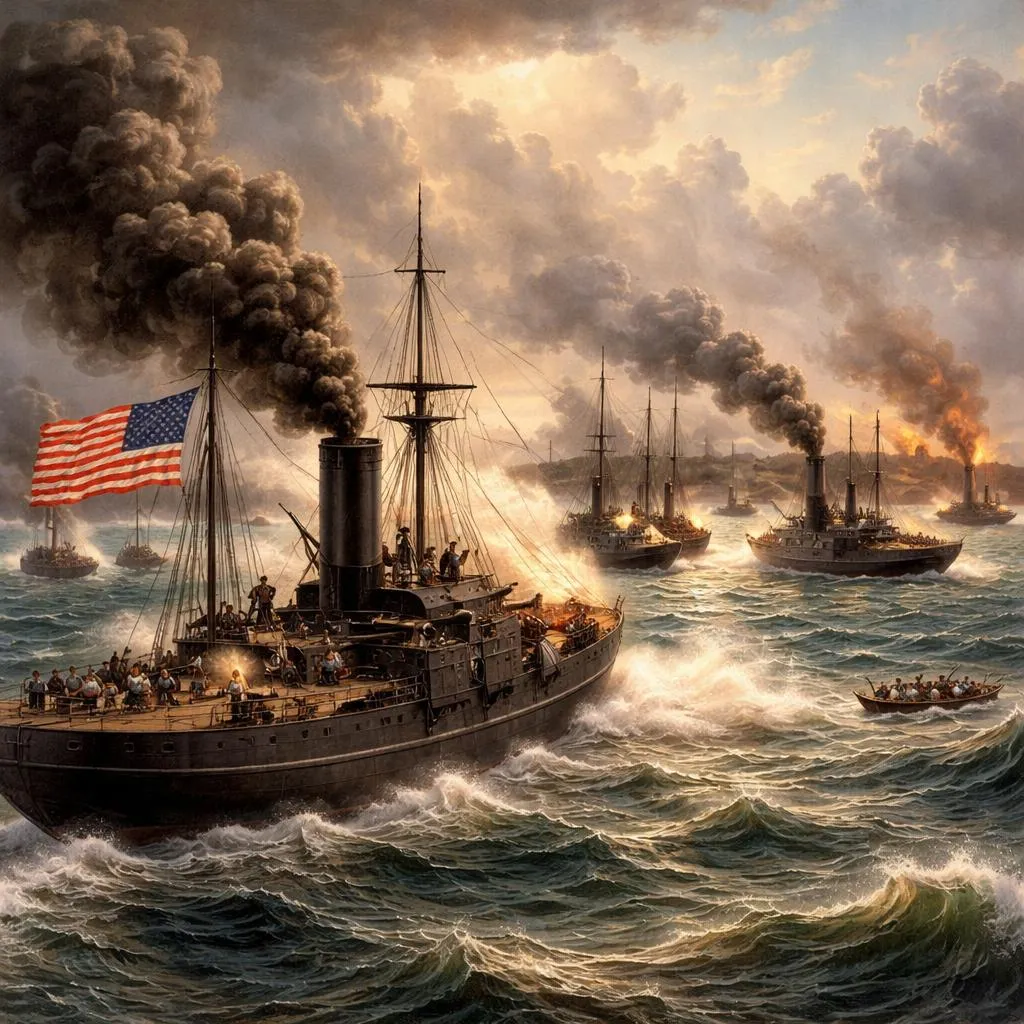

Having assured himself that the ship was fully up with Cape Henlopen, Christy retired to his cabin, and still “alone in his glory,” he broke the seal of the official envelope. He was to cruise outside of the blockaders, and report to the flag-officer when opportunity presented. Just then it was believed that Richmond, which received all its foreign supplies from Wilmington, could not long hold out if it was captured; and the Secretary of the Navy was giving special attention to the forts which protected it.
It was evident to the young commander that he was not to rust in inactivity, as had been the case of late off Mobile Bay, and a wide field of operations was open to him. His instructions were minute, but they did not confine his ship to the immediate vicinity of the mouth of the Cape Fear River. It was evident that the speed of the St. Regis had been an important factor in framing the secret orders.
If a blockade-runner eluded or outsailed the vessels of the fleet near the coast, the St. Regis was expected to “pick her up.” On the other hand, the fastest of the vessels were sent out farther from the shore, and the ship was expected to support them. Christy realized that he should be called upon to exercise his judgment in many difficult situations, and he could only hope that he should be equal to such occasions.
“Good-morning, Captain Passford,” said Paul Vapoor, saluting him on the quarter-deck. “I hope you slept well in your brief watch below.”
“I did not sleep a wink, I was so anxious to read my orders. But I know them now, and I feel as cool as an arctic iceberg. I shall sleep when I turn in again.”
“Well, where are we going, Captain, if it is no longer a secret?” asked the engineer.
“It is not a secret now; and we are to cruise off the mouth of the Cape Fear River,” replied the commander, as he proceeded to give the information more in detail.
“We are not likely to have any hot work then if we are only to chase blockade-runners,” added Paul.
“Probably we can render greater service to our country in this manner than in any other way, or we should not have been sent to this quarter,” said Christy, with a long gape.
Paul saw that his friend was sleepy, and he bade him good-night. The commander went to his stateroom, and was soon fast asleep, from which he did not wake till eight o’ clock in the morning. When he went on deck the ship was carrying all sail. The second lieutenant had the deck, and he asked him what speed the steamer was making.
“The last log showed seventeen knots an hour,” replied Mr. Makepeace.
“I hope you slept well, Captain Passford,” said the chief engineer, saluting him at this minute.
“I slept like a log till eight bells this morning,” replied Christy.
“Mr. Makepeace reports the last log at seventeen knots,” continued Paul. “But the ship is not making revolutions enough per hour for more than fifteen, for I have got the hang of her running now. The wind is blowing half a gale, and the canvas is giving her two knots.”
No events transpired on board worthy a special chronicle during the day. The men were drilled in various exercises, and gave excellent satisfaction to their officers. The next morning the St. Regis was off Cape Hatteras, and though it is a greater bugbear than it generally deserves, it gave the ship a taste of its quality. The wind had hauled around to the south-west, and was blowing a lively gale. The sails had been furled in the morning watch, and off the cape the course had been changed to south-west.
Just before eight bells in the afternoon watch, when the ship was making fifteen knots an hour, the lookout man on the top-gallant forecastle called out “Sail, ho!” and all eyes were directed ahead.
“Where away?” demanded the officer of the deck sharply.
“Close on the lee bow, sir!” returned the lookout.
The commander was in his cabin studying the chart of the coast of North Carolina; but the report was promptly sent to him, and he hastened on deck.
“Another sail on the port bow, sir!” shouted a seaman who had been sent to the fore cross trees with a spy-glass.
“What are they?” asked Christy, maintaining his dignity in spite of the excitement which had begun to invade his being.
“Both steamers, sir,” replied the officer of the deck.
“The head one is a blockade-runner, I know by the cut of her jib, sir,” shouted the man with the glass on the cross trees.
All the glasses on board were immediately directed to the two vessels. Christy could plainly make out the steamer that had the lead. She was a piratical-looking craft, setting very low in the water, with two smoke stacks, both raking at the same angle as her two masts. The wind was not fair, and she could not carry sail; but the “bone in her teeth” indicated that she was going through the water at great speed.
“A gun from the chaser, sir!” shouted the man aloft.
The cloud of smoke was seen, and the report of the gun reached the ears of all on board the St. Regis.
“There is no mistaking what all that means, Mr. Baskirk,” said Christy when he had taken in the situation.
At the first announcement of the sail ahead, the commander had ordered the chief engineer to get all the speed he could out of the ship. The smoke was pouring out of the smoke stacks, for the St. Regis had two, and presently she indicated what was going on in the fire room by beginning to shake a little.
“Another sail dead ahead, sir!” called the man on the fore cross trees.
The glasses were directed to the third sail, and she proved to be a steamer, also pursuing the one first seen. It was soon evident to the observers that the blockade-runner, for the man aloft who had so defined her was entirely correct, was gaining all the time on her pursuers. If she had nothing but her two pursuers to fear, her troubles were really over.
Both of the Federal ships were firing at the chase; but they might as well have spared their powder and shot, for they could not reach her into at least a quarter of a mile. The wind was still at the south-west, and already there were signs of fog. The rakish steamer had probably come from the Bermudas, where she must have obtained a skilful pilot, for without one she would have had no chances at all; and she stood boldly on her course as though she had nothing to fear on account of the navigation.
“What are we going to have for weather, Mr. Makepeace?” asked Christy, after a long look to windward.
“It looks a little nasty off towards the shore, sir,” replied the second lieutenant. “I should say it was going to be just what that pirate would like to have.”
“Why do you call her a pirate?” asked the commander with a smile. “Probably she is not armed.”
“I call her a pirate because she looks like one; but I think a blockade-runner is a hundred degrees better than a pirate; and our British friends plainly look upon them as doing a legitimate business. I rather think that highflyer will run into a fog before she gets to the shore.”
“She has nothing to fear from the two steamers that are chasing her,” added Christy. “We are to have a finger in this pie.”
“No doubt of that; and I hope we shall make a hole through her before she gets to the coast.”
“She is not more than a mile and a half from us now, and our midship gun is good for more than that; but I don’t think it is advisable to waste our strength in firing at her just yet.”
“That’s just my way of thinking,” said Mr. Makepeace, with something like enthusiasm in his manner; and he was evidently delighted to find that the commander knew what he was about, as he would have phrased it.
“The rakish steamer seems to be headed to the west south-west, and she is exactly south-east of us. We can see that she is sailing very fast; but how fast has not yet been demonstrated. How high should you rate her speed, Mr. Makepeace?”
“I should say, Captain Passford, that she was making eighteen knots an hour. She is kicking up a big fuss about it; and I’ll bet a long-nine cigar that she is doing her level best.”
“I don’t believe she is doing any better than that,” added Christy. “Make the course south south-west, Mr. Baskirk.”
“South south-west, sir,” replied the executive officer.
The course of the ship was changed, and Christy planked the deck from the quarter-deck to the forecastle in order to obtain the best view he could of the relative positions of the St. Regis, the chase, and the two steamers astern of her. The blockade-runner showed no colors; and no flag could have been of any service to her. She appeared still to be very confident that she was in no danger, evidently relying wholly upon her great speed to carry her through to her destination.
The “highflyer,” as the second lieutenant called her every time he alluded to the blockade-runner, and the two pursuers, occupied the three angles of a triangle. The latter were both sending needless cannon balls in the direction of the chase, but not one of them came anywhere near her.
On the other hand, the highflyer and the St. Regis formed two angles of another triangle, the third of which was the point where they would come together, if nothing occurred to derange their relative positions. By this time Paul Vapoor had developed all the power of the ship’s boilers, and the screw was making more revolutions a minute than her highest record, which was found in a book the former chief engineer had left in his stateroom.
“I don’t think that highflyer quite understands the situation, Mr. Baskirk,” said the commander, as he observed that she did not vary her course, and stood on to her destination, apparently with perfect confidence.
“I don’t think she does, sir,” replied the first lieutenant. “She can see the American flag at the peak, and she knows what we are. Doubtless she is making the mistake of believing that all the Federal ships are slow coaches.”
“Heave the log, Mr. Baskirk,” added Christy, and he walked forward.
It was a matter of angles when it was desirable to come down to a close calculation, and the young commander found his trigonometry very useful, and fortunately not forgotten. With an apparatus for taking ranges he had procured the bearing of the highflyer accurately as soon as the last course was given out, perhaps half an hour before. He took the range again, and found there was a slight difference, which was, however, enough to show that the form of the triangle had been disturbed.
Both ships were headed for the same point, and the sides of the triangle were equal at the first observation. Now the St. Regis’s side of the figure was perceptibly shorter than its opposite. This proved to the captain that his ship had gained on the other. The two chasers had been losing on the chase for the last half-hour, and Christy regarded them as out of the game.
There was some appearance of fog in the south-west, and no land could be seen in any direction. For another hour the St. Regis drove ahead furiously on her course, and the highflyer was doing the same. The two steamers, regardless of the speed of either, were necessarily approaching each other as long as they followed the two sides of the triangle. They had come within half a mile the one of the other, when the commander gave the order to beat to quarters. Ten minutes later the frame of the ship shook under the discharge of the big Parrot. The shot went over the chase; but she promptly changed her course to the southward.
Hintergrund und Einführung des Autors
Diese aufregende Seegeschichte spielt während des Amerikanischen Bürgerkriegs, einer Zeit, in der Seeblockaden eine entscheidende Rolle in dem Konflikt zwischen der Union und der Konföderation spielten. Die Geschichte folgt Captain Christy und seinem Schiff, der St. Regis, bei der Verfolgung eines Blockadebrechers – eines Schiffs, das versucht, an der Union-Marine vorbeizukommen, um die Konföderation mit Nachschub zu versorgen. Der Autor, der im späten 19. oder frühen 20. Jahrhundert schrieb, fängt die Spannung und Strategie der Seekriegsführung mit lebendigen Beschreibungen und detaillierten maritimen Kenntnissen ein.
Der Autor hatte wahrscheinlich ein starkes Interesse an Marinegeschichte und Kriegsführung und nutzte reale Orte wie Cape Henlopen, Cape Fear River und Cape Hatteras, um die Geschichte in der Realität zu verankern. Dies verleiht Authentizität und hilft den Lesern, sich die Herausforderungen vorzustellen, denen sich die Seeleute in dieser Zeit stellten.
Detaillierte Interpretation und Bedeutung
Im Kern geht es in dieser Geschichte um Mut, Führung und schnelles Denken angesichts der Gefahr. Captain Christy muss sein Wissen, sein Urteilsvermögen und die Geschwindigkeit seines Schiffes einsetzen, um den Blockadebrecher zu überlisten und seine Schiffskameraden zu unterstützen. Die Geschichte unterstreicht die Bedeutung von Teamwork, Strategie und Ruhe unter Druck.
Die Verfolgungsjagd und die Verwendung von Geometrie und Trigonometrie zur Berechnung von Positionen zeigen, wie Wissenschaft und Mathematik in realen Situationen angewendet werden können, sogar in der Kriegsführung. Die Geschichte befasst sich auch mit Themen wie Ausdauer und Entschlossenheit, da sowohl die Verfolger als auch der Blockadebrecher ihre Schiffe an die Grenzen bringen.
Lektionen und Erkenntnisse für Schüler
-
Führung und Verantwortung: Captain Christys Rolle zeigt, wie ein Anführer ruhig bleiben, fundierte Entscheidungen treffen und Vertrauen in sein Team wecken muss. Die Schüler können den Wert von Verantwortung und Gelassenheit in schwierigen Zeiten lernen.
-
Anwendung von Wissen: Die Verwendung von Karten, Berechnungen und das Verständnis der Mechanik des Schiffes lehrt die Bedeutung der Anwendung dessen, was man in der Schule lernt, auf praktische Situationen.
-
Teamwork und Kommunikation: Die koordinierten Bemühungen der Crew und die klare Kommunikation sind für den Erfolg unerlässlich. Dies ist eine Erinnerung daran, dass eine gute Zusammenarbeit mit anderen und der Informationsaustausch wichtige Fähigkeiten in jeder Gruppenaktivität oder jedem Projekt sind.
-
Ausdauer: Sowohl der Kapitän als auch der Blockadebrecher zeigen Entschlossenheit. Die Schüler können dazu inspiriert werden, es immer wieder zu versuchen und nicht aufzugeben, selbst wenn sie auf Hindernisse stoßen.
Wie man diese Lektionen im täglichen Leben anwendet
-
Im Lernen: Gehen Sie Ihre Studien wie Captain Christy seine Mission an – bereiten Sie sich gut vor, nutzen Sie Ihr Wissen kreativ und bleiben Sie konzentriert, auch wenn es schwierig wird.
-
In sozialen Situationen: Üben Sie klare Kommunikation und Teamwork. Ob bei der Arbeit an einem Gruppenprojekt oder bei der Lösung von Konflikten, ruhig und kooperativ zu sein, hilft allen, erfolgreich zu sein.
-
In der persönlichen Entwicklung: Entwickeln Sie Ausdauer, indem Sie sich Ziele setzen und Schwierigkeiten überwinden. Denken Sie daran, dass Herausforderungen Gelegenheiten sind, zu lernen und stärker zu werden.
Positive Eigenschaften aus der Geschichte kultivieren
-
Mut: Nehmen Sie Herausforderungen mutig an, auch wenn Sie sich unsicher fühlen.
-
Urteilsvermögen: Denken Sie sorgfältig nach, bevor Sie handeln, sammeln Sie Informationen und berücksichtigen Sie die Konsequenzen.
-
Verantwortung: Seien Sie zuverlässig und bereit, die Verantwortung zu übernehmen, wenn es nötig ist.
-
Neugier und Lernen: Wie Captain Christy, der Trigonometrie verwendet, versuchen Sie immer, neue Fähigkeiten zu erlernen, die Ihnen auf unerwartete Weise helfen können.
Durch das Lesen von Geschichten wie dieser genießen junge Leser nicht nur aufregende Abenteuer, sondern gewinnen auch wertvolle Einblicke in Geschichte, Führung und persönliche Entwicklung. Diese Geschichte ermutigt die Schüler, nachdenklich, mutig und beharrlich zu sein – Eigenschaften, die ihnen im Leben gute Dienste leisten werden.
