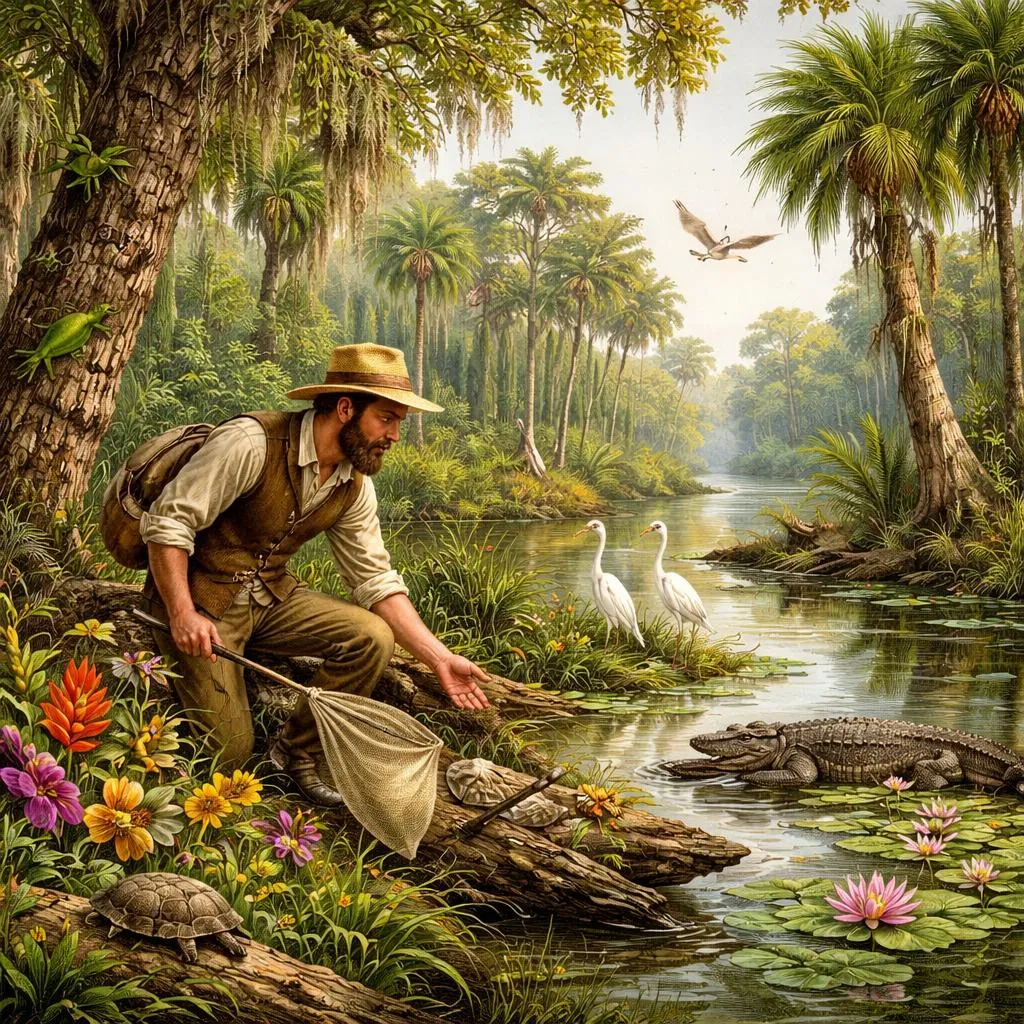

The trip across Florida, from the Atlantic Ocean to the Gulf of Mexico, is made by railroad. Rising with the birds and eating an early breakfast, a ten minutes walk takes us to the depot, which is about a mile from the hotels. There is no commotion or hustling, no noise of many hackmen nor crowding of passengers, neither any difficulty in finding a seat; a single car is sufficient to accommodate the few persons that have occasion to travel. Of the small number, probably one-half will stop at stations by the way; the principal business of the road is the transportation of freight, and were it not for the extensive business in the forwarding of merchandize, consisting of cotton, rosin, sugar, lumber, etc., on account of the steamship connections which form, together with this road, a through line from New Orleans to New York, by which much time is saved compared with the other routes, it would, doubtless, prove unprofitable to its proprietors.
The ride from the Ocean to the Gulf of Mexico absorbs nearly a day, for it will be supper time when we reach Way Key. The landscape is exceedingly monotonous, and the journey somewhat tiresome; nevertheless, it affords an opportunity for observation, and a very fair idea of the general character of the country can be obtained. There are no pretty villages with neat houses and bright garden patches to please the eye; a few shabby towns are passed through, or stopped at for a moment to discharge freight or to allow a brace of passengers to get off or on. Away from the sad looking villages, an isolated cabin or a cluster of huts occupied by tar and rosin makers are passed by. The forest scenery has neither tropical beauty nor the grandeur of the pineries of Maine, Michigan or California, which so impresses the beholder; the prevailing timber is the Pinus palustris, or pitch-pine; the trees are not above medium size and stand many paces apart; hundreds may be seen whose sides are defaced by the rough scars or notches made by the ruthless axes of the pitch gatherers, and some trees have many of these wounds. At one place there is an extensive establishment for the distillation of the spirits of turpentine, which employs several persons; at other points saw-mills may be seen. The products of the pines are the prime fountain of revenue to the inhabitants of the neighborhood for many miles along the line of the railway.
Here, as elsewhere within the territory of the United States, the pine tree and not the palm, contributes wholly, or in part, to the maintenance of large communities, and although the palms, by their fruits, furnish the chief subsistence for a large portion of the inhabitants of the torrid zone, and entire tribes of men in the valley of the Orinoco live for several months in the year on their fruits, yet it is undoubtedly true that a much greater proportion of the population of the globe are indirectly supplied with their daily food through the generous bounty of the pines than by any other of the forest tribes; yet, perhaps, the voluptuous beauty of the palms has inspired the poetic muse more frequently than the sedate bearing and sturdy merits of the noble pines; the Artocarpus incisa is no more the "tree of bread" to the naked natives of the South Sea Islands, than is the pine tree to a greater number of civilized and refined people. But each is glorious in its way!
The sallow and sickly faces of many of the people hint strongly of fever and ague. The small size of the cattle shows that the country is overstocked, or that the pasturage is limited and poor; the milk used in the so called hotels is the condensed milk from the North; the butter is imported, and the beef is stringy and dry; most of the corn used, at least in this part of the state, is brought from abroad, and the country does not produce the wheat that the people consume. Few fruit trees are seen from the car windows; an occasional orange or peach tree is therefore noticed. We are informed that this is not a fruit region, but that in the vicinity of the St. John's River, and in that part of the state, the orchards are large and numerous.
The stranger is impressed by the general flatness of the country; nothing like an embankment or an excavation upon the line of the road can be seen. The surface is never more than very slightly undulating, and is covered with sand, except in such places as are wet or swampy. After a rain every depression becomes a pool or lake, to be in time absorbed by the sand or evaporated by the sun; as the elevation of the land is but little above the sea, the process of draining the surface by the sinking of the water must be exceedingly slow. The topography may be better understood, perhaps, when we consider that South Florida is but a succession of beaches piled up by the sea, a superstructure of shore debris resting upon ancient coral reefs. This is confirmed by the outcroppings of the old reefs, that, projecting from the ground, are visible at various points by the side of the road. In addition to the accumulation of sands portions of the state have undoubtedly been, and perhaps are still being gradually elevated.
Agassiz estimates that not "less than seventy thousand years have elapsed since the coral reefs already known to exist in Florida began to grow." What the area of the state may be seven hundred centuries hence we can only conjecture. The same agencies are still in active operation. It will, probably, extend much farther in a southerly direction, and the southern part of the state will be greatly widened toward the west. Those insignificant (so far as size is considered) but persistent workers, the reef-building masons, the Astroeans, the Meandrinas and the Porites, are cooperative workers at the present time as during the centuries that have passed. Deep in the sea the foundations of future reefs are being laid, upon which the more ornamental coral-workers, the Madrepores, will attach their snow-white shrubbery, fringing the surfaces and edges with beautiful forms, an elaborate and graceful finish to otherwise substantial structures.
The few tree Palmettos or Cabbage-palms (Chamoerops palmetto) that we have already met, indicate that we are approaching the Gulf; as we move along the number increases, and numerous fine specimens are seen.
Here the road runs through wet and swampy ground, with lagoons and stagnant water upon the right and left. The sun bade us "good night" nearly an hour ago, and objects not distant are indistinct in the dusk of the twilight. Presently the train moves more slowly, and looking out we see the twinkling of lights; like a boy travelling in a lonesome place the locomotive whistles, but with the vim of a thousand fifers, and then comes to a halt. Out we get into the darkness and look around; sand is under our feet, and a scanty show of vegetation, principally coarse wiry marsh grass, is about us, and the air is chilly. With a benediction upon the inventor of overcoats, we wrap ourselves closely, and realize that a fireside would be more comfortable than the open air; so with a negro for a guide we start for a public house, to await the dawning of another day before farther spying out the pride or nakedness of the land.
Way Key is one of a group of islands known as Cedar Keys; it is of small size, irregular outline, and for the most part sandy and low, though in some places marshy and wet. Here, as at Fernandina, the railroad company have made extensive improvements, by the erection of a large freight-house, and a substantial wharf for the accomodation of steamers that touch here en route to and from New Orleans, Key West and Havana.
The town consists of a few buildings, not remarkable either for architecture or workmanship, and the hotels are a practical joke upon the traveller. From the end of the railroad wharf, the disciple of Izaak Walton can enjoy his favorite pastime by catching trout, which are plenty, and fine fat oysters abound in the neighborhood. Were it not for the fishes and oysters the fare at the taverns would be wretchedly mean.
The scenery, as viewed from the long wharf, is attractive; other islands of the group being quite near. The "old town," as it is called, is much better located, in point of elevation, than the recent one. It is built upon an island directly opposite from the principal wharf, and presents a pleasant appearance; beyond is the lighthouse, situated upon an eminence on Sea-horse Key. Sea-horses are, probably, the only horses in or about Cedar Keys, for at Way Key the sole beast of burden, at the time of our visit, was a poor cow, which, harnessed into a dray, was forced to do the hauling for the place. What a commentary upon the progressiveness and business enterprise of a community! Our regard for the sex made us indignant at beholding the degredation of the patient brute.
At the south end of Way Key there is a group of mounds of unusual size and elevation; the largest and most southerly presents an abrupt face to the beach, having been partially dug away. Its height, as seen from this point, cannot be far from twenty-five feet; it was, probably, before being disturbed, not less than thirty feet; but this, as well as others of the group was, like the larger mound near Fernandina, used for military purposes during the recent war. The aggregate thickness of the shell strata with the intercalated seams of ashes, upon the southerly side of the principal mound, and directly facing the sea, is about twenty feet, and composed principally of the valves of Oysters (Ostrea Virginica), while on the north side of the same mound the shell deposit is somewhat less in thickness, and largely composed of the valves of Scallops (Pecten dislocatus?). But it must not be understood that the above are the only species of shells found here, for numerous specimens of the mammoth Fasciolaria (F. gigantea), and others of the same family are represented. Large shells of Busycon perversum, and fragments of Quahaug valves (Mercenaria Mortoni Conrad), are quite abundant. Without a farther enumeration of the species contained in this, the largest of the Way Key mounds, we will hastily glance at others near by. Just north of the above is the second in point of size, but the shell deposit, composed of the same species, is not as thick or deep, while at the north-east is a third mound of exceedingly regular form, also composed of shells; this latter has not been materially defaced, though a house of considerable size has been erected upon its summit. Between the two largest mounds, and connecting them, is a piece of flat or slightly uneven ground, which was used apparently for burial purposes, for here can be obtained human remains undoubtedly aboriginal. During the war this island was the asylum for deserters and refugees, and the yellow fever and cholera carried off great numbers. They were buried carelessly, and the unmarked graves are scattered over the higher land of the Key.
In examining this part of the island, which is covered with various forms of shrubbery, the visitor frequently stumbles over the hidden resting-place of some poor victim of pestilential disease. A few trees may be seen here and there growing out of the sides or summits of the mounds; the latter are so crossed and defaced by the embankments, ditches and rifle-pits, that it is difficult or impossible to define their original forms and proportions. Before leaving this extensive and interesting cluster of mounds, we ascended to the highest point to obtain a view of the surrounding scenery. Immediately below, and but a few yards from the base of the elevation, a sloping shelly beach runs gradually down beneath the placid waters of the Gulf; the white sail of a boat, hardly moving in the bland and gentle breeze, and the whiter wings of the circling gulls, with islands near and distant, a cloudless sky, and a bright sunshine, combined to form a scene of quiet and dreamy beauty. Not far from the mounds is a mill, where the soft cedar is sawed into blocks of convenient size for the use of the manufacturers of lead pencils, and in the neighborhood are rude shanties, cabins and houses, that, viewed with the trees and mounds and water, furnish pretty sketches for the drawing-book.
Not many species of shells can be found upon the beach, though much of interest may be dredged in the deeper water of the channel a few hundred yards from the shore. Upon an old wreck, reached at low tide by means of a boat, a species of Murex (M. rufus) may be collected, and the very common Littorina (L. irrorata) may be gathered in quantities, sticking to the marsh grass just above the mud.
The steamer from New Orleans that is to carry us farther South having unexpectedly arrived, we were prevented from making an examination of the adjoining islands, or as thorough an investigation of the mounds as their importance demanded. Early in the afternoon we were "all aboard," and soon after the hawsers were cast loose and the steamer was under way; slowly feeling the course through a crooked and insufficient channel an hour passed away before we were in water deep enough to admit of greater speed. The water is so shallow that vessels are compelled to keep a long distance from shore, and the land being flat, but little can be seen from the deck. The mildness of the temperature, the clear sky and smooth sea, made it a delightful trip; and we shall ever remember with pleasure the down voyage from Cedar Keys to Tampa Bay.
Hintergrund und Einführung des Autors
Diese lebendige Erzählung beschreibt eine Reise durch Florida mit der Eisenbahn und fängt die Naturlandschaft, die lokalen Industrien und die kleinen Gemeinden ein, denen man unterwegs begegnet. Der Text stammt wahrscheinlich aus einem Reisebericht oder einer Naturforscherbeschreibung aus dem 19. Jahrhundert und spiegelt detaillierte Beobachtungen der Umwelt und der Gesellschaft in dieser Zeit wider. Der Stil des Autors ist beschreibend und informativ und zielt darauf ab, den Lesern ein klares Bild der Geografie, der Wirtschaft und der Kultur der Region zu vermitteln.
Detaillierte Interpretation und Bedeutung
Die Geschichte bietet mehr als nur ein Reisetagebuch; sie dient als Fenster in das historische und ökologische Gefüge Floridas in einer Zeit des Wandels und der Entwicklung. Die Eisenbahnreise symbolisiert Fortschritt und Konnektivität, verbindet entfernte Orte und erleichtert den Handel. Doch der Autor hebt auch die Herausforderungen hervor, mit denen die Region konfrontiert war: geringe Bevölkerungsdichte, begrenzte Landwirtschaft und die Härte der natürlichen Umwelt.
Die detaillierten Beschreibungen der Kiefernwälder, der Korallenriffe und der Muschelhügel offenbaren eine intime Kenntnis der Naturgeschichte des Landes. Die Erwähnung der wirtschaftlichen Bedeutung der Kiefer steht im Gegensatz zum romantisierten Bild der Palmen und zeigt eine praktische Perspektive auf die Rolle der Natur für das Überleben des Menschen. Die Muschelhügel und Begräbnisstätten deuten auf die tiefe Menschheitsgeschichte und die Anwesenheit der indigenen Völker hin und verbinden die Vergangenheit mit der Gegenwart.
Lektionen und Erkenntnisse für Schüler
-
Beobachtungsfähigkeiten: Die sorgfältige Detailgenauigkeit des Autors lehrt die Schüler den Wert, ihre Umgebung genau zu beobachten. Ob in der Natur oder im täglichen Leben, das Wahrnehmen kleiner Details kann zu einem tieferen Verständnis der Welt führen.
-
Wertschätzung der Natur: Der Text fördert den Respekt vor den natürlichen Ressourcen und das Bewusstsein für das ökologische Gleichgewicht. Die Schüler können etwas über verschiedene Ökosysteme wie Kiefernwälder und Korallenriffe und ihre Bedeutung für menschliche Gemeinschaften lernen.
-
Historisches Bewusstsein: Die Geschichte gibt einen Einblick in die Vergangenheit und lädt die Schüler ein, darüber nachzudenken, wie sich Orte und Gesellschaften im Laufe der Zeit verändern. Das Verständnis der Geschichte hilft, einen Kontext für aktuelle Ereignisse und Herausforderungen zu schaffen.
-
Kritisches Denken: Die Überlegungen des Autors zu wirtschaftlichen Aktivitäten wie der Holzindustrie und dem Transport regen die Schüler an, über die Beziehung zwischen Umwelt, Wirtschaft und Gesellschaft nachzudenken.
Anwendung dieser Lektionen in Leben und Lernen
-
In der Schule: Die Schüler können das beschreibende Schreiben üben, indem sie ihre eigene Umgebung beobachten und Details lebendig festhalten, so wie es der Autor tut. Sie können auch die lokale Geschichte und Geografie erforschen, um das Wissen aus dem Klassenzimmer mit realen Orten zu verbinden.
-
In sozialen Umgebungen: Die Betonung der Geschichte auf das Verständnis verschiedener Gemeinschaften und ihrer Lebensweisen kann Empathie und kulturelles Bewusstsein unter den Schülern fördern und ihnen helfen, die Vielfalt zu schätzen.
-
Persönliches Wachstum: Die Reflexion der Erzählung über Fortschritt und Herausforderungen kann Widerstandsfähigkeit und Anpassungsfähigkeit wecken. Die Schüler lernen, dass menschliche Anstrengung und Zusammenarbeit zu Verbesserungen führen können, auch wenn die Umwelt und die Umstände schwierig sind.
Förderung positiver Werte und Verhaltensweisen
-
Neugier und Lernen: Ermutigen Sie die Schüler, neugierig auf die Welt um sie herum zu sein, Fragen zu stellen und Wissen über Lehrbücher hinaus zu suchen.
-
Respekt vor der Natur: Fördern Sie die Umweltverantwortung, indem Sie den Schülern nachhaltige Praktiken und die Bedeutung des Schutzes natürlicher Lebensräume vermitteln.
-
Historischer Respekt: Helfen Sie den Schülern, das Erbe der indigenen Völker und vergangener Generationen zu würdigen und den Respekt vor verschiedenen Kulturen und Geschichten zu fördern.
-
Ausdauer: Verwenden Sie die Darstellung der Geschichte von kleinen Gemeinschaften, die trotz Schwierigkeiten überleben und hart arbeiten, um den Wert von Ausdauer und Gemeinschaftsunterstützung zu vermitteln.
Schlussfolgerung
Diese Erzählung ist eine reichhaltige Ressource für Schüler, um Geografie, Geschichte, Ökologie und menschliche Erfahrung zu erforschen. Durch die Auseinandersetzung mit dem Text können junge Leser Beobachtungsfähigkeiten, kritisches Denken und eine tiefere Wertschätzung für die Vernetzung von Natur und Gesellschaft entwickeln. Indem sie über die Reise und ihre Lehren nachdenken, werden die Schüler ermutigt, nachdenkliche, informierte und verantwortungsbewusste Individuen in ihren eigenen Gemeinschaften zu werden.
