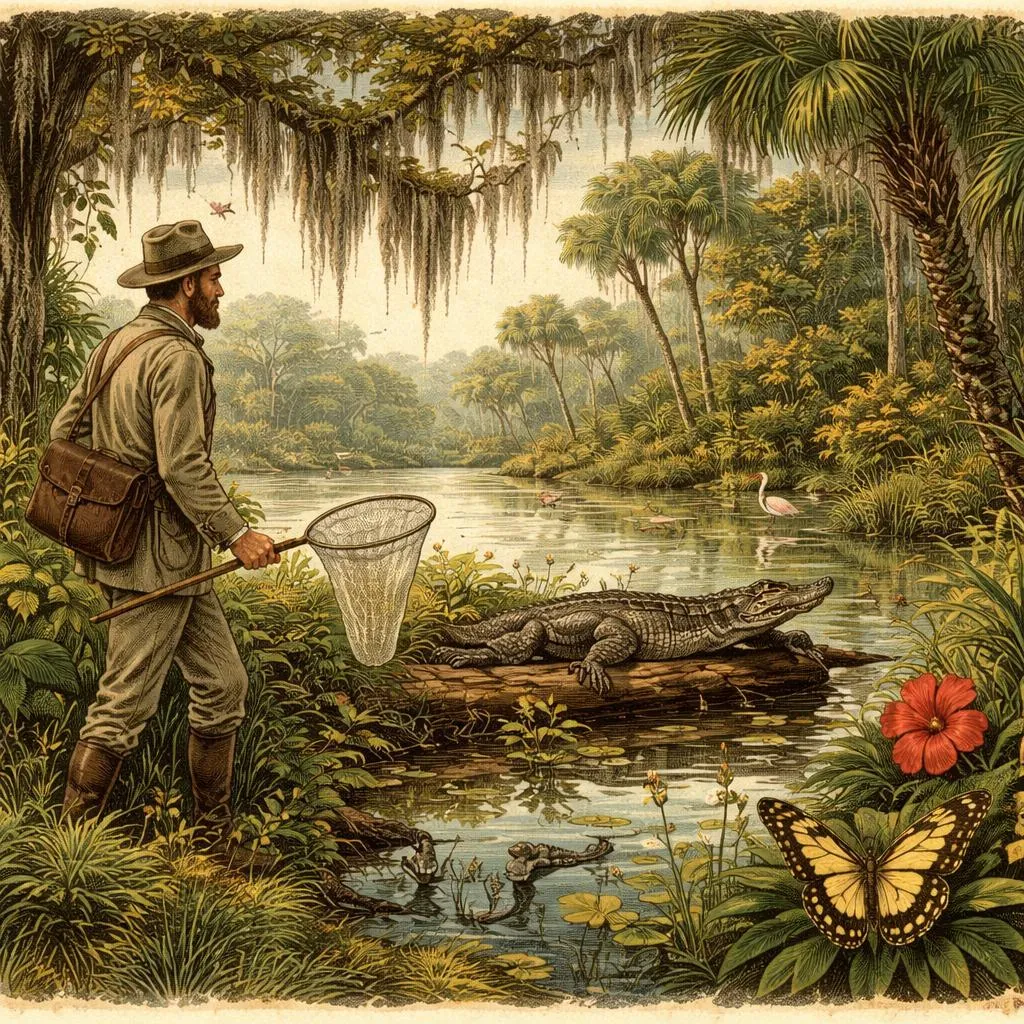

From Cedar Keys to Egmont Key is eighty-five miles. The latter is situated at the mouth of Tampa Bay, and is forty miles from the town of Tampa; upon it is a light-house whose friendly flame shone far across the waters of the Gulf as we steamed along in the early gray of the morning. We had arranged to land at Egmont, wind and wave permitting, as it is good working ground for the naturalist; but a rough sea compelled a change of plan, and we kept on for Tampa.
Tampa Bay is divided at its upper portion, or head, into two smaller bays, one known as Old Tampa Bay, from the town of "Old Tampa," the other as Hillsborough Bay, which receives a river of the same name. It is upon the southerly bank of the latter that the new or present town of Tampa is located. A very narrow and crooked channel and an insufficient depth of water prevent vessels, excepting very small craft, from reaching the wharves, consequently the steamer was anchored some four miles below the place. Viewed from the deck the scenery is attractive, though the shores, as elsewhere, are quite low. As you face the town upon the left hand, and half a mile off, is Ballast Point, an ancient reef; upon the right are islands and the mainland in the distance; in front the military post of Fort Brooke, with its new buildings half-hidden by the sturdy old oaks (Quercus virens), whose stalwart limbs are decked with robes of the long Spanish moss, which hang motionless in the quiet air, or flutter like tattered battle-flags when moved by a passing breeze. The post is built upon a sloping lawn whose margin is washed by the waters of the bay; in front of the trees is the parade ground, in the centre stands a symmetrical flag-staff, from the top of which, far aloft, floats the national flag.
There is some little commotion in getting ashore, for everybody and everything have to be transferred to lighters and small vessels; at the time a transient shower was passing and the warm rain caused an unpleasant stickiness. It was soon over however, and we saw our packages placed safely in a four-ton sloop, and seated ourselves upon the top of the cargo like statues upon a pedestal. The lines were "let go," and after beating in a light wind the sloop was at the wharf by noon.
When a steamer arrives the vent is published by a certain number of strokes on the Court House bell; hence the crowd at the wharf. Friends met us as soon as we landed, and with their assistance we found an unoccupied house and an unemployed Negro; the former was at once hired for a camp, the latter for a commissary and quartermaster. In two hours after landing we were "at rights" and housekeeping. Elated with this wonderful dispatch, in the fullness of our joy we thought the millennium not more than "two blocks off," and rashly named our quarters "Camp Delight;" but we had unwisely crowed before we were out of the woods, as will presently be seen.
The population of Tampa is variously stated at from eight hundred to one thousand (people), of all sizes and colors; but this does not include the million (of fleas) that nightly met in mass-meeting at Camp Delight, and compelled us, both in sorrow and in anger, to change the name to Camp Misery. The fleas of California, the black-flies of the Lake Superior swamps, the mosquitoes of the Ohio Valley, all of these we had met on their own ground and never winced, but the fleas of Tampa proved invincible. We thought of the saying of a German poet, "God made the world, but the devil made the flea."
The appearance of the town creates a favorable impression, for it is well planned, the streets being wide and regular and the buildings comely; many of the streets and yards are ornamented with trees; in some of the latter the bananas were just shooting up new leaves to replace those that were cut down at Christmas time by an unusual and severe frost. A large specimen of the American aloe (Agave Americana) standing in the Post Office yard perished from the same cause, though a rosebush near it was loaded with red flowers. Many of the orange trees were full of fruit, which was ruined by the fatal blast, and bushels were rotting on the ground. In some sheltered spots or warm places on the shore of Old Tampa Bay they were untouched, and we had many a feast upon the golden fruit from that neighborhood. The Florida oranges we consider superior to the Mediterranean, Mexican or Tahitian; they are of large size, good color and fine flavor. The Shaddock (Citrus decumana) also grows in the vicinity of Tampa, and very fine specimens of the fruit were purchased by us at the stores. It is extensively cultivated in the West Indies, and many people prefer it to the orange; it is slightly bitter, and the juice, a mild acid, is cooling and healthful. It is called Grape Fruit by the Floridians. Not far from our camp is a grove consisting principally of pines of the species Pinus palustris, also called the pitch-pine, and long-leaved pine, and P. toeda, known as the loblolly pine, and many may be seen in the streets and elsewhere about the town; they sometimes attain a height of one hundred feet, but we have as yet seen none that exceeded seventy feet. The Chamoerops serrulata, or Saw Palmetto, here, as everywhere in South Florida, grows luxuriantly in the sandy soil, and just outside of the town it seems to have crowded out all other shrubbery.
Without enumerating the many botanical forms that are met with in this section of the country, a few of the prominent species worthy of mention are the Sweet Bay (Magnolia glauca Linn.), which grows to the height of twenty feet, with highly perfumed flowers and shining leaves (an isolated colony of this species sheds its fragrance on the colder air of the north, being found in the vicinity of Gloucester, Mass.); the Southern Buckthorn (Frangula Caroliniana Walt.), a species of Hawthorn; the Catalpa, or Indian-bean; also the Persea Carolinensis, or Alligator pear, sometimes called the Red Bay.
The banks of the Hillsborough River at the water's edge are muddy, with a growth of tall coarse grass. The bivalve shell, Cyrena Carolinensis, may here be obtained; also the pretty little river snail, Neritina reclivata. From the wharves, at the proper tide, many fish are caught, principally Sheep's-head (Sargus) and Mullet (Mugil), both of which are good eating. The supply, however, is quite irregular, and the market therefore cannot be depended upon. Oysters (O. Virginica) of excellent quality abound in the bay, and can usually be purchased from boats at the wharf. During a portion of the period of our stay at Tampa the market was well supplied with venison (Cervus Virginianus) of good quality, thanks to the energy and skill of a one-armed hunter residing a few miles away. The hens of Florida deserve favorable mention, if not a diploma, for their daily dividends were too important to be forgotten.
Stalking along the muddy margin of the stream may frequently be seen the Blue Heron (Florida coerulea Baird), and the White Heron (Herodias egretta Gray). There is a California species that much resembles this last. The White or Whooping Crane (Ardea herodias Linn.), and the Egrets (Demigretti Pealii Baird) with white plumage, and another (D. rufa Baird) of a reddish color, are found in this part of the state around the shores of the bay and gulf. Many others of the long or stilt-legged bipeds, of the feathered tribes belonging to the Grallatores, or waders, are met with when rambling through the marshes or exploring the bends, inlets or sloughs of the river, or are seen by us from the boat while rowing up or down the stream. With a scoop net rigged with a long pole, an important and at many times an indispensable implement for the collector, we dipped up from the bed of the stream a small white bivalve shell (Tellina), and a single dead specimen of the fresh-water Mussel, Unio Jewettii Lea. The Floridian Unios have much lighter shells than most of the species found in the tributaries of the Ohio and Mississippi Rivers. The once famous British pearls were obtained from a species of Unio (U. margaritiferus) found in the mountain streams of Great Britain, and the fishery was continued till the end of the last century in Scotland, where the mussels (Unios) were obtained in the River Tay by the peasantry previous to harvest time. The British pearl fishery has long ceased to be remunerative.
The fresh-water mussels must be exceedingly scarce in this vicinity, and in fact for many miles on the western side of Florida, for we found none living nor a fragment in any of the mounds and shell-heaps that we examined. The Portuguese and Spanish narrators of the expedition of DeSoto have given absurd accounts of the quantities of pearls in the possession of the natives. It is highly probable that the Indians inhabiting Georgia and Alabama, at the time of and prior to the invasion of DeSoto, lived in part upon the animals of the various species of Unio found in the rivers of those states, for "heaps of mussel shells are to be seen on our river banks wherever Indians used to live."
It may be that the Indians referred to collected the shells solely for the purpose of procuring the pearls; yet the proportion of shells containing pearls is so small that when, as mentioned in the text, "the Portuguese narrator says they obtained fourteen bushels of pearls" from a certain sepulcher, and as can be found at another place in the text that a common foot soldier, whose name is given as Juan Terron, had "a linen bag in which were six pounds of pearls;" and elsewhere, that everybody, Spanish and Indian had pearls, and "as large as filberts;" either the sources from whence the old historians derived their information were unreliable, or the Unios which are probably as abundant in the rivers as heretofore, have, to a very great extent, ceased to manufacture these much valued concretions. The latter case is hardly supposable. Perhaps one shell in a hundred might yield a pearl, of which not one in a hundred would be either clear or of perfect form, and not one in many thousands would be as large as a filbert.
Between Camp Misery and the river, in wet or springy places upon the under side of pieces of boards or chips, many snails (Helix volvoxis Pareyss) can be collected, and the Coffee-shell (Melampus caffea) is close at hand. It is also found in the West Indies. Just outside of the fence that encloses the reservation of Fort Brooke, to the south, is a good place for obtaining Glandina truncata, a species of snail with a shell of a pink color, sometimes three inches long. It looks much like one that is found in Nicaragua (G. rosea). The Glandinas are carnivorous, and our Floridian is a cannibal, and eats without either hesitation or remorse the smaller snail, Helix volvoxis. The eggs of Glandina are of a whitish color, and about the size of a very small pea; it lives in moist grassy places, and a few boards that were on the ground at the locality referred to made an excellent trap; the Glandinas prefer the shade, and in order to protect themselves from the heat of the sun, hid themselves under the boards, which we frequently turned over, always capturing some. Upon one occasion, in addition to several Glandinas, two specimens of a beautiful lizard rewarded our search.
We had heard at sundry times marvelous stories of numberless snakes of diverse species, and of assorted sizes, that lay in wait to swallow, crush or poison unsophisticated strangers. These fearful tales led us to keep a sharp lookout when on the tramp. Either the snakes snuffed danger from afar and "hunted their holes," or else they are scarce, as we failed to secure a specimen, though two or three were seen. We concluded that our informants had in some way deceived their eyes by using the fusil oil, which hereabouts is sold for whiskey, one dram of which would cause the drinker to see not only snakes but an entire menagerie. From the time when the serpent made mischief for the human race through the beguilement of its original mother, down to the present day, the snake family have had a bad reputation, and stories illustrating their wickedness, however preposterous, are readily believed.
Near the town, and in the immediate vicinity of the spot where Glandinas "most do congregate," stands an ancient mound, in shape a flattened hemisphere, with the plane side down. Its position is such as to furnish a delightful out-look upon the bay and a fine view of the surrounding scenery. It is not of large size, being only one hundred and sixty paces in circumference and fifteen feet high; it was formerly more nearly semicircular in perpendicular outline, as the rains of centuries have washed it off at the summit, thus reducing the elevation, and consequently increasing the circumference of the base.
The mound was covered with grass, and many stately trees are near it whose graceful proportions form, by contrast with the general flatness of the ground, a conspicuous and charming feature in the landscape. From the investigations made by our party it was undoubtedly devoted to burial purposes, and but few shells were used in its construction. Six species of the common marine shells of the neighborhood were collected; also stone implements, and pieces of crumbling bones,--portions of the skeletons of men. This mound may have been the "artificial eminence near the shore," upon which stood the dwelling of the cacique, Hirrihigua, who bravely opposed the adventurous but cruel Pamphilo de Narvaez in his expedition to Florida, in the year 1528; and the meager remnants of a human form whose sepulcher we had rudely violated, may have belonged to the outraged and vindictive chief, who, stung by the remembrance of his wrongs, replied to the overtures of DeSoto with words of scorn.
Hintergrund und Einführung des Autors
Diese lebendige Erzählung stammt aus einem detaillierten Reise- und Naturkundebuch über Florida im 19. Jahrhundert, einer Zeit, in der ein Großteil des amerikanischen Südens noch wild und voller Geheimnisse war. Der Autor, wahrscheinlich ein Naturforscher oder Entdecker, kombiniert wissenschaftliche Beobachtung mit Erzählkunst und zeichnet so ein lebendiges Bild der Landschaft, Flora, Fauna und der frühen Siedlungen rund um Tampa Bay. Solche Berichte waren im 19. Jahrhundert üblich, als Entdecker neue Gebiete und ihre Naturwunder für ein Publikum dokumentierten, das begierig darauf war, mehr über ferne Orte zu erfahren. Der Schreibstil spiegelt sowohl Neugier als auch Pioniergeist wider und verbindet sachliche Beschreibungen mit persönlichen Erfahrungen.
Detaillierte Interpretation und Bedeutung
Der Text dient sowohl als Reisetagebuch als auch als Journal eines Naturforschers und bietet den Lesern einen Einblick in eine Welt, die vielen damals unbekannt war. Er erforscht die Geografie der Tampa Bay, die Herausforderungen des Reisens, die einheimische Tierwelt und die frühen menschlichen Siedlungen, einschließlich indianischer Grabhügel. Die Beobachtungen des Autors über die natürliche Umgebung – Bäume, Pflanzen, Vögel und Wasserlebewesen – unterstreichen den Reichtum und die Vielfalt des Ökosystems Floridas. Darüber hinaus verbindet die Erwähnung historischer Persönlichkeiten wie des Kaziken Hirrihigua und des spanischen Entdeckers Pamphilo de Narvaez Naturgeschichte mit Menschheitsgeschichte und erinnert die Leser daran, dass jeder Ort Geschichten von Menschen hat, die lebten, kämpften und seine Vergangenheit prägten.
Die Erzählung berührt auch die Härten, mit denen Siedler und Reisende konfrontiert waren, wie z. B. die unerbittlichen Flöhe in "Camp Misery", was der Geschichte ein menschliches und nachvollziehbares Element hinzufügt. Diese Mischung aus Staunen und Kampf spiegelt die Realität der Erforschung und Besiedlung neuer Länder wider.
Lektionen und Erkenntnisse für Schüler
-
Neugier und Beobachtung: Die detaillierten Notizen des Autors ermutigen die Schüler, ihre Umgebung sorgfältig zu beobachten und die natürliche Welt zu schätzen. Zu lernen, Details wahrzunehmen – sei es in der Natur, in der Geschichte oder im täglichen Leben – kann das Verständnis vertiefen und die Neugier wecken.
-
Respekt vor der Natur: Die Beschreibungen von Pflanzen, Tieren und Ökosystemen lehren den Respekt vor der Artenvielfalt und die Bedeutung des Schutzes natürlicher Lebensräume.
-
Historisches Bewusstsein: Indem sie natürliche Merkmale mit historischen Ereignissen und Persönlichkeiten verbinden, lernen die Schüler, dass Geschichte sie umgibt, oft versteckt in der Landschaft oder in lokalen Geschichten.
-
Widerstandsfähigkeit und Anpassung: Die Geschichte von "Camp Misery" zeigt, dass Herausforderungen Teil jedes Abenteuers oder jeder neuen Erfahrung sind. Die Schüler können lernen, Schwierigkeiten mit Geduld und Humor zu begegnen und sich an Situationen anzupassen, anstatt aufzugeben.
-
Kulturelle Sensibilität: Die Erwähnung indianischer Grabhügel lädt dazu ein, über den Respekt vor anderen Kulturen und ihren Geschichten nachzudenken und zu verstehen, dass Orte eine tiefere Bedeutung haben, als man sieht.
Anwendungen im Leben, im Lernen und in sozialen Umgebungen
-
Im Lernen: Die Schüler können den Ansatz des Autors anwenden, indem sie Journale über ihre eigenen Beobachtungen führen, sei es in den Naturwissenschaften, der Literatur oder den Sozialkunde. Diese Übung schärft das kritische Denken und die Schreibfähigkeiten.
-
Im sozialen Leben: Die Themen der Geschichte über Zusammenarbeit und Hilfe – wie z. B. Freunde, die den Reisenden helfen, eine Unterkunft zu finden – unterstreichen den Wert von Gemeinschaft und Teamwork.
-
In der persönlichen Entwicklung: Die Übernahme des Geistes der Erkundung ermutigt die Schüler, ihre Komfortzonen zu verlassen, neue Dinge auszuprobieren und sowohl aus Erfolgen als auch aus Rückschlägen zu lernen.
Positive Eigenschaften aus der Geschichte kultivieren
-
Neugier: Ermutigen Sie dazu, Fragen zu stellen und Wissen über die Welt zu suchen.
-
Geduld: Verstehen Sie, dass es einige Zeit dauert, bis einige Herausforderungen bewältigt sind, wie z. B. der Umgang mit Flöhen oder die Navigation in schwierigen Gewässern.
-
Respekt: Für Natur, Geschichte und andere Kulturen, Förderung von Empathie und Aufgeschlossenheit.
-
Widerstandsfähigkeit: Trotz Schwierigkeiten weitermachen und Humor und Kreativität zur Bewältigung einsetzen.
-
Beobachtung: Entwickeln Sie die Liebe zum Detail, die in allen Studienbereichen und im Leben wertvoll ist.
Durch das Lesen und Nachdenken über diese Erzählung erlangen die Schüler nicht nur Wissen über einen bestimmten Ort und eine bestimmte Zeit, sondern auch zeitlose Lektionen über Erkundung, Respekt und Ausdauer, die sie in ihr eigenes Leben mitnehmen können.
