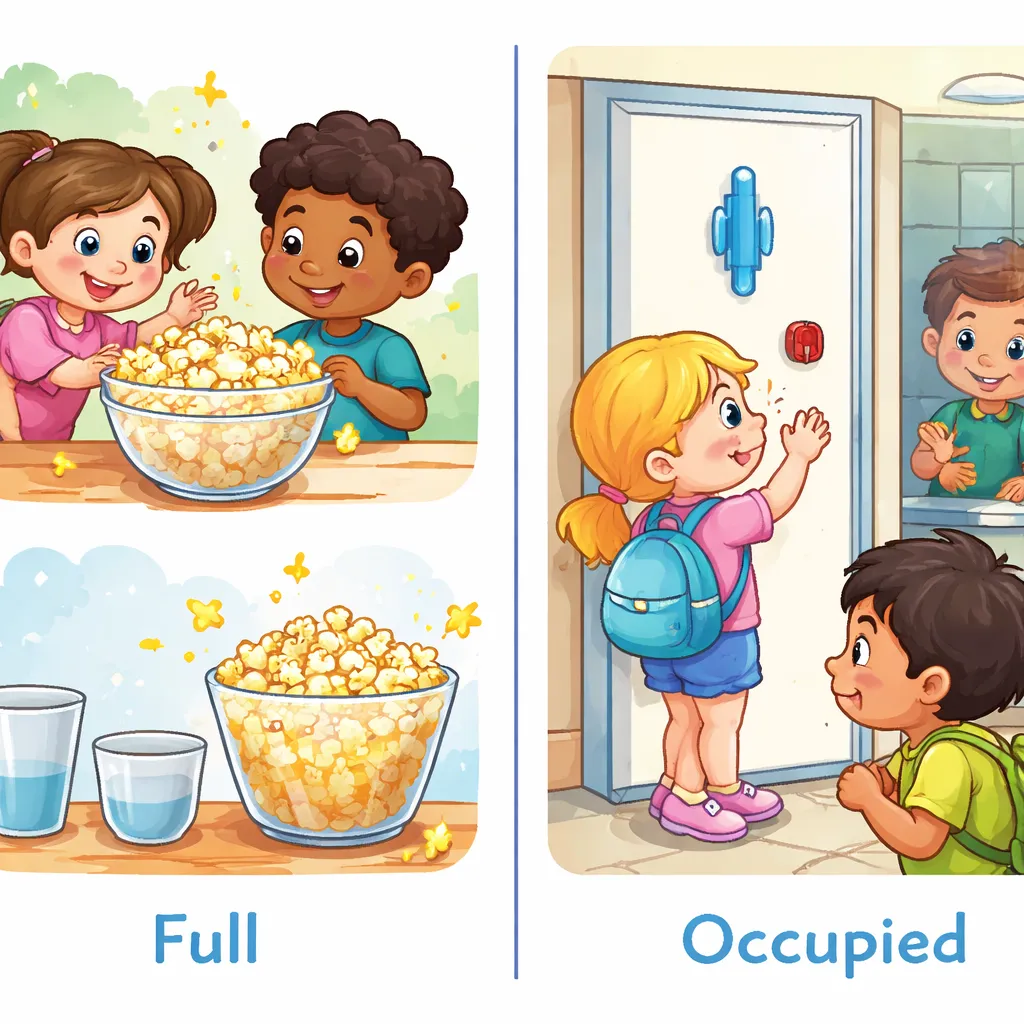

Are Similar Words Really Interchangeable?
Children often meet word pairs that look similar in meaning. At first, they may think these words can always replace each other.
“Full and occupied” both suggest that something is not available or has no free space. However, they are not always interchangeable. Each word has its own role in English.
“Full” usually describes capacity. “Occupied” often describes use or activity. When children learn this difference, they improve both speaking and understanding.
This topic helps learners move from simple vocabulary to more accurate communication. It also builds confidence in real-life English situations.
Set 1: full vs occupied — Which One Is More Common?
“Full” is more common in daily English. Children hear it early in learning. It appears in simple and familiar situations.
Examples include:
The glass is full. The room is full. My plate is full.
“Occupied” is less common in early conversation. It often appears in signs or formal speech.
Examples include:
The bathroom is occupied. The seat is occupied. The room is occupied.
Because “full” appears more often in daily life, children usually learn it first. “Occupied” comes later as vocabulary becomes more advanced.
Set 2: full vs occupied — Same Meaning, Different Contexts
Both words suggest that something is not available, but the reason is different.
“Full” describes quantity or space. It means something cannot hold more.
Examples:
A full bottle A full box A full cup
“Occupied” describes use. It means someone or something is already using the space.
Examples:
A hotel room is occupied A restroom is occupied A desk is occupied
This difference helps children understand context. One focuses on space. The other focuses on activity or presence.
Set 3: full vs occupied — Which Word Is “Bigger” or More Emphatic?
“Full” is simple and direct. It describes a complete amount. There is no space left.
It feels visual and easy to imagine. Children can picture a glass filled to the top.
“Occupied” feels more formal and structured. It suggests an active situation. Someone is already using the space.
For example:
A full bus means no seats left. An occupied seat means someone is sitting there.
“Occupied” often carries more social meaning. It tells us about people and usage, not just space.
Set 4: full vs occupied — Concrete vs Abstract
“Full” is concrete. Children can see it, touch it, and measure it.
Examples include:
A full backpack A full jar A full bowl
These are easy for children to understand because they are physical objects.
“Occupied” is more abstract. It describes a situation rather than an object.
Examples include:
A meeting room is occupied A parking space is occupied A phone line is occupied
Children must imagine activity or presence. This makes “occupied” slightly more advanced in thinking.
Set 5: full vs occupied — Verb or Noun? First Understand the Role
“Full” and “occupied” are both adjectives. They describe nouns.
However, “full” is more flexible in everyday language. It can also appear in expressions like “fill up” (verb form related).
Examples:
Please fill the bottle. The glass is full.
“Occupied” does not change form easily. It stays as an adjective in most cases.
Examples:
The room is occupied. The seat is occupied.
This difference helps children avoid confusion when forming sentences.
Set 6: full vs occupied — American English vs British English
Both words are used in American and British English. Their meanings stay consistent across regions.
However, usage patterns differ slightly.
In American English, “occupied” is often seen in public signs, such as restrooms or hotel rooms.
In British English, the same pattern appears, but “full” is still more common in casual speech.
Examples across both regions:
“Room full” (informal description) “Room occupied” (formal notice)
Children learning global English benefit from knowing both words, as they appear in books, signs, and daily speech worldwide.
Set 7: full vs occupied — Which Fits Formal Situations?
“Full” is informal and neutral. It fits everyday conversation and simple description.
Examples:
The basket is full. My schedule is full.
“Occupied” is more formal. It often appears in official or public contexts.
Examples:
The office is occupied. The facility is occupied at the moment.
Children can learn to adjust language based on situation. This skill is important for real-world communication.
Set 8: full vs occupied — Which One Is Easier for Kids to Remember?
“Full” is easier for children. It is short, visual, and connected to everyday life.
Children see full cups, full plates, and full bags every day. This makes learning natural.
“Occupied” is harder because it is less visual and more abstract. It also appears less frequently in early learning.
To help children remember “occupied,” parents can use real-life examples:
A toilet sign saying “occupied” A busy seat on a bus A reserved table in a restaurant
These experiences help children connect meaning to context.
Mini Exercise: Can You Spot the Differences Between These Words?
Try these simple questions with children.
Choose the correct word:
The bottle is (full / occupied). The seat is (full / occupied). My backpack is (full / occupied). The restroom is (full / occupied). The bus is (full / occupied).
Suggested answers:
full occupied full occupied full
You can also ask children to create their own examples. This builds confidence and memory.
Parent Tips: How to Help Kids Learn and Remember Similar Words
Parents can make vocabulary learning easier through small daily habits.
First, use real objects at home. Show a full cup or a full container. Ask children to describe it.
Second, point out public signs. When you see “occupied,” explain its meaning in simple words.
Third, encourage comparison. Ask children: “Is this full or occupied?” This helps them think critically.
Fourth, use repetition in natural conversation. The more children hear words, the easier they remember them.
Finally, stay patient and positive. Learning comes step by step.
With practice, children will understand not only “full and occupied,” but also many other word pairs in English. This builds a strong foundation for reading, speaking, and real communication.