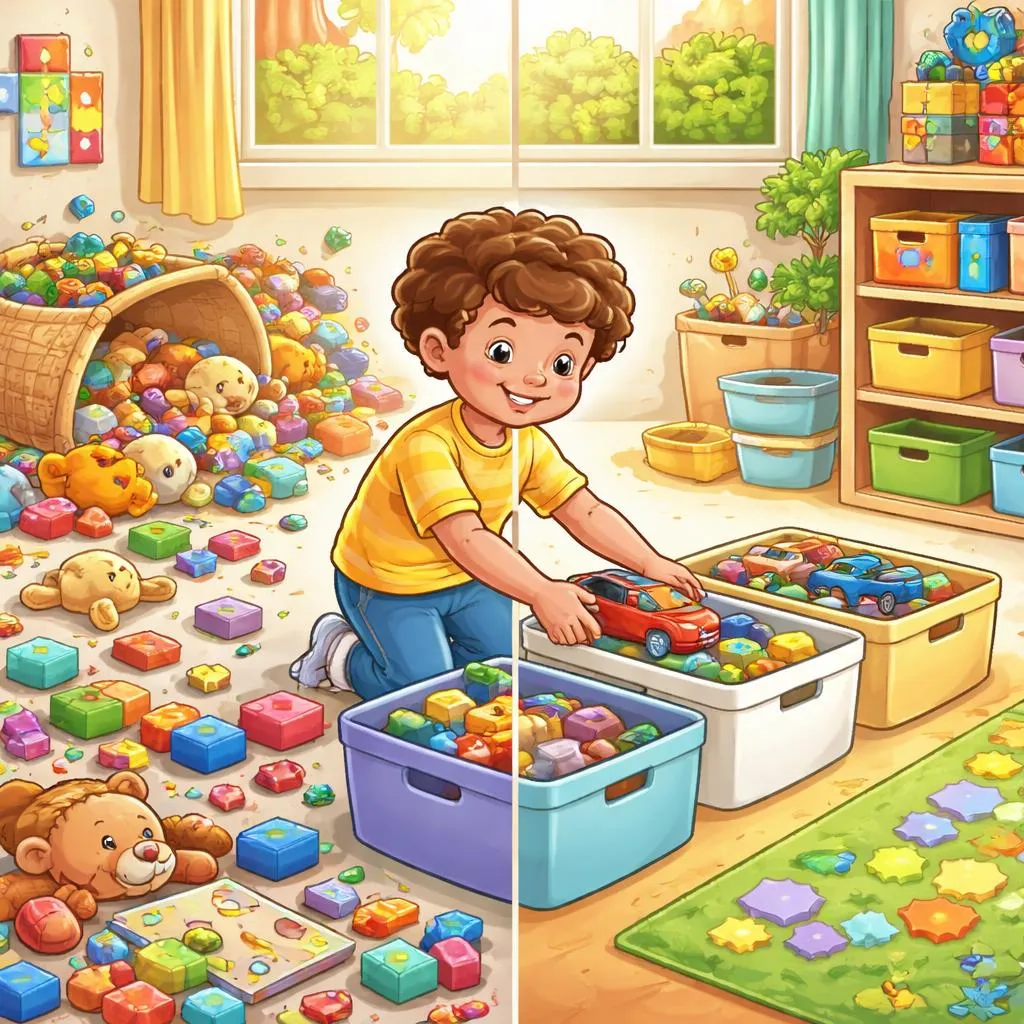

Every child faces chaos. A messy room. A noisy classroom. A busy morning. English gives us a powerful family of words for understanding how to create peace. The root is “order.” From this root come three more words. “Orderly” describes a calm, organized state. “Ordering” names the act of arranging things. “Disorder” names the opposite: chaos and mess. These four words help children organize their spaces and their minds. They also help children understand why routines matter. Let us explore this calming family.
What Does “Same Word, Different Forms” Mean? One idea takes different word shapes. “Order” can be a noun. Place your books in order by size. “Order” can be a verb. Please order your toys from big to small. “Orderly” is the adjective. An orderly line moves faster. “Ordering” is the noun for the action. The ordering of the closet took an hour. “Disorder” is the noun for chaos. Disorder in the kitchen makes cooking hard. Your child sees this pattern in other words. “Sort” becomes “sorter.” “Arrange” becomes “arrangement.” “Order” gives us even more structure.
Personal Pronouns Change Their Form Pronouns shift shape too. “I” becomes “me.” “She” becomes “her.” “We” becomes “us.” This shows that English changes words for grammar. Our word family “order” changes for grammar as well. But it also changes for meaning. A noun names a state or action. A verb shows action. An adjective describes. Learning these roles helps your child talk about organization clearly.
From Noun to Verb to Adjective – One Family, Many Words “Order” is a noun. Keep your desk in order. “Order” is a verb. Order the cards by number. “Orderly” is the adjective. An orderly room helps you focus. “Ordering” is the action noun. Ordering your day saves time. “Disorder” is the noun for mess. Disorder stresses people out. This family gives your child five tools for creating calm. One root. Five ways to fight chaos.
One Root, Many Roles – How Words Grow from Calm to Chaos Let us follow an order story. A child’s room shows disorder everywhere. Toys on the floor. Clothes on the chair. The child decides to restore order. The child works in an orderly way: one pile for toys, one for clothes. The child practices ordering by color and size. Soon the room has no more disorder. See how “order” runs through all four sentences. Each form adds a new layer. Your child can say “There is too much disorder.” “I will bring order.” “I will work in an orderly way.” “Ordering my toys is satisfying.” One root tells a whole story of transformation.
Same Meaning, Different Jobs – Is It a Verb or a Noun? How does your child know the job? Look at the sentence position. As a subject or object, use the noun “order.” Example: “Order makes life easier.” After “please” or “will,” use the verb “order.” Example: “Please order the crayons by color.” Before a noun or after “be,” use “orderly.” Example: “She has an orderly backpack.” As a subject or object, use the action noun “ordering.” Example: “Ordering takes patience.” As a subject or object, use the noun “disorder.” Example: “Disorder leads to lost items.” Endings give clues. “Order” is noun or verb. “-ly” signals an adjective. “-ing” signals an action noun. “Dis-” signals the opposite.
Adjectives and Adverbs – When Do We Add -ly? From “orderly” we can make the adverb “orderlily.” This word is very rare. From “ordered” we can make “orderedly.” That is also rare. Focus first on “order,” “orderly,” “ordering,” and “disorder.” Teach the “-ly” rule briefly. Most adjectives become adverbs with “-ly.” “Quick” becomes “quickly.” “Orderly” already ends with “-ly.” It is an adjective. The adverb would be “orderlily,” which is awkward. So English uses phrases like “in an orderly way” instead. That is fine. Some word families focus on adjectives and nouns without common adverbs.
Watch Out for Tricky Spelling Changes (Double Letters, y to i, and More) “Order” has no double letters. No silent letters. When we add “-ly” to make “orderly,” keep the “r.” No change. “Order” + “ly” = “orderly.” When we add “-ing” to make “ordering,” keep the “r.” No change. “Order” + “ing” = “ordering.” When we add “dis-” to make “disorder,” keep the “order.” “Dis” + “order” = “disorder.” No spelling changes in this family. That is very helpful. The only challenge is remembering that “orderly” has an “e” after the “r”? Yes. “Order” then “ly.” Not “ordely.” Keep the “e.” Also note that “disorder” has one “s” in “dis” and one “s” in “order”? No. “Dis” has one “s.” “Order” has no “s.” So “disorder” has only the one “s” from “dis.”
Let’s Practice – Can You Choose the Right Form? Try these simple sentences with your child.
Put your shoes in (order / disorder) by the door. (Answer: order)
An (order / orderly) classroom helps everyone learn. (Answer: orderly)
(Ordering / Disorder) your backpack each night saves morning time. (Answer: Ordering)
The toy room was in complete (order / disorder). (Answer: disorder)
Please (order / orderly) the books from tallest to shortest. (Answer: order)
Make your own sentences from daily life. Say “Let us bring order to this room.” Say “An orderly line moves faster.” Say “Ordering your clothes makes dressing easier.” Say “Disorder makes it hard to find things.”
Tips for Parents – Help Your Child Learn Word Families in a Fun Way Practice ordering together. Sort toys by size. Line up shoes by color. Arrange books by height. Use the words. Say “Let’s bring order to this shelf.” Say “An orderly closet is easier to use.” Say “Ordering takes patience.” Say “Look at this disorder! Let us fix it.” This hands-on learning builds organization and vocabulary.
Play the orderly game. Set a timer for five minutes. Say “Let’s make this room orderly.” Race to put things in order. Say “Order has returned!” Say “You worked in an orderly way.” Say “Ordering your space feels good.” This game builds speed and calm.
Read books about organizing and routines. Many children’s books show characters learning to sort and arrange. Pause during reading. Ask “Is this room in order or disorder?” Ask “Is the character acting in an orderly way?” Ask “What ordering system does the character use?” Ask “How does disorder affect the character?” These questions build executive function skills.
Create a family “order” chart. List daily ordering tasks. “Order your backpack.” “Order the dishes in the rack.” “Order the shoes by the door.” Check them off. Say “Order makes mornings easier.” “Orderly people find things faster.” “You are a master of ordering.” “Disorder has no place here!” This builds habits and vocabulary.
Use “disorder” to name frustration. When your child feels overwhelmed by a mess, say “I see disorder. Let us make a plan.” When feelings are messy, say “Your emotions are in disorder. Let us sort them.” This builds emotional regulation.
Distinguish “order” as command vs. arrangement. “A police officer gave an order” (command). “The books are in order” (arrangement). This builds contextual understanding.
Now you have a complete guide. Bring order to your spaces. Act in an orderly way. Practice ordering every day. Notice when disorder creeps in. This word family does more than teach English. It teaches that calm follows order. It teaches that small ordering acts create big peace. It teaches that every child can be a chaos-fighter. Keep ordering. Keep growing together. One word family at a time.