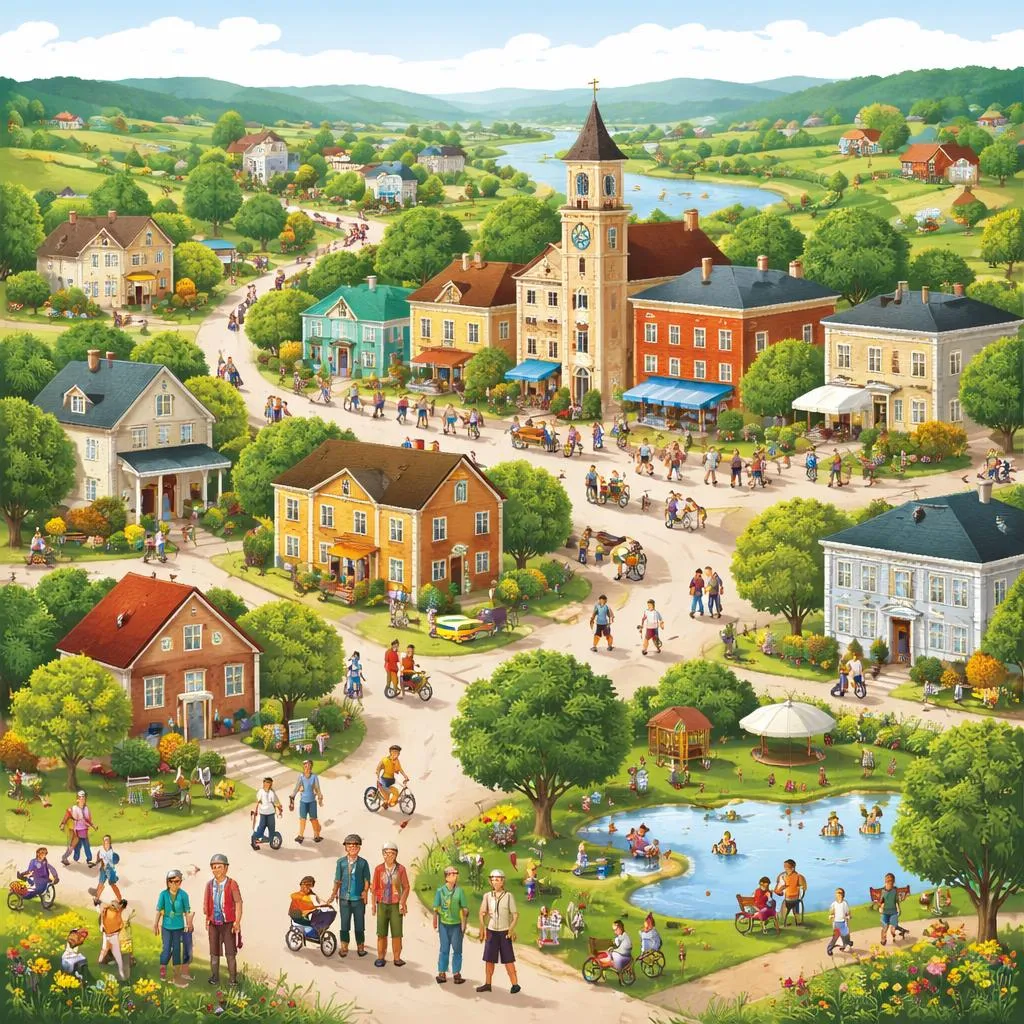

A town is smaller than a city. Townsfolk are the people who live there. The words “town, townsfolk, township, downtown” all come from one family. Each word talks about a community or its people. But each one has a different job in a sentence. Learning this family helps children understand where they live. Let us explore these four words together.
What Does “Same Word, Different Forms” Mean? One core idea can grow into many word shapes. The meaning stays the same at the heart. But the word changes its ending or combines for a new role. For example, “town” is a noun. “Townsfolk” is a noun. “Township” is a noun. “Downtown” is a noun or an adjective. Knowing these four forms helps a child talk about communities and government.
Personal Pronouns Change Their Form Pronouns change from “he” to “him” or “his”. Our word family changes by adding suffixes and compounds. Think of “town” as the core place. “Townsfolk” combines town with folk to name the people. “Township” adds -ship to name a form of government. “Downtown” combines down with town to name the center. Each form answers a simple question. What place? Town. Who lives there? Townsfolk. What is the governing area? Township. What is the central area? Downtown.
From Verb to Noun to Adjective to Adverb – One Family, Many Words This family has nouns and an adjective. Let us start with the noun “town”. Noun: Our town has one traffic light. “Town” means a place with homes and streets, smaller than a city.
Next is the noun “townsfolk”. Noun: The townsfolk gathered for the festival. “Townsfolk” means the people who live in a town.
Then the noun “township”. Noun: The township board meets every Tuesday. “Township” means a unit of local government.
Finally the word “downtown”. Noun: Let us go downtown to the library. “Downtown” means the main business center of a town. “Downtown” can also be an adjective. Adjective: We ate at a downtown restaurant. This family has no verb or adverb form.
One Root, Many Roles – How Words Grow from Actions to Qualities The Old English word “tun” meant an enclosure or farmstead. From this root, we built a family about small communities. “Town” kept the main noun meaning. Combining “town” with “folk” made “townsfolk” (the people). Adding -ship made “township” (the governing area). Combining “down” with “town” made “downtown” (the lower or central part). Children can see the same pattern in other families. For example, “village, villagers, village (no ship), downtown (not used with village)”. Learning compounds helps kids describe their neighborhood.
Same Meaning, Different Jobs – Is It a Verb or a Noun? Look at each word’s job carefully. “Town” is a noun. Example: I grew up in a small town.
“Townsfolk” is a noun. Example: The townsfolk helped rebuild the church.
“Township” is a noun. Example: The township provides garbage collection.
“Downtown” is a noun or an adjective. Noun example: Downtown is busy on weekends. Adjective example: The downtown area has many shops. Each form has a clear job. Only “downtown” has two roles.
Adjectives and Adverbs – When Do We Add -ly? This family has no common adverb form. We do not say “townly” or “townsfolkly”. Use other words to describe locations. Example: The town is quaint. For young learners, focus on the difference between “town” and “downtown.” A simple reminder: “Town is the whole place. Downtown is the busy center.”
Watch Out for Tricky Spelling Changes (Double Letters, y to i, and More) “Town” has no double letters. Combine with “folk” to make “townsfolk”. Town + folk = townsfolk (no changes). Add -ship to make “township”. Town + ship = township (no changes). Combine with “down” to make “downtown”. Down + town = downtown (no changes). A common mistake is writing “town” as “toun” (like tour). Say “Town has a w, like down and crown.” Another mistake is “townsfolk” spelled “townsfolk” (correct) but some write “townfolks” (with s). Townsfolk is already plural. No extra s needed. Another mistake is “township” spelled “township” (correct) but some write “townshop”. Say “Township has ship, like friendship.” Another mistake is “downtown” written as “down town” as two words. “Downtown” as one word is correct.
Let’s Practice – Can You Choose the Right Form? Try these sentences with your child. Read each one aloud. Pick the correct word from the family.
Our ______ has a beautiful park in the center. Answer: town (noun)
The ______ gathered to celebrate the holiday. Answer: townsfolk (noun)
The ______ board decided to build a new school. Answer: township (noun)
Let us go ______ to see a movie at the big theater. Answer: downtown (noun)
My ______ is so small that everyone knows each other. Answer: town (noun)
The ______ of Maplewood includes several small towns. Answer: township (noun)
The ______ welcomed the new family with a potluck dinner. Answer: townsfolk (noun)
We ate at a ______ pizza place last night. Answer: downtown (adjective)
A ______ meeting was held at the fire station. Answer: township (noun)
The ______ of this area are very friendly. Answer: townsfolk (noun)
After the practice, ask your child one question. Is this word a place, the people, a governing area, or the central area? That simple question teaches grammar through community.
Tips for Parents – Help Your Child Learn Word Families in a Fun Way Use a map to teach “town”. Point to your town. Say “This is our town.”
Use a parade to teach “townsfolk”. Say “The townsfolk wave flags in the parade.”
Use a local government building to teach “township”. Say “The township office handles our recycling.”
Use a drive to teach “downtown”. Say “Let us drive downtown to the bookstore.”
Play “fill in the blank” during car rides. Say “Our ______ has two schools.” (town) Say “The ______ voted for a new park bench.” (townsfolk) Say “The ______ supervisor gave a speech.” (township) Say “We parked ______ near the fountain.” (downtown - noun)
Read a story about a small community. Ask “Who helps in the town?” Ask “What happens downtown?”
Turn a drawing activity into a word lesson. Draw a collection of houses. Label “town”. Draw stick figures holding hands. Label “townsfolk”. Draw a building with a flag. Label “township hall”. Draw tall buildings and shops. Label “downtown”.
When your child makes a mistake, stay calm. If they say “Let us go to the town center, township,” say “Almost. Let us go downtown. Township is the government area.” If they say “The townfolk is nice,” say “Yes. Or townsfolk. It is already plural. The townsfolk are nice.”
Write the four words on sticky notes. Put them on a map of your town. Each time you pass a landmark, point to the words.
Remember that every town is special. Use these words to build local pride. “We are the townsfolk. We take care of our town.” Soon your child will know their town name. They will understand that townsfolk help each other. They will learn that a township makes rules. And they will love going downtown for ice cream. That is the community power of learning one small word family together.