
Meaning
Pronouns replace nouns in sentences.
Teachers explain that pronouns help avoid repeating names. They make speech smoother and more natural.
For example: “Tom is a boy. He is my friend.” “He” replaces “Tom.”
This concept builds clear sentence structure. Pronouns appear in daily speaking and writing.
Teachers introduce pronouns early in grammar learning. They connect language with people, objects, and places.
Conjugation
Pronouns do not change like verbs. But pronouns change form depending on sentence roles.
Teachers explain subject and object forms. “I” changes to “me.” “He” changes to “him.”
This idea helps learners understand sentence positions. Teachers model short sentences with clear patterns.
“I see her.” “She sees me.”
These pairs show how pronouns shift in context.
Present tense
Pronouns appear with present tense verbs.
“I am happy.” “You are here.” “He plays soccer.” “She reads books.” “It is a dog.” “We learn English.” “They like music.”
Teachers repeat patterns with simple verbs. Pronouns connect with verb agreement in present tense.
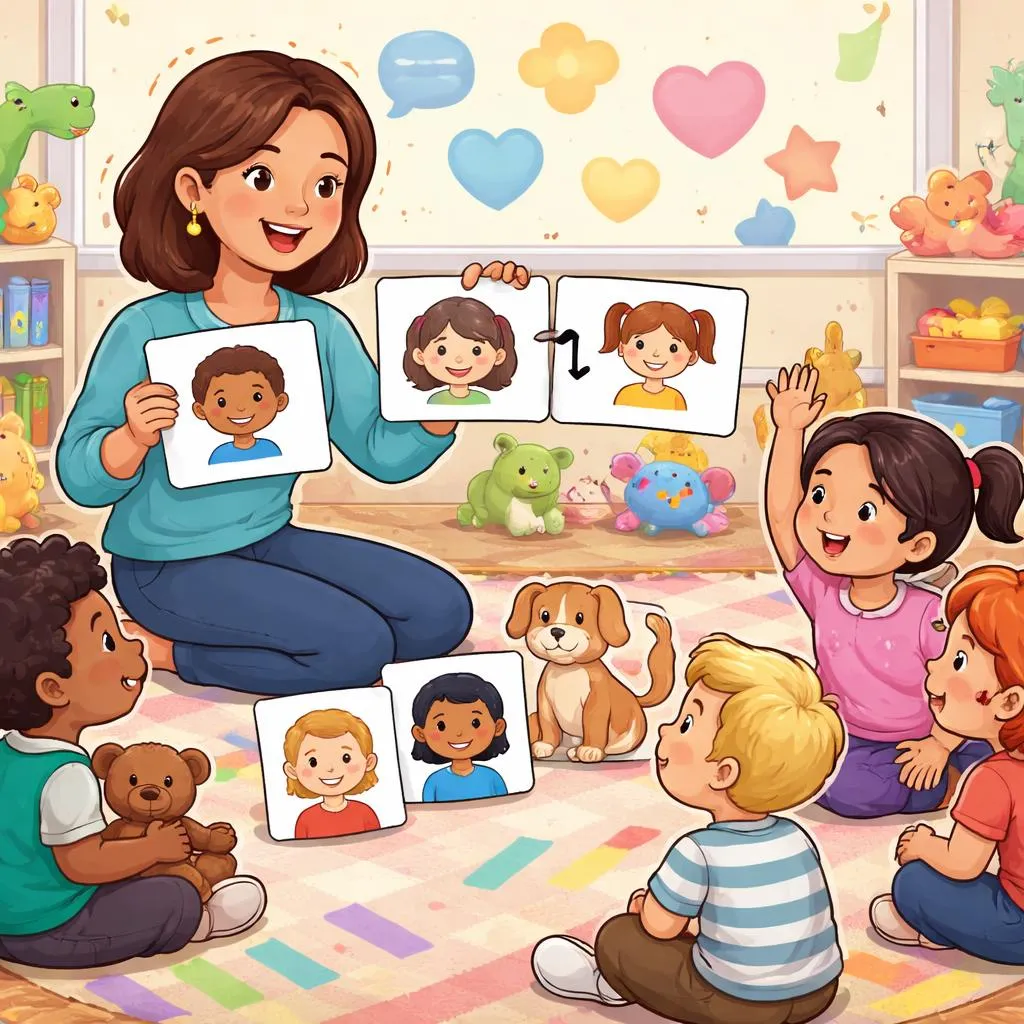
Teachers highlight subject pronouns with visual cues. Pictures and gestures help connect meaning and form.
Past tense
Pronouns stay the same in past tense sentences. Only verbs change.
“I was at school.” “He played basketball.” “They watched a movie.”
Teachers explain that pronouns stay stable. This reduces confusion during tense learning.
Short sentences reinforce structure and meaning. Repetition supports confidence in grammar usage.
Future tense
Future tense uses pronouns with will or going to.
“I will study.” “She will visit the library.” “They are going to play.”
Teachers show that pronouns guide who does the action. Future tense planning activities help reinforce usage.
Classroom examples connect grammar with real routines.
Questions
Pronouns appear in questions.
“Who is he?” “Where are they?” “Do you like apples?”
Teachers model question forms with pronouns. Learners repeat and practice in guided speaking tasks.
Yes and no questions build conversational confidence. Wh-questions build descriptive and interactive skills.
Other uses
Pronouns include possessive and reflexive forms.
“My book is blue.” “That is her bag.” “He sees himself in the mirror.”
Teachers explain that possessive pronouns show ownership. Reflexive pronouns show the subject and object are the same.
Pronouns also appear in stories and songs. They connect characters and actions clearly.
Teachers integrate pronouns with storytelling activities.
Learning tips
Teachers use visual charts to display pronoun forms. Color coding helps distinguish subject and object forms.
Short chants help memorize pronoun patterns. “I, you, he, she, it, we, they” becomes a rhythm activity.
Teachers encourage sentence frames. “I like ___.” “She has ___.”
Daily repetition in classroom routines strengthens recall. Pronouns should appear in natural classroom speech.
Teachers model correct usage consistently. Clear modeling supports internalization of grammar patterns.
Educational games
Pronouns become engaging through interactive tasks.
Pronoun role play
Teachers assign roles like “I,” “he,” and “she.” Learners speak from that role using simple sentences.
Pronoun picture cards
Teachers show a picture and ask, “Who is this?” Learners respond with pronouns and short sentences.
Sentence swap game
Teachers give sentences with names. Learners replace names with pronouns.
“Anna is happy.” becomes “She is happy.”
Pronoun story chain
Teachers start a story with a name. Learners continue using pronouns instead of repeating the name.
This builds narrative skills and grammar awareness.
Pronoun bingo
Teachers read sentences with missing pronouns. Learners choose the correct pronoun on their bingo card.
This supports listening and grammar recognition.
Pronouns for kids create a foundation for fluent communication. Teachers guide understanding through modeling, repetition, and contextual practice. Pronouns connect people, actions, and ideas in simple and powerful ways. When pronouns become part of daily classroom language, grammar learning feels natural, meaningful, and enjoyable.