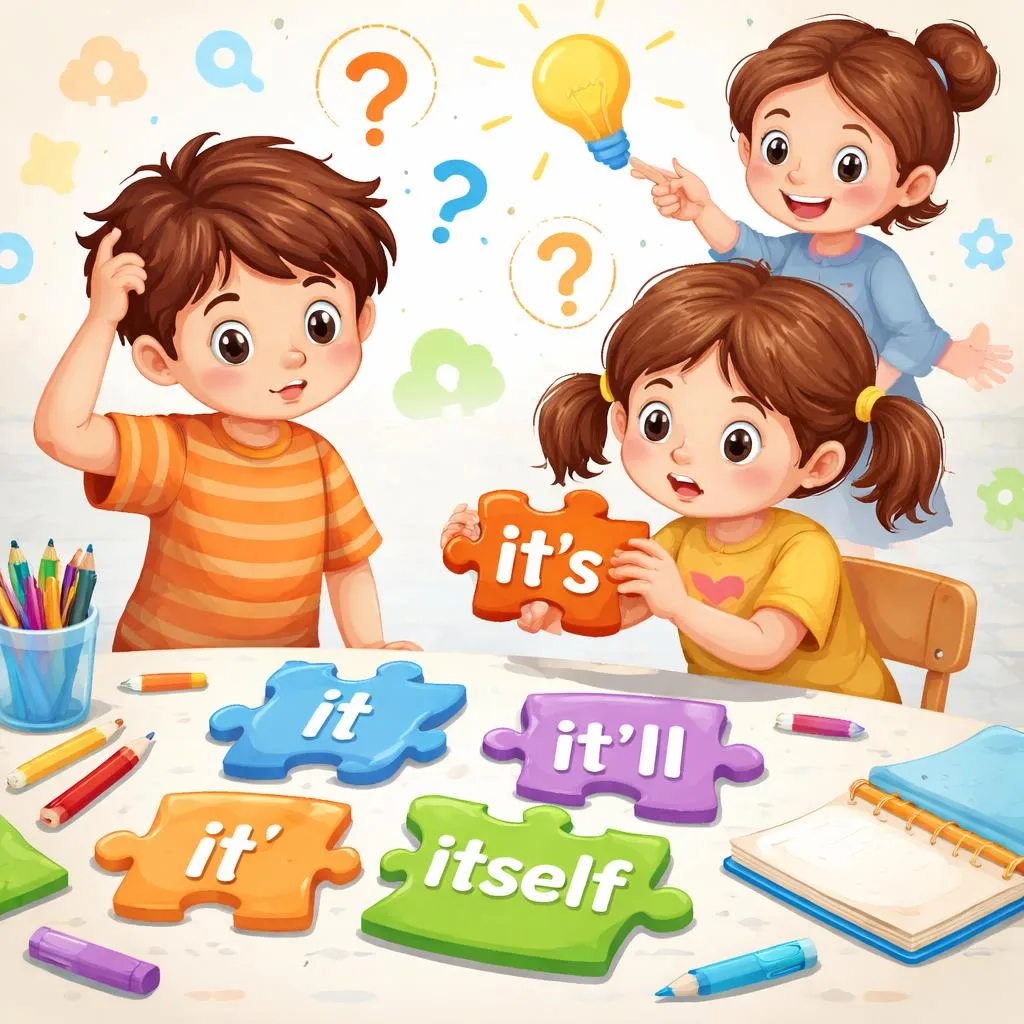
What Is the Difference Between It and Its? A Simple Guide for Kids
What Does “Same Word, Different Forms” Mean? Some words share one meaning but change shape. “It and its” come from the same root. The root means one t ...
Read More
What Does “Same Word, Different Forms” Mean? Some words share one meaning but change shape. “It and its” come from the same root. The root means one t ...
Read More
What Does “Same Word, Different Forms” Mean? English words like to change their shape. The meaning often stays the same. But the form shifts to fit th ...
Read More
What Does “Same Word, Different Forms” Mean? Words often wear different clothes. The meaning stays the same inside. The outside changes to fit the sen ...
Read More
What Does “Same Word, Different Forms” Mean? Some words share one meaning but change shape. “You, your, yours” is a perfect example. Each word refers ...
Read More
What Does “Same Word, Different Forms” Mean? Words change their shape. This happens often in English. The word “I” has four common forms. These are “I ...
Read More
Imagine you are telling a story. You say, "I have a friend. This friend loves dinosaurs." That sounds a bit choppy. What if you could connect these tw ...
Read More
What Is Reflexive pronouns? Imagine you are standing in front of a shiny bedroom mirror. When you look into the glass, who do you see looking back? Yo ...
Read More
What Is Demonstratives: 'this', 'that', 'these', 'those'? Imagine you are at a busy toy store with your family. You see a beautiful teddy bear right i ...
Read More
Many sentences have more than just a subject and a verb. They also have an object. The object receives the action of the verb. It answers the question ...
Read More
Every sentence needs a subject. The subject tells who or what the sentence is about. It is the star of the sentence. Without a subject, we wouldn't kn ...
Read More
Your child uses pronouns every day without thinking. I, you, he, she, it, we, they appear in almost every sentence. Pronouns take the place of nouns s ...
Read More
Pronouns are the words we use instead of nouns. He, she, it, they, me, him, her – these small words carry big meaning. They prevent repetition and mak ...
Read More
Hello, word friend Do you know your name? My name is Penny the Pronoun Pal. I love to help Sometimes we do not use names all the time. It sounds funny ...
Read More
Hello, little word helper Have you ever played with name tags? You write your name on a tag. Then you wear it. But what if you had a magic name tag th ...
Read More
Hello, little talker Do you have a nickname? Maybe your family calls you a sweet, short name. Words have nicknames too These word nicknames are called ...
Read More
Small words do big jobs in English. Words like I, you, he, she, it, we, and they appear in almost every sentence. These words are called pronouns. The ...
Read More
Small words do big jobs in English. Words like I, you, he, and she appear in almost every sentence. They replace nouns. They tell who does the action. ...
Read More
Pronouns are small words with big jobs. They replace nouns in sentences. They keep language from sounding repetitive. Without pronouns, we would say " ...
Read More
Hello, dedicated educators Today we are exploring a fundamental part of English grammar. We will focus on "pronouns and examples." Pronouns are small ...
Read More
What is the Concept? Let's explore a warm and essential topic: family members. This concept refers to the words we use to name the people in our famil ...
Read More
Welcome, everyone, to a very special lesson Today, we are going to sing and learn with a joyful topic. We are exploring "it my birthday song lyrics". ...
Read More