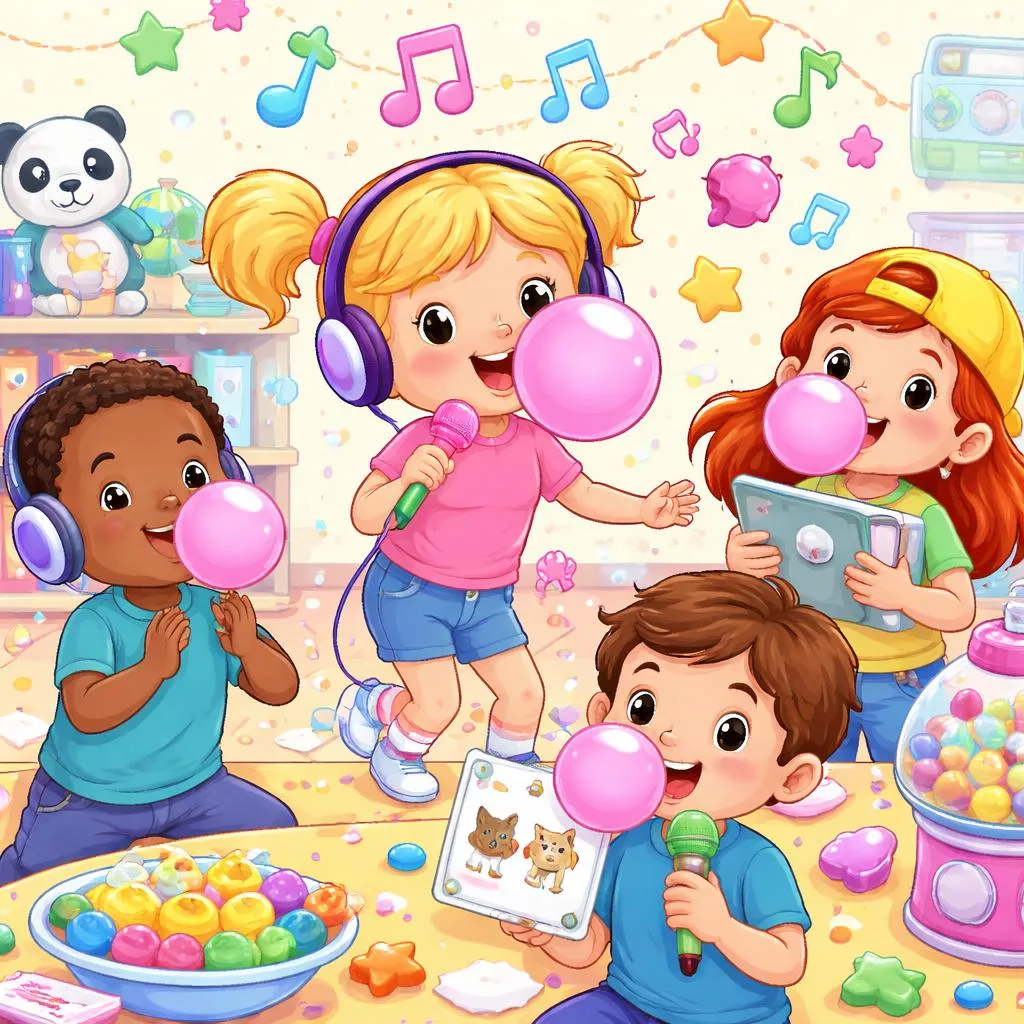

Welcome, everyone! Today, we are going to get moving and learning with a playful tune. We will explore the "chewing my bubblegum song". This is a lively, cumulative action song. It is perfect for practicing verbs, following sequences, and having lots of fun. Let's warm up our voices and our bodies for this energetic English lesson!
What is the rhyme?
The rhyme we are learning is a popular children's action chant. It is often called "Bubblegum, Bubblegum" or "Chewing My Bubblegum." This is a cumulative song, meaning each verse adds a new action while repeating all the previous ones in order. The song starts with the simple act of chewing bubblegum. Then, it builds by adding actions like clapping hands, stomping feet, and turning around. Its repetitive structure makes it easy to learn. The growing sequence challenges memory and coordination. This makes it a fantastic group activity for building listening skills and confidence.
The lyrics of nursery rhymes
Let's look at the common lyrics for this chant. There are several variations, but the structure remains the same.
The song typically starts like this:
I am chewing my bubblegum, (make chewing motions)
Chewing my bubblegum,
Chewing my bubblegum.
Then, a new action is added:
I am chewing my bubblegum,
And I am clapping my hands. (start clapping)
The next verse repeats both actions and adds a third:
I am chewing my bubblegum,
And I am clapping my hands,
And I am stomping my feet. (add stomping)
This continues, adding actions like turning around, touching my nose, sitting down, or jumping up. The song continues until the sequence becomes delightfully long and silly.
Vocabulary learning
This song is a powerhouse for learning action verbs and body parts. The key vocabulary is central to the actions.
First, we have the core phrase: chewing my bubblegum. This introduces the verb chew and the noun bubblegum.
The subsequent verses teach clear action verbs: clapping, stomping, turning, touching, sitting, jumping. These are high-frequency words for describing movement.
The song also reinforces body parts: hands, feet, nose. It combines them naturally with the verbs.
Other useful vocabulary includes directional words like around and down. The repetitive "I am" structure makes this vocabulary memorable through physical action.
Phonics points
This chant offers great practice for specific sounds and phonetic patterns.
The /tʃ/ sound in "chewing" and "ch" in "chew" is prominent. This is a distinct consonant sound.
The /ɪŋ/ ending in present continuous verbs is heavily featured: chewing, clapping, stomping, turning. Singing these words helps children naturally produce this common verb ending.
The rhythm of the song emphasizes syllable stress. Listen to the pattern: "chew-ing my bub-ble-gum." Clapping along helps internalize the rhythm of multi-syllable words.
The repetitive nature allows for clear enunciation of each new verb, helping to distinguish sounds like the /st/ blend in "stomping" from the /kl/ blend in "clapping."
Grammar patterns
This song beautifully demonstrates the present continuous tense in a natural and physical way.
The entire song uses the "I am + [verb]-ing" structure. This is the standard form for talking about actions happening right now. "I am chewing." "I am clapping."
It shows how to connect multiple actions using the conjunction "and." "I am chewing my bubblegum, and I am clapping my hands."
The cumulative structure reinforces sequencing and memory recall in language. It practices listing actions in the order they are performed.
The song also models how to follow multi-step instructions, which is a key listening comprehension skill in any language.
Learning activities
We can extend this song into many fun and educational classroom or home activities.
-
"Add Your Own Action" Game: After going through the standard verses, invite learners to invent the next action. They must say it in the correct format: "And I am... wiggling my fingers." This encourages creativity and sentence formation.
-
Slow Motion/Fast Motion Challenge: Perform the song in super slow motion, emphasizing each movement and word. Then, try it super fast! This builds body control and highlights the rhythm of the language in a fun way.
-
Picture Sequence Cards: Create cards with images for each action (chewing gum, clapping, stomping, etc.). As you sing, have learners put the cards in order on the floor. Mix them up and try to sequence them from memory.
-
Opposites Version: Sing a version using opposite actions. "I am stopping my bubblegum..." "And I am opening my hands..." This introduces antonym vocabulary within a familiar framework.
Printable materials
Printable resources can help solidify the learning from this active song.
Create a "My Action Book" template. Each page has a sentence starter: "I am ______." Children can draw the action and write (or trace) the verb. The first page would be "I am chewing my bubblegum."
Design action word cards. Each card has a verb from the song in large print with a simple icon. Use them for matching games or to prompt the next action in the song sequence.
A song sequence poster is very helpful. It visually shows each action in order with a picture and the words. This supports pre-readers and serves as a reference.
Provide a "cut and paste" sequencing sheet. Children cut out pictures of the actions and glue them in the order they appear in the song. This combines fine motor skills with story sequencing.
Educational games
Let's structure the core mechanics of the song into focused educational games.
-
"Bubblegum Simon Says": Play a game of Simon Says using only the verbs from the song. "Simon says, start chewing your bubblegum." "Simon says, add clapping your hands." "Stomp your feet!" (If Simon didn't say it, they shouldn't do it!). This hones listening for specific commands.
-
Memory Circle Chain: Sit in a circle. The first person says and performs one action from the song. "I am chewing my bubblegum." The next person repeats that action and adds a new one. This continues around the circle, creating a long chain. It builds memory and encourages peer support.
-
Verb Charades with a Twist: Write the song's action verbs on cards. A learner picks a card and acts it out without speaking. The others guess, "You are stomping your feet!" Once guessed correctly, that action becomes the first in a new cumulative song that the group then performs together.
The "chewing my bubblegum song" turns language learning into a full-body experience. It proves that grammar and vocabulary can be learned through rhythm, movement, and laughter. The joy of successfully remembering a long sequence builds immense confidence. So keep chewing, clapping, stomping, and singing. You are building much more than just a list of verbs. You are building fluency, coordination, and the happy memory that learning English is an active, joyful play.