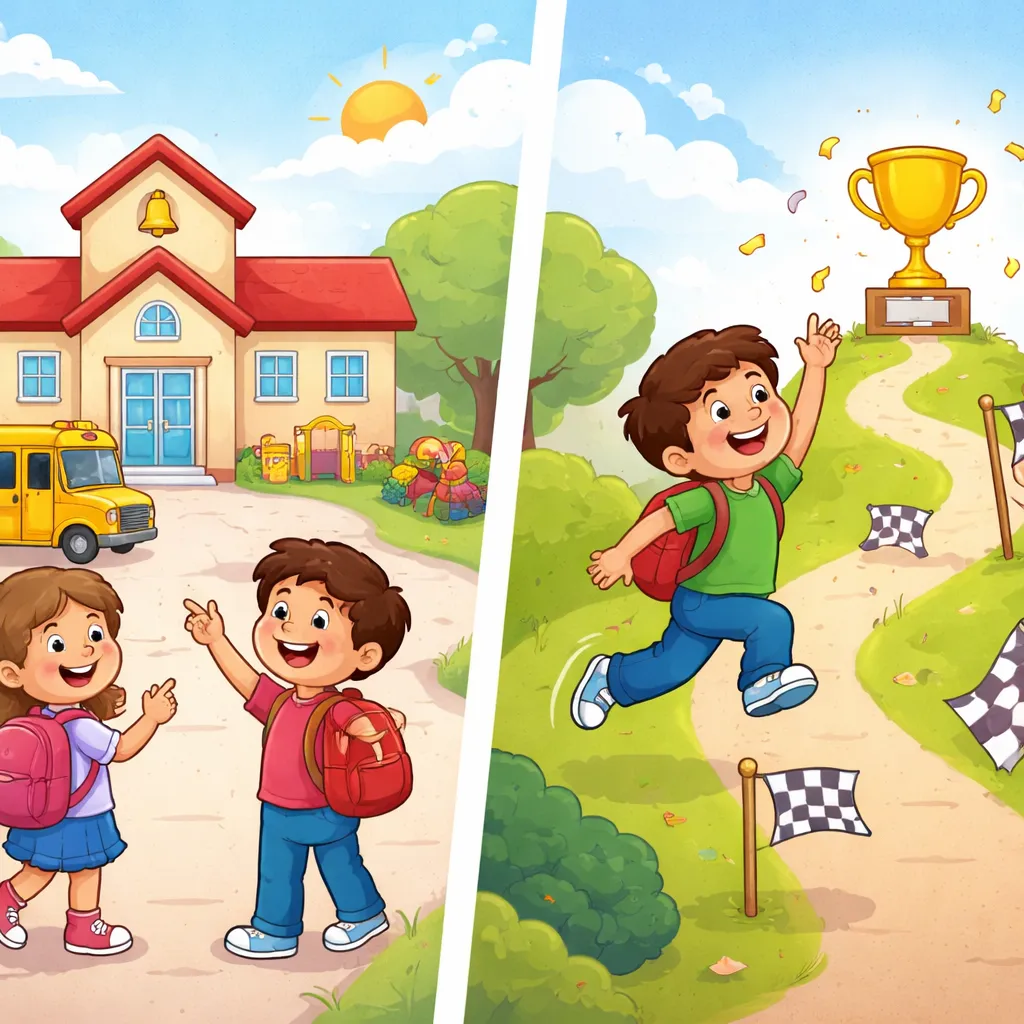

Hello, word explorer! Have you ever gone on a trip? Maybe to a friend's house. Or tried to get a book from a high shelf? How do you talk about that? Do you arrive at your friend's house? Or do you reach for the book? They both seem to mean getting somewhere. But are they the same? They are like two different finish lines. One is the end of a journey. One is the act of stretching to touch something. Let's find out! Today, we explore the word friends "arrive" and "reach". Knowing their secret is a superpower. It makes you a master of journeys and goals. Let's start our destination adventure!
First, let's be Destination Detectives. Listen at home. Here are two sentences. "Our guests will arrive at our house around six o'clock for dinner." "I can't quite reach the top shelf; I need a step stool." They both talk about getting to a point. A house. A top shelf. Do they sound the same? One feels like completing a trip. One feels like stretching to touch something. Can you sense it? Great observation! Now, let's look at the map.
Adventure! On the Path to a Destination
Welcome to the path to a destination! "Arrive" and "reach" are two different finish lines. Think of "arrive" as the final sign at a train station. It says, "You are here! The journey is over." Think of "reach" as the finish line ribbon in a race. You stretch to touch it. Both are about getting to a point. But they focus on different parts. Let's learn about each one.
The Station Sign vs. The Finish Line Ribbon Think about the word "arrive". "Arrive" feels like the final sign at a station. It means to get to a place, especially at the end of a journey. The focus is on the destination. We arrive in London. The package arrived today. It is about completing the travel. Now, think about "reach". "Reach" feels like the finish line ribbon. It means to stretch out to touch or get to something. It can be a place, a goal, or an object. I reach the door. She reached her goal. "Arrive" is the station sign. "Reach" is the ribbon. One is the end. The other is the act of getting there.
Completing a Journey vs. Stretching to a Point Let's compare their action. "Arrive" is about the moment you get to a destination. It is the successful end of moving. You arrive at school. The train arrives on time. It is a moment in time. "Reach" is about the action of extending to a point. It can be physical or about achieving something. You reach for a star. He reached the age of ten. "Arrive" is the end. "Reach" is the effort or the achievement. One is a stop. The other is an action or milestone.
Their Special Word Partners and Grammar Rules Words have best friends. "Arrive" loves to team up with "at" or "in" for places. Arrive at the party. Arrive in a country. It is about the destination. "Reach" usually doesn't need "at" or "in" before the place. It is directly followed by the goal. Reach an agreement. Reach the summit. Reach out. Note: We say "arrive home" (no preposition). We say "reach home" (also okay). But "arrive" is more common for journeys.
Let's visit a school scene. After a long bus ride, your class finally arrives at the museum. This marks the end of the trip. Now, during a science lesson, you learn about a plant. The plant's roots grow down to reach water in the soil. This describes the action of extending to a resource. Using "reach" for the museum is possible, but "arrive" better emphasizes the journey's end. Using "arrive" for the roots is wrong because roots don't take a journey; they stretch.
Now, let's go to the playground. You run to the slide. You arrive at the bottom with a happy shout. This is the end point of your slide. You see a butterfly on a high flower. You jump, trying to reach it. The word "arrive" paints the destination. The word "reach" paints the stretching effort.
Our Little Discovery So, what did we find? "Arrive" and "reach" are both about getting to a point. But they highlight different things. "Arrive" means to get to a place, especially at the end of a journey. It focuses on the destination. "Reach" means to stretch out or extend to get to a point, place, or goal. It focuses on the action or achievement. You arrive at a party. You reach a conclusion. Knowing this helps you describe endings and efforts perfectly.
Challenge! Become a Destination Word Champion
Ready for a fun test? Let's try your new skills!
"The Best Choice" Challenge Let's imagine a nature scene. A migrating bird flies thousands of miles. It finally arrives at its warm winter home. This is the end of its long journey. Now, a young vine grows on a tree. It stretches and stretches to reach the sunlight at the top. This is the action of extending towards a goal. "Arrive" wins for the bird's journey end. "Reach" is the champion for the vine's growing effort.
"My Sentence Show" Your turn to create! Here is your scene: A family hiking trip. Can you make two sentences? Use "arrive" in one. Use "reach" in the other. Try it! Here is an example: "After a three-hour hike, we will arrive at the beautiful mountain lake." This focuses on the destination. "I hope I can reach the next lookout point before I get too tired." This focuses on the effort to get to a spot. Your sentences will show two perspectives!
"Eagle Eyes" Search Look at this sentence. Can you find the word that could be better? Let's check a home context. "I arrived for the cookie jar on the top shelf, but I was too short." Hmm. The sentence describes stretching or trying to get something. The word "reached" is the correct choice for the action of extending to touch something. "I reached for the cookie jar on the top shelf, but I was too short." "Arrived" is for reaching a destination, not stretching for an object. Did you spot it? Excellent word work!
Harvest and Action! Turn Knowledge Into Your Superpower
Great exploring! We started thinking "arrive" and "reach" were the same. Now we know they are two different finish lines. We can see the station sign of "arrive". We can touch the ribbon of "reach". You can now talk about endings and efforts with perfect accuracy. This is a great skill for stories and goals.
What you can learn from this article: You can now feel that "arrive" is about getting to a place, especially at the end of a trip or journey, focusing on the destination. You can feel that "reach" is about stretching out to touch, get to, or achieve something, focusing on the action or the milestone. You know that you "arrive" at a friend's house, but you "reach" a decision. You learned that "arrive" often needs a preposition (at/in), while "reach" usually does not.
Life practice application: Try your new skill today! When you get to school, you arrive. When you stretch to get a toy, you reach. Tell someone about a time you arrived somewhere. Tell them about a goal you want to reach. Listen to travel announcements. Do they use "arrive" or "reach"? You are now a master of destination words! Keep exploring and achieving.