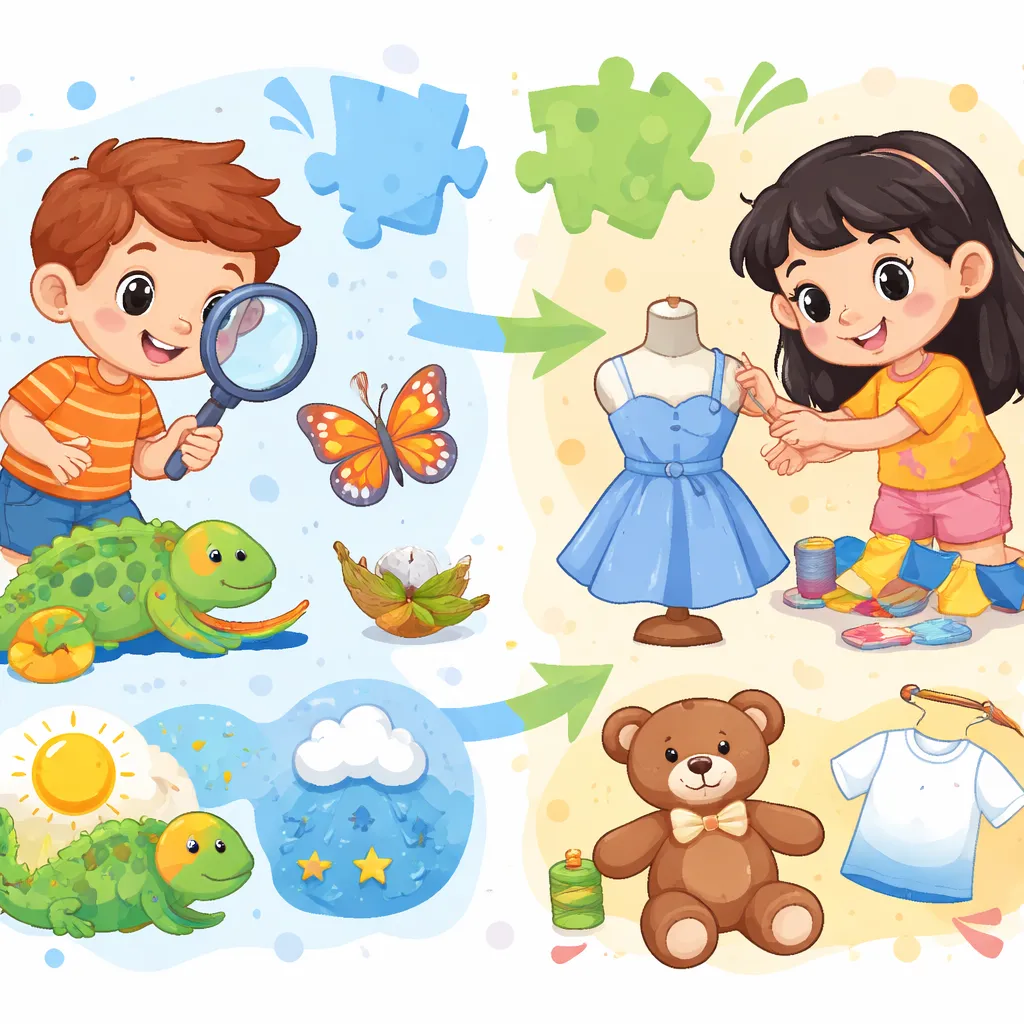

Hello, word explorer! Have you ever switched your shirt for a different one? Or adjusted the strap on your backpack? How do you talk about that? Do you change your clothes? Or do you alter the strap? They both seem to mean making something different. But are they the same? They are like two different ways to make a difference. One is a complete wardrobe swap. One is a tiny tailor's tweak. Let's find out! Today, we explore the word friends "change" and "alter". Knowing their secret is a superpower. It makes you a master of describing differences. Let's start our transformation adventure!
First, let's be Difference Detectives. Listen at home. Here are two sentences. "I need to change into my pajamas before bedtime." "The tailor can alter the length of these pants so they fit me better." They both talk about making something different. Pajamas. Pant length. Do they sound the same? One feels like a complete swap. One feels like a small adjustment. Can you sense it? Great observation! Now, let's look at the difference.
Adventure! Inside the World of Making Differences
Welcome to the world of making differences! "Change" and "alter" are two different tailors. Think of "change" as a quick, complete wardrobe swap. You take off one outfit and put on another. Think of "alter" as a careful, precise tailor with a needle and thread. They make a small adjustment to fit better. Both are about making something not the same. But they do it in different ways. Let's learn about each tailor.
The Wardrobe Swap vs. The Tailor's Tweak Think about the word "change". "Change" feels like a wardrobe swap. It is the common, everyday word. It means to make or become different. It can be big, small, complete, or partial. I change my mind. The weather changes. Let's change the subject. It is a very broad word. Now, think about "alter". "Alter" feels like a tailor's tweak. It is a more formal, precise word. It means to make a small change, usually to improve or adjust something. The dress was altered to fit. The plan was altered slightly. "Change" is the wardrobe. "Alter" is the tweak. One is for any difference. The other is for a small adjustment.
Any Difference vs. A Small, Careful Adjustment Let's compare their scale. "Change" can be any kind of difference. It can be a total transformation or a tiny shift. You can change a tire, change a baby, or change the channel. It doesn't specify the size. "Alter" is usually for a minor, careful modification. The core thing stays the same, but with a tweak. You alter a recipe, alter your voice, or alter a document. "Change" can be revolutionary. "Alter" is usually evolutionary. One is a new painting. The other is a touch-up.
Their Special Word Partners and Common Contexts Words have best friends. "Change" loves to team up in many common phrases. Change your tune. Change hands. Small change. It is used everywhere. "Alter" has its own special, often formal teams. Alter ego. Altercation. Unalterable. Note: We say "change clothes". We don't say "alter clothes" (unless we mean tailoring). They are different.
Let's visit a school scene. The teacher says, "We are going to change the seating arrangement tomorrow." This means a complete new layout. Now, the teacher reviews your essay. She suggests you alter a few words to make a sentence clearer. This is a small, precise adjustment. Using "alter" for the seating plan is too precise. Using "change" for the words is okay, but "alter" better captures the small, careful edit.
Now, let's go to the playground. The game rules are unfair. The group votes to change the rules completely. This is a big transformation. You are building a model car. You need to alter the angle of a wing to make it more aerodynamic. The word "change" paints the big rule overhaul. The word "alter" paints the small, precise angle adjustment.
Our Little Discovery So, what did we find? "Change" and "alter" are both about making something different. But they are different in scale and feeling. "Change" is the common, general word for making or becoming different in any way. It can be big or small. "Alter" is a more formal word. It usually means to make a small change, often to improve or adjust something. You change your hair color. You alter the recipe a bit. Knowing this helps you describe transformations with perfect accuracy.
Challenge! Become a Difference Word Champion
Ready for a fun test? Let's try your new skills!
"The Best Choice" Challenge Let's imagine a nature scene. A caterpillar undergoes a huge transformation. It will change into a butterfly. This is a complete, dramatic metamorphosis. Now, watch a bird building a nest. It tries a twig in one spot, then moves it slightly. The bird will alter the position of the twig for a better fit. This is a small, careful adjustment. "Change" wins for the caterpillar's total transformation. "Alter" is the champion for the bird's tiny tweak.
"My Sentence Show" Your turn to create! Here is your scene: Decorating your room for a new hobby. Can you make two sentences? Use "change" in one. Use "alter" in the other. Try it! Here is an example: "I want to change the wall color from blue to green to match my new sports team." This is a big, complete difference. "I just need to alter the position of this shelf to hold my trophy." This is a small adjustment. Your sentences will show two scales of difference!
"Eagle Eyes" Search Look at this sentence. Can you find the word that could be better? Let's check a home context. "I completely altered my opinion about the movie after watching the amazing sequel." Hmm. The word "completely" suggests a total reversal. The word "altered" is too weak and implies a small adjustment. The word "changed" is the strong, correct choice for a complete shift. "I completely changed my opinion about the movie after watching the amazing sequel." "Altered" doesn't match the strength of "completely". Did you spot it? Excellent word work!
Harvest and Action! Turn Knowledge Into Your Superpower
Great exploring! We started thinking "change" and "alter" were the same. Now we know they are two different tailors. We can do the wardrobe swap of "change". We can do the tailor's tweak of "alter". You can now talk about making things different with perfect accuracy. This is a great skill for growing and improving.
What you can learn from this article: You can now feel that "change" is the common, everyday word for making something different in any way, big or small, like changing your shoes or changing a law. You can feel that "alter" is a more formal word that usually means to make a small, careful change to adjust or improve something, like altering a dress or altering your approach. You know that you "change" a password, but you might "alter" a sentence. You learned to match the word to the scale: "change" for any difference, "alter" for a small adjustment.
Life practice application: Try your new skill today! Think of one big thing you would like to change. Think of one small thing you could alter to make it better. Tell a friend. Listen to how people use these words. Is it a big change or a small alteration? You are now a master of difference words! Keep growing and adjusting in wonderful ways.