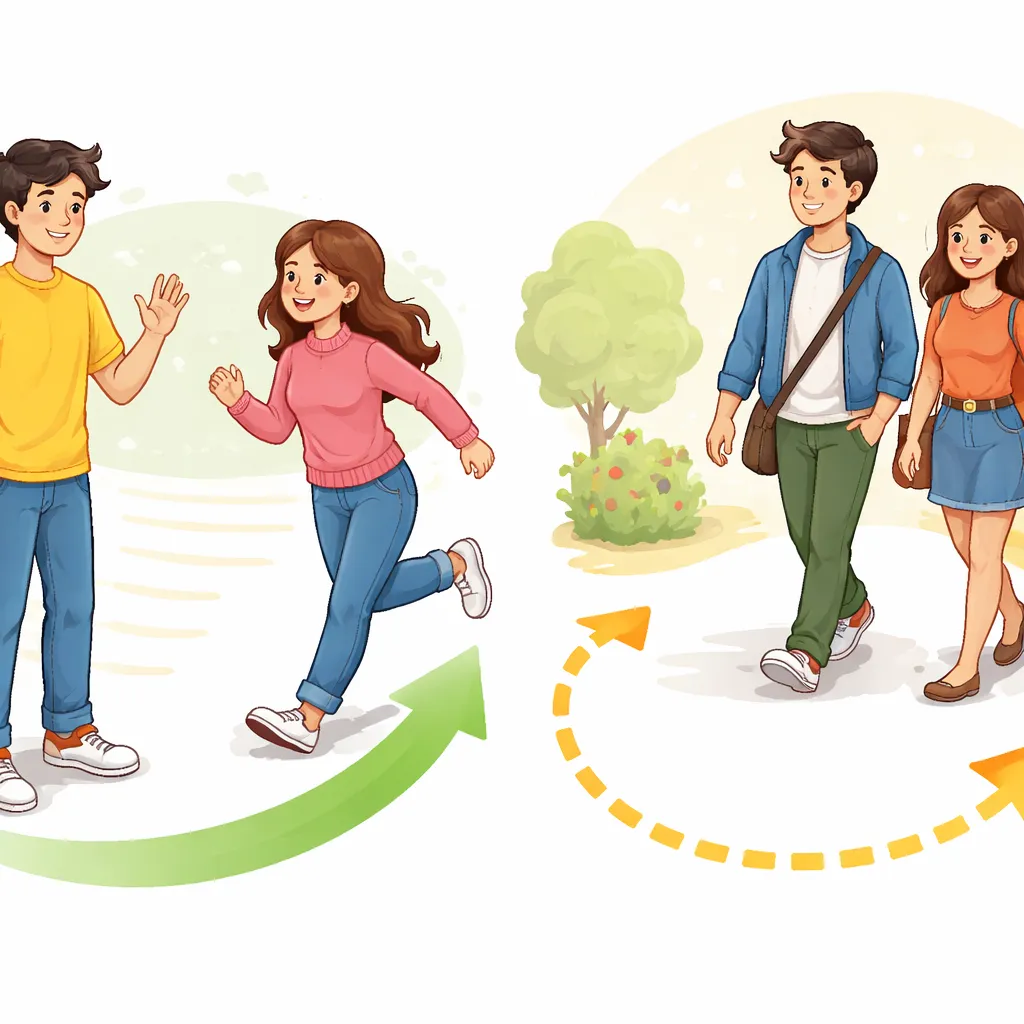

Hello, word explorer! Have you ever seen a friend walking toward you? Or watched a storm cloud get closer? How do you talk about that? Do you say your friend will come to you? Or do you say the storm is approaching? They both seem to mean moving closer. But are they the same? They are like two different ways to close a gap. One is a friendly, direct walk into a hug. One is a slow, steady movement toward a point. Let's find out! Today, we explore the word friends "come" and "approach". Knowing their secret is a superpower. It makes you a master of describing movement. Let's start our moving adventure!
First, let's be Movement Detectives. Listen at home. Here are two sentences. "Please come to the kitchen; dinner is ready." "I can see the delivery truck approaching our street from the window." They both talk about moving closer. To the kitchen. To our street. Do they sound the same? One feels like an invitation to a destination. One feels like an observation of something getting nearer. Can you sense it? Great observation! Now, let's look at the path.
Adventure! Inside the World of Moving Closer
Welcome to the world of moving closer! "Come" and "approach" are two different movers. Think of "come" as a friend running up to you for a high-five. The movement ends with arrival at the speaker. Think of "approach" as a ship slowly sailing toward the shore. It is getting nearer, but hasn't arrived yet. Both are about closing distance. But they do it in different ways. Let's learn about each mover.
The Running Friend vs. The Sailing Ship Think about the word "come". "Come" feels like a friend running for a high-five. It means to move toward the speaker or toward a place that is the focus. The destination is key. Come here! My cousin is coming for a visit. Spring is coming. It is about movement to a point. Now, think about "approach". "Approach" feels like a ship sailing toward shore. It means to get closer to something in distance or time. It focuses on the act of getting nearer. The cat approached the mouse. We approach the end of the year. "Come" is the running friend. "Approach" is the sailing ship. One is about arriving. The other is about getting nearer.
Movement to a Point vs. The Act of Getting Nearer Let's compare their focus. "Come" is about the action of moving toward a destination, often the speaker. It is an everyday, direct word. Come with me. The bus is coming. It often implies the journey's end. "Approach" is about the process of getting closer. It can be physical or about time. It is a bit more formal or descriptive. The deadline is approaching. He approached the problem carefully. "Come" is for the destination. "Approach" is for the nearing action. One is an invitation. The other is an observation.
Their Special Word Partners and Grammar Words have best friends. "Come" loves to team up with many prepositions. Come from. Come back. Come across. It is used in many phrases. "Approach" is often used alone or with an object. It is also a noun. A new approach. Approach with caution. The approach of winter. Note: We say "come to a decision". We say "approach a problem" (tackle it). They are different.
Let's visit a school scene. The teacher says, "Sam, please come to the front and present your project." This is a direct call to move to a specific spot. Now, the class is on a field trip to a pond. The teacher whispers, "Look, a heron is approaching the water's edge." This describes the bird's careful, slow movement closer to the water. Using "approach" for Sam is too formal. Using "come" for the heron is okay, but "approach" better captures the careful, observed movement.
Now, let's go to the playground. You call to your friend, "Come and see this cool bug!" You want them to move to your location. You are on the swings and see a big dog. You say, "That dog is approaching the playground." This means it is getting nearer, and you are watching its movement. The word "come" paints the invitation. The word "approach" paints the observed, nearing action.
Our Little Discovery So, what did we find? "Come" and "approach" are both about moving closer. But they have different uses. "Come" is the common word for movement toward the speaker or a specific destination. It is about the action of arriving. "Approach" means to get closer to something, often focusing on the process of getting nearer. It is used for physical distance and also for time or ideas. You come home. Winter approaches. Knowing this helps you describe movement with style.
Challenge! Become a Movement Word Champion
Ready for a fun test? Let's try your new skills!
"The Best Choice" Challenge Let's imagine a nature scene. A mother bird calls from the nest. Her hungry chick hops toward her. The chick will come to its mother for food. This is movement to a specific destination (the mother). Now, a hunting fox in the grass sees a rabbit. The fox slowly, quietly moves closer. The fox is approaching the rabbit. This describes the careful act of getting nearer to a target. "Come" wins for the chick's direct movement to its mother. "Approach" is the champion for the fox's stealthy movement.
"My Sentence Show" Your turn to create! Here is your scene: Waiting at a bus stop with a parent. Can you make two sentences? Use "come" in one. Use "approach" in the other. Try it! Here is an example: "I hope our bus will come soon." This is about the bus arriving at our destination (the stop). "I can see a bus approaching in the distance." This is about observing the bus getting nearer. Your sentences will show two perspectives!
"Eagle Eyes" Search Look at this sentence. Can you find the word that could be better? Let's check a home context. "I approached to the living room to watch TV with my family." Hmm. The phrase "to the living room" indicates a destination. The word "come" is not right because the speaker is moving. Actually, the word "went" might be best, but between our two words, "approach" is not typically used with "to" in this way. A more natural choice is "went" or "came". But for our lesson, using "approach" here is awkward. Better: "I went to the living room..." or "I came to the living room..." (if the speaker is joining others there). The point is "approach" is for getting nearer, not for stating a destination. Let's fix it: "I went to the living room to watch TV with my family." "Approach" is the wrong word for this simple action. Did you spot it? Excellent word work!
Harvest and Action! Turn Knowledge Into Your Superpower
Great exploring! We started thinking "come" and "approach" were the same. Now we know they are two different movers. We can call the running friend with "come". We can watch the sailing ship with "approach". You can now describe how things move closer with perfect accuracy. This is a great skill for stories and safety.
What you can learn from this article: You can now feel that "come" is the everyday word for moving toward the speaker or a specific place, like coming home or coming to a party. You can feel that "approach" means to get closer to something, focusing on the act of moving nearer, and it can be used for things like time, ideas, or careful movements. You know that you "come" to the door, but you "approach" a challenge carefully. You learned that "come" is about the destination, while "approach" is about the process of getting nearer.
Life practice application: Try your new skill today! Call your pet: "Come here!" Watch a car down the street. Say, "That car is approaching." Listen to the weather report. Does it say a storm is "approaching"? You are now a master of movement words! Keep observing and describing the world around you.