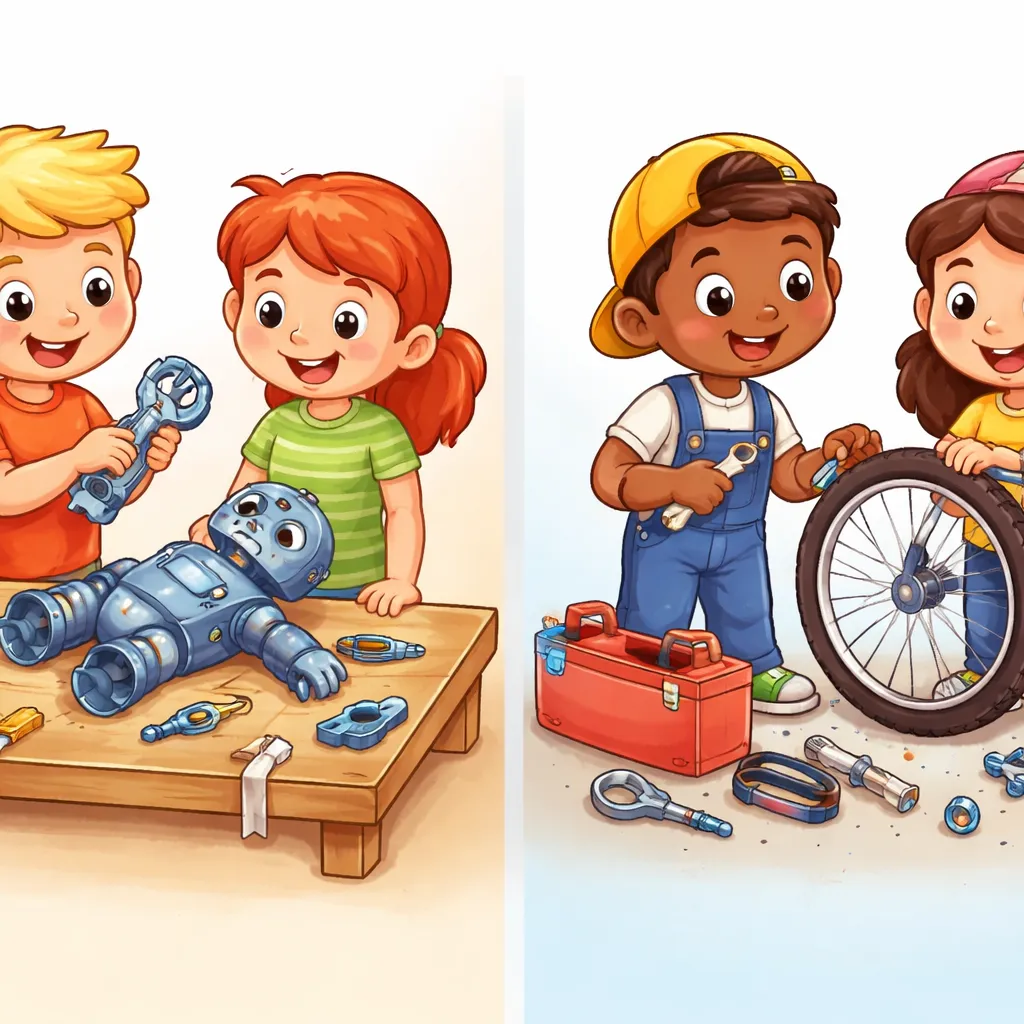

Hello, word expert! Have you ever had a loose button? Or a flat bike tire? How do you talk about making it right? Do you fix the button? Or do you repair the tire? They both seem to mean making something work again. But are they the same? They are like two different toolboxes. One is a small, handy first-aid kit. One is a big, professional workshop. Let's find out! Today, we explore the word friends "fix" and "repair". Knowing their secret is a superpower. It makes you a master of making things right. Let's start our toolbox adventure!
First, let's be Tool Detectives. Listen at home. Here are two sentences. "I can fix your ponytail; the elastic is coming loose." "A mechanic will repair the engine of our car at the garage." They both talk about making things right. A ponytail. A car engine. Do they sound the same? One feels quick and simple. One feels complex and professional. Can you sense it? Great observation! Now, let's open the toolboxes.
Adventure! Inside the World of Making Things Right
Welcome to the world of making things right! "Fix" and "repair" are two different toolboxes. Think of "fix" as a small, handy first-aid kit. It is for quick, everyday solutions. Think of "repair" as a big, professional workshop. It is for major, complicated projects. Both are about restoring. But they restore in different ways. Let's learn about each toolbox.
The First-Aid Kit vs. The Professional Workshop Think about the word "fix". "Fix" feels like a first-aid kit. It is the common, everyday word. It means to make something work again, to attach, or to solve a problem. It is quick and casual. I will fix a snack. Can you fix this error? He fixed his eyes on me. It is very flexible. Now, think about "repair". "Repair" feels like a professional workshop. It is a more formal, serious word. It means to restore something damaged or broken to a good condition. It often takes skill. They will repair the road. She repaired the friendship. "Fix" is the first-aid kit. "Repair" is the workshop. One is for small jobs. The other is for big jobs.
The Quick Solution vs. The Skilled Restoration Let's compare their depth. "Fix" is for all kinds of problems, big or small. It is a general word. You can fix a leak, fix a date, or fix a game. It doesn't specify the method. "Repair" suggests a careful, skilled process. It is often used for physical objects that are broken. You repair a watch, repair a roof, or repair damage. "Fix" can be temporary. "Repair" is often thorough. One is a bandage. The other is surgery.
Their Special Word Partners and Common Contexts Words have best friends. "Fix" loves to team up in many common phrases. Fix up. Fix on. In a fix. It is used in casual situations. "Repair" has its own special, more formal teams. It is often a noun. Under repair. Beyond repair. Repairs are needed. Note: We say "fix a drink". We don't say "repair a drink". They are different.
Let's visit a school scene. Your pencil tip breaks. You fix it by sharpening it with a sharpener. This is a quick, simple solution. Now, imagine the school's roof has a leak after a storm. A construction crew must come to repair it. This is a skilled, major job. Using "repair" for the pencil is too formal. Using "fix" for the roof is okay, but "repair" better fits the serious, skilled work.
Now, let's go to the playground. The chain on the swing is loose. You fix it by hooking it back on the link. This is a simple attachment. The wooden bench has a large, broken slat. The park worker will repair it with new wood and tools. The word "fix" paints the quick hook. The word "repair" paints the skilled carpentry work.
Our Little Discovery So, what did we find? "Fix" and "repair" are both about restoring. But they are used for different levels of problems. "Fix" is the common, casual word for solving a problem or making something work. It is for quick, simple, or everyday issues. "Repair" is a more formal word. It means to carefully restore something broken or damaged, often requiring skill. You fix a wobbly table. You repair a shattered vase. Knowing this helps you choose the right word for the job.
Challenge! Become a Restoration Word Champion
Ready for a fun test? Let's try your new skills!
"The Best Choice" Challenge Let's imagine a nature scene. A spider's web gets a small tear. The spider will quickly fix the web with new silk. This is a fast, routine maintenance. Now, imagine a beaver's dam gets a large hole after heavy rain. The beaver must gather many logs and mud to repair the structure. This is a major, skilled rebuilding job. "Fix" wins for the spider's quick web mending. "Repair" is the champion for the beaver's dam reconstruction.
"My Sentence Show" Your turn to create! Here is your scene: Your bicycle has a problem. Can you make two sentences? Use "fix" in one. Use "repair" in the other. Try it! Here is an example: "I can fix the loose bell on my handlebar by tightening the screw." This is a simple adjustment. "My dad will help me repair the bent wheel at the bike shop." This is a more complex, skilled task. Your sentences will show two levels of restoration!
"Eagle Eyes" Search Look at this sentence. Can you find the word that could be better? Let's check a school context. "The computer technician repaired a small typo in my document in just two seconds." Hmm. Fixing a typo is a very quick, simple correction. The word "repaired" is too formal and heavy for this tiny error. The word "fixed" is the natural, common choice. "The computer technician fixed a small typo in my document in just two seconds." "Repaired" sounds like a major computer breakdown. Did you spot it? Excellent word work!
Harvest and Action! Turn Knowledge Into Your Superpower
Great exploring! We started thinking "fix" and "repair" were the same. Now we know they are two different toolboxes. We can use the first-aid kit of "fix" for small problems. We can use the professional workshop of "repair" for big projects. You can now talk about solving problems with perfect accuracy. This is a great skill for life.
What you can learn from this article: You can now feel that "fix" is the common, everyday word for solving a problem or making something work, used for quick, simple, or casual situations. You can feel that "repair" is a more formal word for carefully restoring something that is broken or damaged, often needing skill and time. You know that you "fix" a messy room, but a specialist might "repair" a cracked phone screen. You learned to match the word to the job: "fix" for small, quick jobs, "repair" for big, skilled jobs.
Life practice application: Try your new skill today! If a toy is loose, you can try to fix it. If something is seriously broken, an adult might need to repair it. Look around your home. What small thing can you fix? What big thing might need a repair? You are now a master of restoration words! Keep solving problems and helping out.