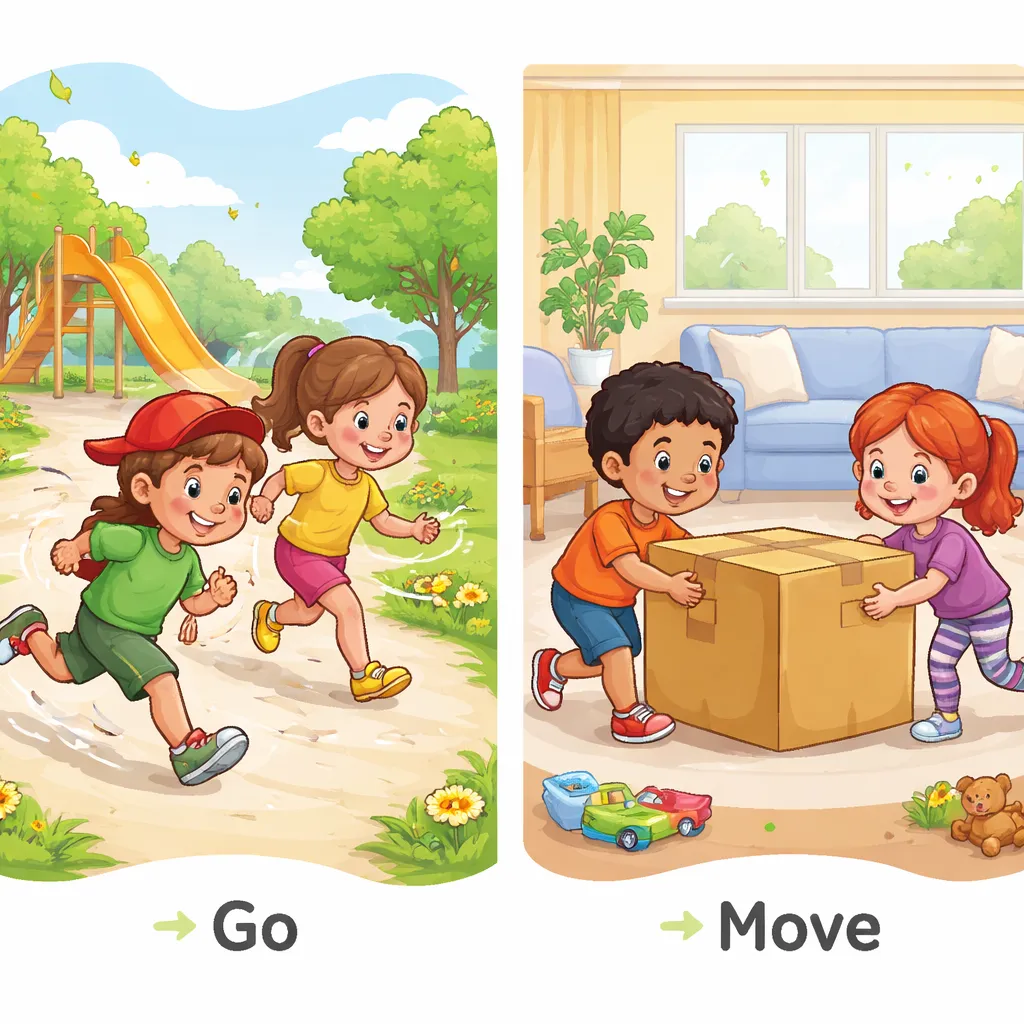

Hello, word explorer! Have you ever walked to a friend's house? Or just shifted in your chair? How do you talk about that? Do you go to your friend's house? Or do you move in your chair? They both seem to mean changing position. But are they the same? They are like two different ways to travel. One is a train on a track to a station. One is a cloud drifting in the sky. Let's find out! Today, we explore the word friends "go" and "move". Knowing their secret is a superpower. It makes you a master of describing action. Let's start our motion adventure!
First, let's be Motion Detectives. Listen at home. Here are two sentences. "I go to the park every Saturday to play soccer." "Please don't move while I tie your shoe; stay still." They both talk about action. To the park. While tying a shoe. Do they sound the same? One feels like traveling to a place. One feels like any kind of action or change. Can you sense it? Great observation! Now, let's look at the motion.
Adventure! Inside the World of Motion
Welcome to the world of motion! "Go" and "move" are two different engines. Think of "go" as a train on a track. It has a direction and a destination. Think of "move" as the engine itself. It makes things happen, but doesn't say where. Both are about action. But they focus on different parts. Let's learn about each engine.
The Train on a Track vs. The Engine Itself Think about the word "go". "Go" feels like a train on a track. It means to travel or leave for a place. The focus is on the destination. Let's go home. I go to school. Where did it go? It is about direction. Now, think about "move". "Move" feels like the engine itself. It means to change position or to cause something to change position. It is the basic act of motion. Please move your bag. The earth moves around the sun. Don't move! "Go" is the train. "Move" is the engine. One is for destinations. The other is for the action of changing place.
Traveling to a Place vs. The Act of Changing Place Let's compare their focus. "Go" is about the journey from one place to another. It answers "where?" I go to the store. We are going to Grandma's. It implies leaving. "Move" is about the physical change. It answers "what happened?" The car moved forward. Move the box. He was moved by the story (emotionally). "Go" is for trips. "Move" is for any shift, big or small. One is about leaving. The other is about acting.
Their Special Word Partners and Common Uses Words have best friends. "Go" loves to team up with places and activities. Go away. Go shopping. Go on a trip. It is used for future plans. "Move" has its own special teams. It often pairs with body parts and objects. Move over. Move house. Get a move on. Note: We say "go home" (no preposition). We say "move to a new home". They are different.
Let's visit a school scene. The bell rings. It's time to go to your next class. This is about traveling to a destination. Now, during a science lesson, you learn that atoms constantly move. This is about the basic action of motion, not going anywhere specific. Using "move" for changing classes is okay, but "go" emphasizes the destination. Using "go" for atoms is wrong because atoms don't travel to a place; they just vibrate or shift.
Now, let's go to the playground. You decide to go on the merry-go-round. This is your intention to travel to and use it. Once on it, you move in a circle. The word "go" paints the decision to travel to the equipment. The word "move" paints the circular action you do on it.
Our Little Discovery So, what did we find? "Go" and "move" are both about action. But they are different. "Go" means to travel or leave for a place. It focuses on the destination. "Move" means to change position or cause something to change position. It focuses on the action itself. You go to the kitchen. You move a cup to the table. Knowing this helps you describe actions perfectly.
Challenge! Become a Motion Word Champion
Ready for a fun test? Let's try your new skills!
"The Best Choice" Challenge Let's imagine a nature scene. A salmon swims from the ocean. It must go up the river to the exact place it was born to lay eggs. This is a purposeful journey to a specific destination. Now, watch a snake. It doesn't have legs. It uses its muscles to move forward along the ground. This describes the physical action of its motion. "Go" wins for the salmon's purposeful trip. "Move" is the champion for the snake's method of motion.
"My Sentence Show" Your turn to create! Here is your scene: A rainy afternoon indoors. Can you make two sentences? Use "go" in one. Use "move" in the other. Try it! Here is an example: "I want to go to the living room to build a fort." This is about traveling to a destination. "I need to move the big cushions to make the walls." This is about the action of changing their position. Your sentences will show two kinds of action!
"Eagle Eyes" Search Look at this sentence. Can you find the word that could be better? Let's check a home context. "I told my little brother to go from the doorway because he was blocking it." Hmm. The issue is about changing position to stop blocking, not about traveling to a destination. The word "move" is the correct choice for getting out of the way. "I told my little brother to move from the doorway because he was blocking it." "Go" would imply leaving for somewhere else. Did you spot it? Excellent word work!
Harvest and Action! Turn Knowledge Into Your Superpower
Great exploring! We started thinking "go" and "move" were the same. Now we know they are two different engines. We can ride the train of "go" to a destination. We can start the engine of "move" for any action. You can now describe travel and motion with perfect accuracy. This is a great skill for games and instructions.
What you can learn from this article: You can now feel that "go" is about traveling or leaving for a place, focusing on the destination or the journey. You can feel that "move" is about changing position or causing something to change position, focusing on the action itself. You know that you "go" to the store, but you "move" a toy from the floor. You learned to match the word to the focus: "go" for destinations, "move" for the action of changing place.
Life practice application: Try your new skill today! Tell someone where you will go. Ask someone to move an object. When you play, are you "going" somewhere or "moving" something? Listen to instructions. Do they say "go" or "move"? You are now a master of motion words! Keep exploring and describing your world.