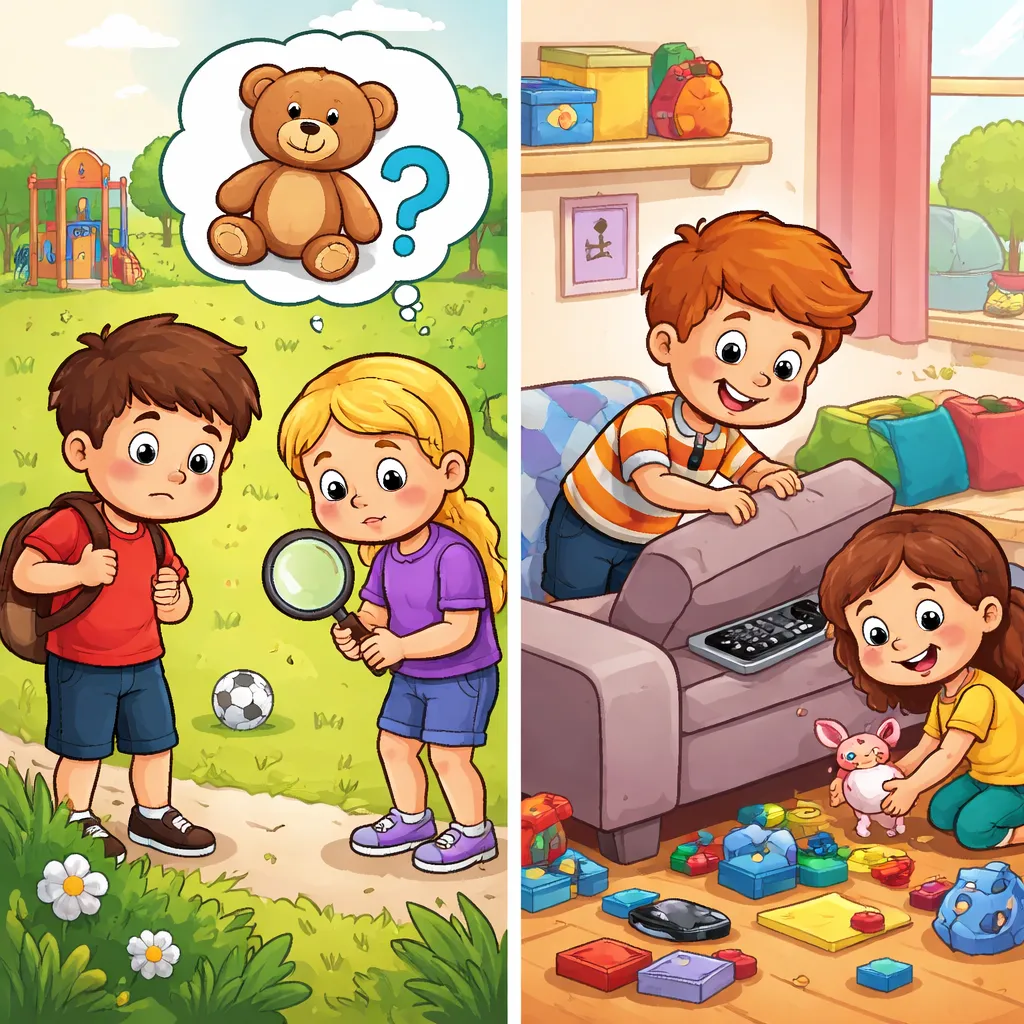

Hello, word explorer! Have you ever been unable to find something? Maybe your favorite pen. You know it’s somewhere in your room. How do you talk about that? Did you lose your pen forever? Or did you just misplace it? They both seem to mean you can’t find something. But are they the same? They are like two different kinds of "lost." One is a big, scary storm. One is a small, annoying drizzle. Let's find out! Today, we explore the word friends "lose" and "misplace". Knowing their secret is a superpower. It makes you calm and clear about missing things. Let's start our search!
First, let's be Search Detectives. Listen at home. Here are two sentences. "I hope I don't lose my brand new jacket at the park." "I think I misplaced my library book; it's probably under my bed." They both talk about not finding things. A jacket. A library book. Do they sound the same? One feels serious and permanent. One feels temporary and less scary. Can you sense it? Great observation! Now, let's look for the clues.
Adventure! Inside the World of Missing Things
Welcome to the world of missing things! "Lose" and "misplace" are two different weather reports. Think of "lose" as a big, scary storm. The thing is gone, maybe forever. Think of "misplace" as a light, annoying drizzle. The thing is just put in the wrong spot. Both are about not having something. But they have different levels of worry. Let's learn about each forecast.
The Big Storm vs. The Light Drizzle Think about the word "lose". "Lose" feels like a big storm. It is a strong, general word. It means to be unable to find something, often for a long time or forever. It can be serious. Try not to lose your phone. I lost the game. He lost his way. It causes worry. Now, think about "misplace". "Misplace" feels like a light drizzle. It is a gentler, more specific word. It means to put something in the wrong place, so you can't find it right now. It suggests it's probably nearby. I misplaced my glasses. She misplaced her permission slip. "Lose" is the storm. "Misplace" is the drizzle. One is serious. The other is a small mistake.
Gone Forever vs. In the Wrong Spot Let's compare their permanence. "Lose" often means the thing is truly gone. You don't know where it is. You can lose a friend (stop being friends). You can lose your keys. It has a feeling of finality. "Misplace" means you know you put it somewhere, but that somewhere is wrong. The thing is likely in your house or room. You misplace a remote. You misplace a hair clip. "Lose" is often permanent. "Misplace" is temporary. One is gone. The other is hidden.
Their Special Word Partners and Common Uses Words have best friends. "Lose" teams up with important things and feelings. Lose your temper. Lose track of time. Lose your mind. It is a common, strong verb. "Misplace" has milder friends. It often pairs with small, everyday objects. A misplaced folder. Misplace your trust (in someone). Note: We say "lost and found" (a place for lost items). We don't say "misplaced and found". They are different.
Let's visit a school scene. You are at the playground. Your special pencil falls from your pocket. You might lose it in the grass. It is gone, maybe for good. Now, in the classroom, you put your homework in your science book by mistake. You have misplaced it in the wrong book. It is not lost; it's in the wrong spot. Using "misplace" for the pencil in the grass is wrong because it's not in a wrong spot you chose. Using "lose" for the homework is okay, but "misplace" is more accurate for something put in the wrong book.
Now, let's go to the playground. You take off your hat. The wind blows it away. You might lose your hat. It's gone. Later, you put your water bottle next to the bench, not in your bag. You have misplaced it. It's not with your things. The word "lose" paints the scary, gone-forever feeling. The word "misplace" paints the "oops, wrong spot" feeling.
Our Little Discovery So, what did we find? "Lose" and "misplace" are both about not finding something. But they are very different. "Lose" is a strong, general word for when something is gone and you don't know where it is. It can be permanent. "Misplace" is a gentler word. It means you put something in the wrong place, so it's temporarily missing, but it's probably nearby. You lose a race. You misplace your left shoe. Knowing this helps you stay calm and explain what happened.
Challenge! Become a Search Word Champion
Ready for a thoughtful test? Let's try your new skills!
"The Best Choice" Challenge Let's imagine a nature scene. A squirrel hides a nut for winter. Later, it cannot remember the spot. The squirrel has lost the nut. The nut is gone from its memory. Now, imagine a raccoon. It finds a shiny coin and puts it in a hollow log. Later, it looks in the wrong log. The raccoon has misplaced the coin. It's in a log, just not the one it's checking. "Lose" wins for the squirrel's forgotten nut. "Misplace" is the champion for the raccoon's coin in the wrong log.
"My Sentence Show" Your turn to create! Here is your scene: Getting ready for school in the morning. Can you make two sentences? Use "lose" in one. Use "misplace" in the other. Try it! Here is an example: "I am always afraid I will lose my house key on the way to school." This is a serious, permanent fear. "I often misplace my homework on the kitchen table under the mail." This is a temporary mistake of putting it in the wrong pile. Your sentences will show two levels of "lost"!
"Eagle Eyes" Search Look at this sentence. Can you find the word that could be better? Let's check a home context. "I'm so upset; I think I lost my favorite pen somewhere in my bedroom. I just had it an hour ago." Hmm. The phrase "somewhere in my bedroom" suggests the pen is still in the room, just in an unknown spot. The word "misplaced" is a more accurate and less worrying choice. "I'm so upset; I think I misplaced my favorite pen somewhere in my bedroom. I just had it an hour ago." "Lost" sounds too final for something in your room. Did you spot it? Excellent and calm word work!
Harvest and Action! Turn Knowledge Into Your Superpower
Great exploring! We started thinking "lose" and "misplace" were the same. Now we know they are two different weather forecasts. We can prepare for the storm of "lose". We can handle the drizzle of "misplace". You can now talk about missing things with perfect accuracy and less worry. This is a great life skill.
What you can learn from this article: You can now feel that "lose" is a strong word for when something is gone and you don't know where it is, which can be scary or permanent. You can feel that "misplace" is a gentler word for when you put something in the wrong place, so it's temporarily missing but likely nearby. You know that you might "lose" a game, but you "misplace" your glasses. You learned to match the word to the situation: "lose" for serious or gone-forever things, "misplace" for temporary "wrong-spot" mistakes.
Life practice application: Try your new skill today! If you can't find a toy, ask yourself: Is it lost or just misplaced? Tell a family member if you "lost" something or "misplaced" it. Listen to how people use these words. Are they worried or just annoyed? You are now a master of search words! Keep your things organized and your words clear.