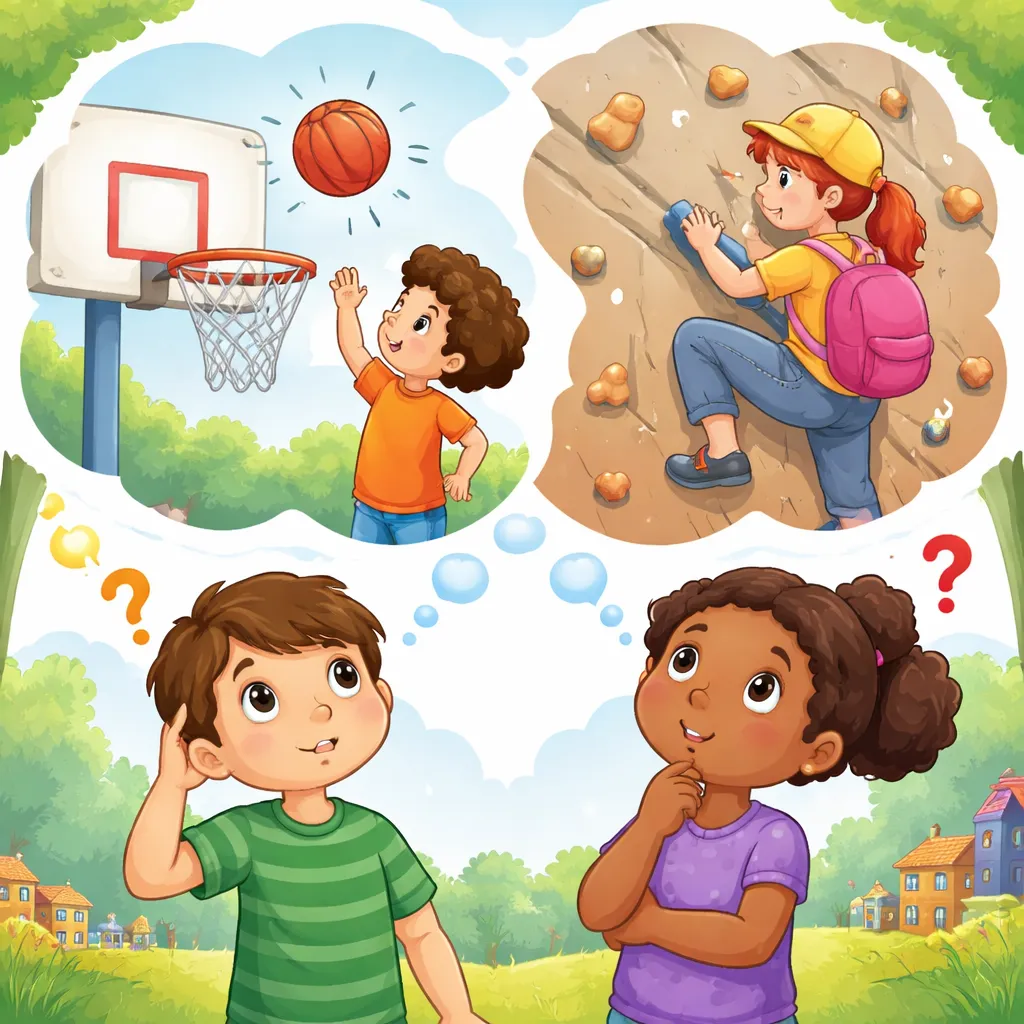

Hello, word explorer! Have you ever faced a challenge? Maybe a tricky puzzle. Or a new skateboard trick. How do you talk about that? Do you try the puzzle? Or do you attempt the trick? They both seem to mean making an effort. But are they the same? They are like two different kinds of practice. One is a fun, casual game in the yard. One is the official tryouts for the team. Let's find out! Today, we explore the word friends "try" and "attempt". Knowing their secret is a superpower. It makes you sound confident about your efforts. Let's start our challenge adventure!
First, let's be Effort Detectives. Listen at home. Here are two sentences. "I will try to eat all my broccoli at dinner." "The astronaut will attempt a difficult spacewalk repair." They both talk about making an effort. Broccoli. A spacewalk. Do they sound the same? One feels more everyday and casual. One feels more serious and formal. Can you sense it? Great observation! Now, let's look at the effort.
Adventure! Inside the World of Making an Effort
Welcome to the world of making an effort! "Try" and "attempt" are two different practice fields. Think of "try" as a friendly, backyard practice. It is for any effort, big or small. Think of "attempt" as an official, stadium competition. It is for a more serious, deliberate effort. Both are about doing your best. But they have different levels of formality. Let's learn about each field.
The Backyard Practice vs. The Stadium Competition Think about the word "try". "Try" feels like a backyard practice. It is the common, everyday word. It means to make an effort to do something. It is casual and friendly. I will try to call you. Try this cookie. Can you try? It is used all the time. Now, think about "attempt". "Attempt" feels like a stadium competition. It is a more formal word. It means to make an effort to achieve something, often something difficult. The climber will attempt the summit. He made no attempt to run. "Try" is the backyard. "Attempt" is the stadium. One is casual. The other is formal.
The Casual Effort vs. The Serious Effort Let's compare their feeling. "Try" is a very flexible, general word. It can be for small things or big things. Try to be quiet. I tried my best. It is warm and encouraging. "Attempt" is more specific. It often describes a single, deliberate effort to overcome a challenge. The rescue team will attempt to reach the survivors. She attempted a world record. "Try" is for any effort. "Attempt" is for a challenging goal. One is for the playground. The other is for the news report.
Their Special Word Partners and Common Contexts Words have best friends. "Try" loves to team up in many common phrases. Try on clothes. Try out for the team. Give it a try. It is used in invitations and suggestions. "Attempt" has its own special, more formal teams. It is often used as a noun. Make an attempt. A failed attempt. Attempt to escape. Note: We say "try and do" (informal). We say "attempt to do" (formal). They are different.
Let's visit a school scene. Your friend is sad. You try to cheer them up with a joke. This is a kind, casual effort. Now, imagine the school science fair. You have a complex experiment. You will attempt to prove your hypothesis. This is a serious, planned effort for a specific goal. Using "attempt" for the joke is too formal. Using "try" for the experiment is okay, but "attempt" fits the serious, goal-oriented work.
Now, let's go to the playground. You see a high monkey bar. You want to try to reach it. This is a casual, "let's see" effort. Later, you decide you really want to cross the whole set. You take a deep breath and attempt the crossing. The word "try" paints the casual test. The word "attempt" paints the serious challenge.
Our Little Discovery So, what did we find? "Try" and "attempt" both mean to make an effort. But they are used in different contexts. "Try" is the common, casual, everyday word for any effort. It is friendly and flexible. "Attempt" is a more formal word. It is often used for a single, serious, or difficult effort to achieve a specific goal. You try a new flavor. You attempt a hard climb. Knowing this helps you describe your efforts perfectly.
Challenge! Become an Effort Word Champion
Ready for a fun test? Let's try your new skills!
"The Best Choice" Challenge Let's imagine a nature scene. A young bird is on a branch. It flaps its wings. The bird will try to fly for the first time. This is a natural, learning effort. Now, imagine a salmon swimming upstream. It must jump up a powerful waterfall. The salmon will attempt the jump to reach its breeding grounds. This is a difficult, life-or-death effort. "Try" wins for the bird's learning effort. "Attempt" is the champion for the salmon's difficult, purposeful jump.
"My Sentence Show" Your turn to create! Here is your scene: Baking a cake for the first time. Can you make two sentences? Use "try" in one. Use "attempt" in the other. Try it! Here is an example: "I will try to mix the ingredients without making a mess." This is a casual hope. "I will attempt to decorate the cake like the picture in the book." This is a specific, challenging goal. Your sentences will show two levels of effort!
"Eagle Eyes" Search Look at this sentence. Can you find the word that could be better? Let's check a home context. "I attempted to tie my shoes this morning, but I was in a hurry and did a bad job." Hmm. Tying shoes is a normal, everyday task. The word "attempted" sounds too formal and serious for this. The word "tried" is the natural, common choice. "I tried to tie my shoes this morning, but I was in a hurry and did a bad job." "Attempted" would be for something like a new, complex knot. Did you spot it? Excellent word work!
Harvest and Action! Turn Knowledge Into Your Superpower
Great exploring! We started thinking "try" and "attempt" were the same. Now we know they are two different fields of effort. We can practice in the backyard of "try". We can compete in the stadium of "attempt". You can now describe your efforts with perfect accuracy. This is a great skill for sharing your stories.
What you can learn from this article: You can now feel that "try" is the common, casual word for making any kind of effort, big or small, in everyday situations. You can feel that "attempt" is a more formal word, often used for a single, serious, or difficult effort to achieve a specific, challenging goal. You know that you "try" a bite of new food, but a scientist might "attempt" a difficult experiment. You learned to match the word to the situation: "try" for casual efforts, "attempt" for formal or challenging ones.
Life practice application: Try your new skill today! Tell a friend you will try to meet them later. Read about a mountain climber who will attempt to climb a peak. Listen to how people use these words. Are they talking about a simple effort or a big challenge? You are now a master of effort words! Keep trying new things and attempting great challenges.