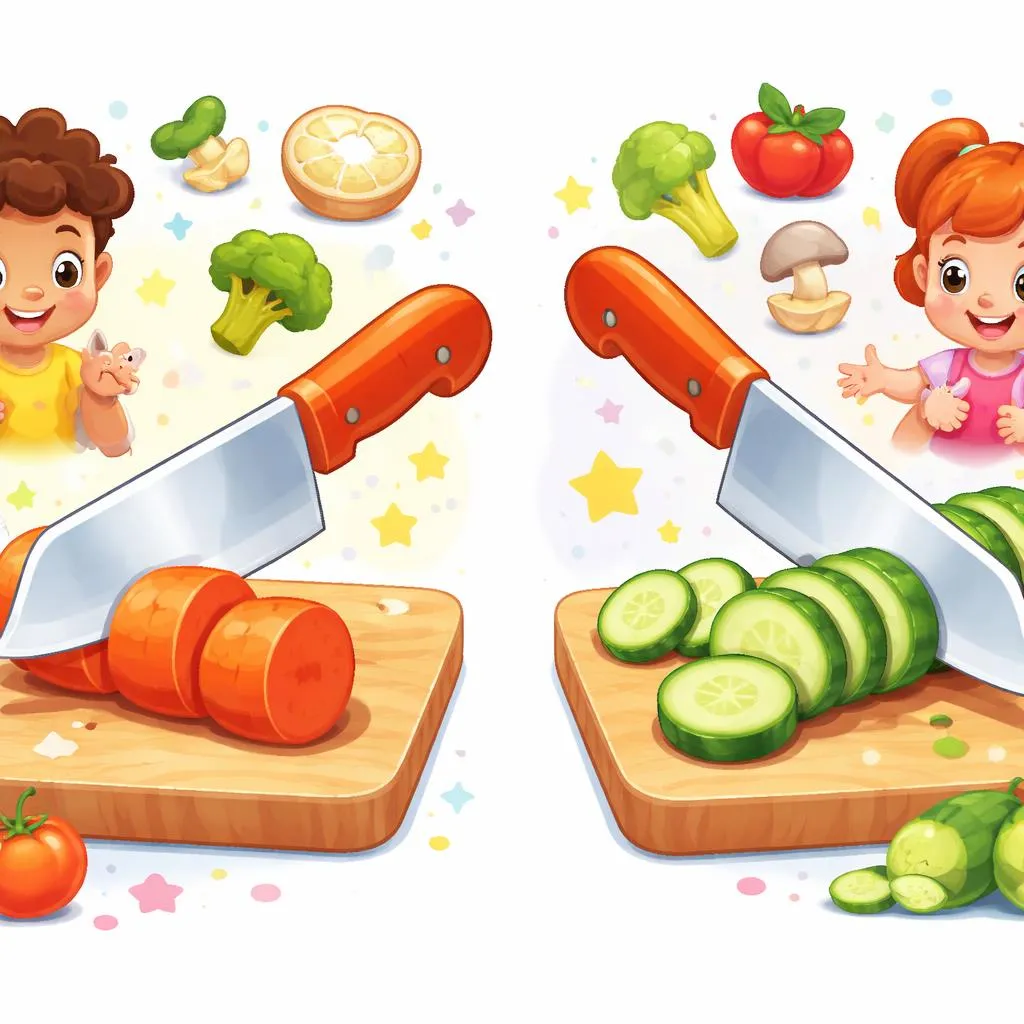

A child watches a parent prepare food. The parent takes a knife and cuts a carrot into pieces. Then they slice a tomato into thin rounds. Two words. Both mean "separate using a sharp tool." But one is general. One is more specific about thin pieces.
Children see cutting and slicing every day. Understanding the difference helps them describe kitchen actions and other separations.
This article helps families explore these cutting phrases. Your child will learn when to say "cut" and when to say "slice."
What Do These Expressions Mean?
"Cut to" means "separated or divided something using a sharp tool like scissors, a knife, or an axe." The word is very general. It says "you used a blade to make something into smaller parts."
For a child, think of cutting paper with scissors. You cut the paper into two pieces. The word "cut" works for almost any blade action.
"Sliced to" means "cut something into thin, flat pieces, often with one smooth motion." The word is more specific. It says "you made thin, wide pieces, like slices of bread or cheese."
For a child, think of cutting a loaf of bread. You slice it into thin pieces for sandwiches. Each piece is a slice. Slicing creates flat, even pieces.
These two expressions seem similar because both use a blade to separate things.
But one is general. One is specific to thin, flat pieces.
What's the Difference?
The main difference lies in the shape of the resulting pieces. "Cut to" is general. "Sliced to" creates thin, flat pieces.
One is for any shape. One is for flat slices.
"Cut to" sounds like any separation with a blade. You cut a rope. You cut a piece of paper. You cut a block of wood. The pieces can be any shape or size.
"Sliced to" sounds like food preparation. You slice bread. You slice cheese. You slice meat. The pieces are thin, wide, and often even.
Another difference involves the motion. Cutting can be one or many motions. Slicing is often one smooth, gliding motion.
Also, you can cut something into many shapes. Slicing always creates slices.
So remember: cut to = general blade separation. sliced to = created thin, flat pieces.
When Do We Use Each One?
Use "cut to" for general cutting. Use it for paper. Use it for rope. Use it for wood. Use it for fabric. Use it for hair.
For example, a child uses scissors to cut a piece of string. "She cut the string into two pieces." The word "cut" works perfectly.
Use "cut to" for vegetables in chunks. "He cut the carrot into large chunks."
Use "sliced to" for thin, flat pieces. Use it for bread. Use it for cheese. Use it for meat. Use it for tomatoes. Use it for cake.
For example, a child watches a parent prepare a sandwich. "She sliced the bread into thin pieces." The pieces are flat and even.
Use "sliced to" for fruit. "He sliced the apple into thin wedges."
Also use "sliced to" for any thin, flat cut. "The knife sliced through the soft butter."
Remember: general blade separation = "cut to." creating thin, flat pieces = "sliced to."
Example Sentences for Kids
Here are simple sentences for "cut to":
He cut the paper into small squares for the art project.
(General cutting of paper.)
She cut the rope into two equal lengths.
(General cutting of rope.)
The scissors cut the wrapping paper into a rectangle.
(General cutting for a shape.)
Here are simple sentences for "sliced to":
She sliced the loaf of bread into thick pieces for toast.
(Thin, flat pieces from bread.)
He sliced the cucumber into thin rounds for the salad.
(Thin, flat rounds.)
The baker sliced the cake into even portions for the party.
(Thin, flat slices of cake.)
Notice how "cut to" is general. "Sliced to" is specific to thin, flat pieces.
Common Mistakes to Avoid
Many people say "sliced to" for general cutting. This sounds too specific. A child cuts a piece of string. You say "he sliced the string."
Incorrect: String. "Sliced."
Correct: "He cut the string."
General cutting uses "cut."
Another mistake: using "cut to" for thin slices. This is not wrong, but "sliced" is more precise. A person slices bread. You say "he cut the bread."
Incorrect: Not wrong, but less precise.
Better: "He sliced the bread."
Thin, flat pieces fit "sliced" better.
A third mistake: forgetting that "slice" can also be a noun. "A slice of pizza" is the piece itself. "To slice" is the action. Teach your child both uses.
Easy Memory Tips
Here is a fun trick for kids. Think of scissors and a bread knife.
"Cut to" = scissors. You cut paper. You cut string. You cut anything. Scissors are general. Cut is general.
"Sliced to" = a bread knife. The bread knife has a long, smooth blade. It glides through bread. It makes thin, even slices. Slice is specific.
Another memory tip: look at the first letters. "Cut" starts with C like "Chop" (general). "Sliced" starts with S like "Sandwich" (thin pieces for a sandwich).
Draw a simple picture. Draw scissors cutting a piece of paper next to "cut to." Draw a bread knife slicing a loaf of bread next to "sliced to." The images help children feel the difference.
Also try this question: "Are you making thin, flat pieces or just cutting something?" If thin, flat pieces, say "sliced to." If general cutting, say "cut to."
Quick Practice Time
Try these easy exercises with your child. Fill in the blank with "cut" or "sliced."
She ________________ the cardboard into small pieces for a school project.
He ________________ the cheese into thin, flat pieces for the crackers.
The tailor ________________ the fabric to make a shirt.
She ________________ the tomato into thin rounds for the burger.
Answers:
Cut (general cutting of cardboard)
Sliced (thin, flat cheese pieces)
Cut (general fabric cutting)
Sliced (thin, flat tomato rounds)
Now practice using both phrases at home. When your child cuts anything in general, say "cut." When your child makes thin, flat pieces, especially of food, say "sliced." Your child will learn the difference between scissors and a bread knife.
Wrap-up
Use "cut to" for general separation with a blade, whether it is paper, rope, fabric, or wood. Use "sliced to" specifically for creating thin, flat pieces, usually of food like bread, cheese, meat, or vegetables. Both use a blade, but one works with scissors while one works with a bread knife.