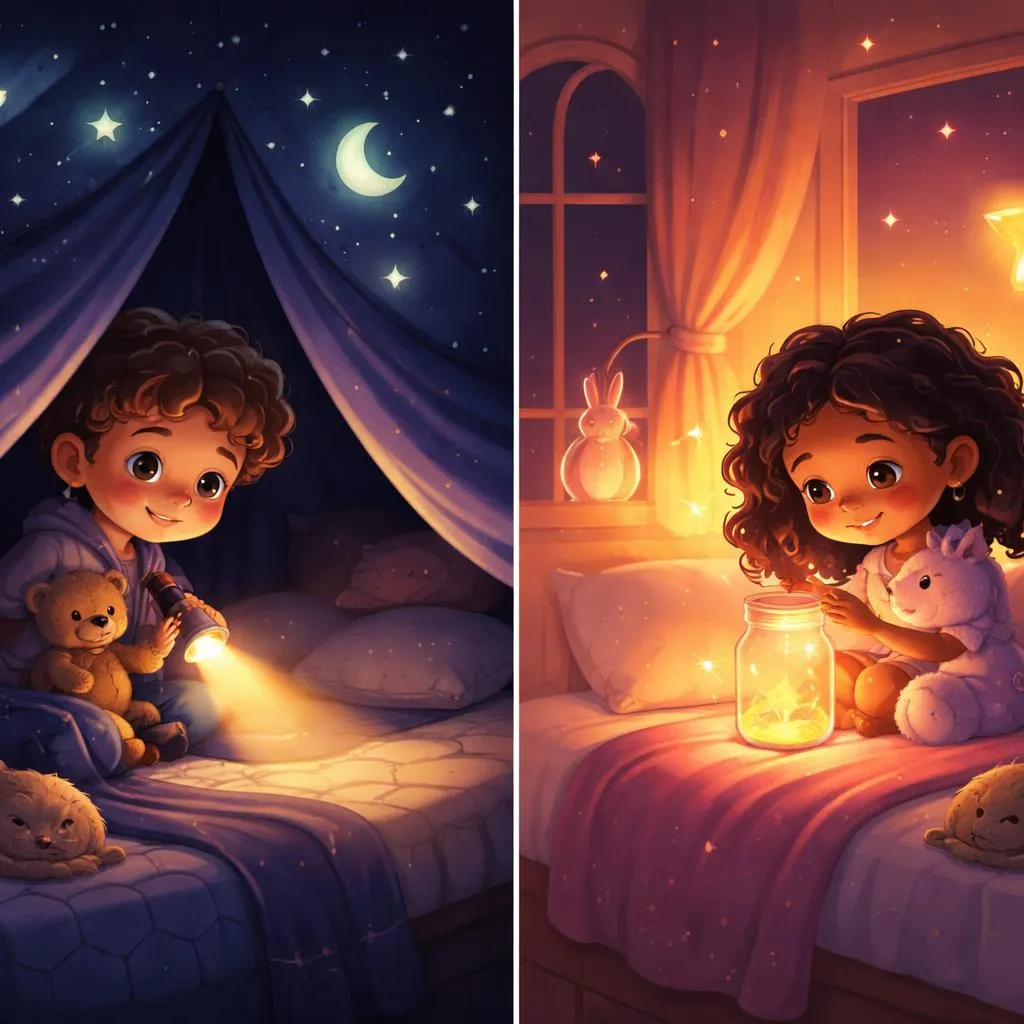

A child turns off the lights. "The room is dark," they say. Another child tries to read in a shadowy corner. "The light is too dim," they say. Two words. Both mean "not bright or having little light." But one is about having almost no light. One is about having weak, unclear light.
Children experience dark and dim places every day. Understanding the difference helps them describe light conditions accurately.
This article helps families explore these low-light words. Your child will learn when something is dark and when it is dim.
What Do These Expressions Mean?
"Dark to" means "having very little or no light; hard or impossible to see." The word describes absence of light. It says "this place has almost no light. You cannot see well."
For a child, think of a closet with the door closed. It is dark. You cannot see your hand. Dark is about nearly total absence of light.
"Dim to" means "having some light, but not enough to see clearly or brightly." The word describes weak illumination. It says "there is a little light, but it is not strong enough to see well."
For a child, think of a candle in a large room. The light is dim. You can see shapes, but you cannot read a book. Dim is about weak, insufficient light.
These two expressions seem similar because both describe low light situations.
But one is about almost no light. One is about weak, unclear light.
What's the Difference?
The main difference lies in how much light is present. "Dark to" means very little or no light. "Dim to" means some light, but not enough.
One is about absence. One is about weakness.
"Dark to" sounds like a moonless night, a closed closet, or a room with the lights off. You cannot see details. You might need a flashlight.
"Dim to" sounds like a room with one small lamp, a twilight sky, or a flashlight with low batteries. You can see shapes, but reading is hard.
Another difference involves what you can do. In the dark, you cannot see at all. In dim light, you can see shapes but not fine details.
Also, "dark" can describe colors (dark blue). "Dim" can describe intelligence (not smart).
So remember: dark to = almost no light, cannot see. dim to = weak light, can see shapes but not clearly.
When Do We Use Each One?
Use "dark to" for places with very little light. Use it for nights. Use it for closets. Use it for basements. Use it for rooms with lights off.
For example, a child walks into a room without windows. "The room was completely dark." There was almost no light.
Use "dark to" for color. "She has dark hair." (Not illumination, but color.)
Use "dim to" for weak light. Use it for old light bulbs. Use it for twilight. Use it for candles. Use it for screens at low brightness.
For example, a child tries to read by a small nightlight. "The light was too dim to read." There was some light, but not enough.
Use "dim to" for memory or hope. "His chances were dim." (Figurative, meaning not good.)
Also use "dim" for intelligence (informal). "He is a bit dim."
Remember: almost no light, cannot see = "dark to." weak light, can see shapes = "dim to."
Example Sentences for Kids
Here are simple sentences for "dark to":
The basement was so dark that we needed a flashlight to see.
(Almost no light.)
The sky grew dark as the sun set.
(Light fading away.)
He wore a dark blue shirt.
(Color, not illumination.)
Here are simple sentences for "dim to":
The old light bulb was dim and flickering.
(Weak light.)
In the dim light of the hallway, she could see shadows but not faces.
(Some light, but not clear.)
The stars looked dim through the cloudy sky.
(Weak brightness.)
Notice how "dark to" is for very little or no light. "Dim to" is for weak, insufficient light.
Common Mistakes to Avoid
Many people say "dim to" for complete darkness. This is incorrect. A room with no light is not dim. It is dark. You say "the room is dim."
Incorrect: No light. "Dim."
Correct: "The room is dark."
Complete darkness uses "dark."
Another mistake: using "dark to" for weak light. This is too strong. A room with a small lamp is not dark. It is dim. You say "the room is dark."
Incorrect: Weak light. "Dark."
Correct: "The room is dim."
Weak but present light uses "dim."
A third mistake: forgetting that "dim" can describe a person's intelligence. "He is dim" means not smart. That is different from "the light is dim." Teach your child the context.
Easy Memory Tips
Here is a fun trick for kids. Think of a closed closet and a dying flashlight.
"Dark to" = a closed closet. You open the door. It is dark. You cannot see anything. Dark is almost no light.
"Dim to" = a dying flashlight. The batteries are low. The beam is weak. You can see a little, but not much. Dim is weak light.
Another memory tip: look at the first letters. "Dark" starts with D like "Deep darkness." "Dim" starts with D like "Dull light."
Draw a simple picture. Draw a black, dark closet next to "dark to." Draw a weak flashlight beam next to "dim to." The images help children feel the difference.
Also try this question: "Is there almost no light at all, or is there some weak light?" If almost no light, say "dark to." If some weak light, say "dim to."
Quick Practice Time
Try these easy exercises with your child. Fill in the blank with "dark" or "dim."
The room was so ________________ that she could not find the door.
The candle gave a ________________ glow that barely lit the table.
The night sky was ________________ except for a few stars.
The old computer screen was ________________ and hard to read.
Answers:
Dark (almost no light, could not see)
Dim (weak glow)
Dark (very little light from stars)
Dim (weak screen brightness)
Now practice using both phrases at home. When there is almost no light, say "dark." When there is some weak light but not enough to see clearly, say "dim." Your child will learn the difference between a closed closet and a dying flashlight.
Wrap-up
Use "dark to" for places or times with very little or almost no light, where seeing is nearly impossible. Use "dim to" for weak, insufficient light where you can see shapes but not clearly or comfortably. Both describe low light, but one is a closed closet while one is a dying flashlight.