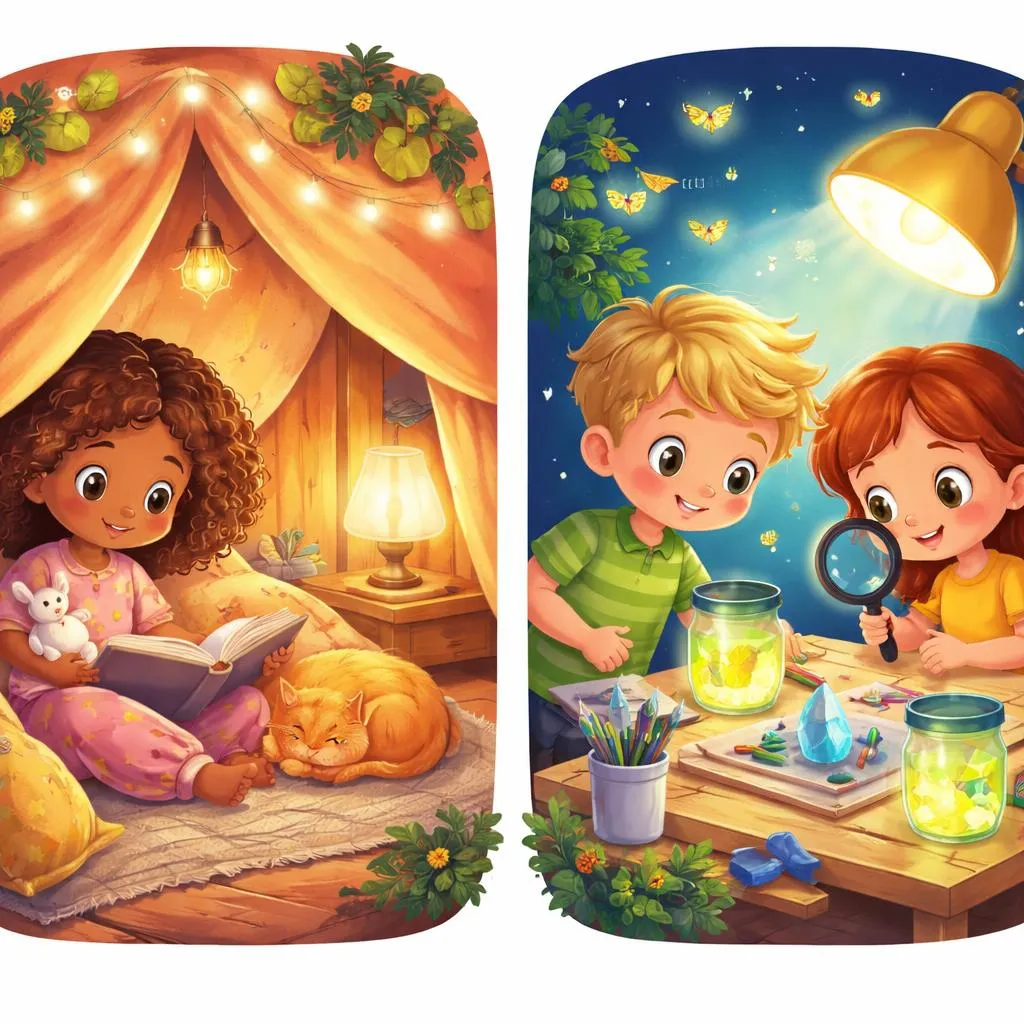

A child turns on a lamp. "The room is light now," they say. Another child looks at the sun. "The sun is so bright," they say. Two words. Both mean "full of light." But one is about having enough light to see. One is about shining strongly.
Children see light and bright things every day. Understanding the difference helps them describe what they see.
This article helps families explore these illumination words. Your child will learn when something is light and when it is bright.
What Do These Expressions Mean?
"Light to" means "having enough illumination to see clearly, not dark." The word describes adequate lighting. It says "this place is not dark. You can see."
For a child, think of a room with a lamp on. The room is light. You can read a book. Light is about having enough light, not being dark.
"Bright to" means "shining with intense light; very brilliant." The word describes strong illumination. It says "this light is very strong. It might hurt your eyes."
For a child, think of the sun. You cannot stare at it. It is bright. Bright is about intensity, not just having light.
These two expressions seem similar because both are about light.
But one is about enough light to see. One is about very strong light.
What's the Difference?
The main difference lies in the intensity of the light. "Light to" means adequate, not dark. "Bright to" means very strong, intense.
One is about sufficiency. One is about intensity.
"Light to" sounds like a well-lit room, a light sky, or a light-colored object. The light is enough for comfort.
"Bright to" sounds like a flashlight in your eyes, the sun, or a shiny diamond. The light is so strong it stands out.
Another difference involves the feeling. Light is comfortable. Bright can be uncomfortable.
Also, "light" can describe weight or color. "Bright" can describe intelligence or vivid color. These are different meanings.
So remember: light to = enough light to see (not dark). bright to = very strong, intense light.
When Do We Use Each One?
Use "light to" for adequate illumination. Use it for rooms. Use it for mornings. Use it for skies. Use it for colors (light blue).
For example, a child walks into a room with a window. "The room is light during the day." There is enough light to see.
Use "light to" for pale colors. "She wore a light green shirt."
Use "bright to" for intense light. Use it for the sun. Use it for flashlights. Use it for headlights. Use it for shiny surfaces.
For example, a child looks at a car's headlights. "The lights were so bright they hurt my eyes." The intensity is high.
Use "bright to" for vivid colors. "The flower was bright red."
Also use "bright" for intelligence. "She is a bright student."
Remember: adequate light, not dark = "light to." very strong, intense light = "bright to."
Example Sentences for Kids
Here are simple sentences for "light to":
The kitchen was light and airy with big windows.
(Enough light to see comfortably.)
She wore a light jacket on a warm day.
(Here "light" means not heavy, not illumination.)
The sky turned light blue in the morning.
(Pale color, not intense.)
Here are simple sentences for "bright to":
The bright sun made us wear sunglasses.
(Intense light.)
The flashlight was so bright it lit up the whole yard.
(Strong illumination.)
Her smile was bright and cheerful.
(Figurative, meaning happy and shining.)
Notice how "light to" is for adequate or pale. "Bright to" is for intense or vivid.
Common Mistakes to Avoid
Many people say "bright to" for adequate light. This is too strong. A well-lit room is not bright. You say "the room is bright."
Incorrect: Not wrong, but "bright" is too strong.
Better: "The room is light."
Adequate light uses "light."
Another mistake: using "light to" for intense light. This is too weak. The sun is not light. It is bright. You say "the sun is light."
Incorrect: Sun intensity. "Light."
Correct: "The sun is bright."
Intense light uses "bright."
A third mistake: forgetting that "light" has many meanings (not heavy, pale, illumination). "Bright" also has many meanings (intelligent, vivid, shining). Teach your child the context to choose the right meaning.
Easy Memory Tips
Here is a fun trick for kids. Think of a reading lamp and the sun.
"Light to" = a reading lamp. The lamp makes the room light enough to read. Light is comfortable.
"Bright to" = the sun. The sun is so bright you cannot look at it. Bright is very intense.
Another memory tip: look at the first letters. "Light" starts with L like "Lamp" (comfortable light). "Bright" starts with B like "Blinding" (very strong).
Draw a simple picture. Draw a lamp lighting a room next to "light to." Draw the bright sun with rays next to "bright to." The images help children feel the difference.
Also try this question: "Is the light comfortable and adequate or very strong and intense?" If comfortable and adequate, say "light to." If very strong and intense, say "bright to."
Quick Practice Time
Try these easy exercises with your child. Fill in the blank with "light" or "bright."
The classroom was ________________ with sunlight from the windows.
The car's headlights were so ________________ that I had to look away.
She painted her room a ________________ blue color.
The fireworks exploded in ________________ colors against the night sky.
Answers:
Light (adequate light to see)
Bright (intense light, painful)
Light (pale color, not intense)
Bright (vivid, intense colors)
Now practice using both phrases at home. When you have enough light to see comfortably, say "light." When you see very strong, intense light, say "bright." Your child will learn the difference between a reading lamp and the sun.
Wrap-up
Use "light to" for adequate illumination that is comfortable for seeing, and for pale colors. Use "bright to" for very strong, intense light that shines powerfully, and for vivid colors. Both describe light, but one is a reading lamp while one is the sun.