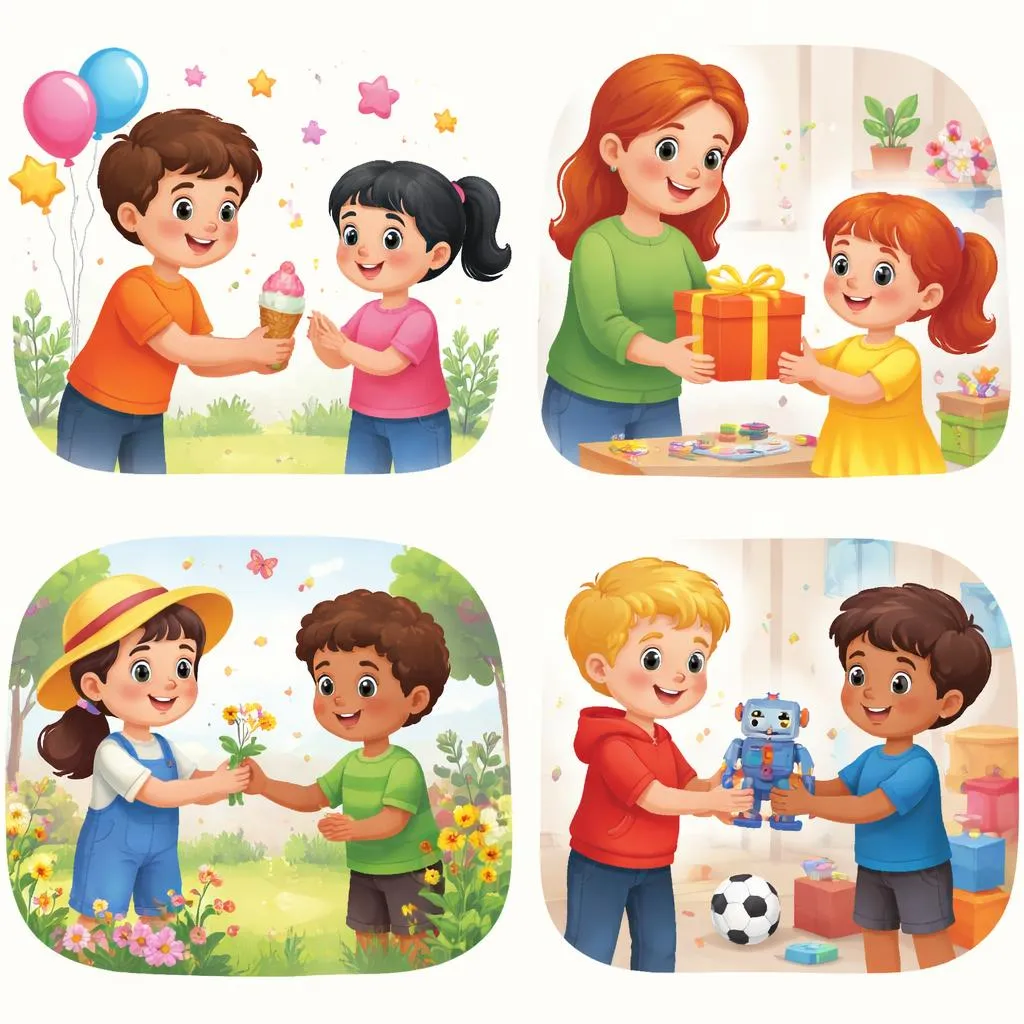

A child holds out a cookie to a friend. "I offer you this cookie," they say. Another child stands in front of the class. "I present my science project," they say. Two words. Both mean "give or show something to someone." But one is about giving a choice. One is about showing formally.
Children offer and present things every day. Understanding the difference helps them describe how they give or show things.
This article helps families explore these giving phrases. Your child will learn when they offer and when they present.
What Do These Expressions Mean?
"Offered to" means "gave someone the chance to take or receive something." The word suggests choice. It says "here is something if you want it. You can say yes or no."
For a child, think of sharing a snack. You hold out a cracker. "Do you want one?" You offer the cracker. The other person can take it or leave it.
"Presented to" means "showed or gave something formally, often in front of people." The word suggests a ceremony or a formal setting. It says "here is something important. Please pay attention."
For a child, think of giving a speech in class. You stand up. You show your poster. You present your project to the teacher and classmates.
These two expressions seem similar because both involve giving or showing something to someone.
But one is about giving a choice. One is about formal showing.
What's the Difference?
The main difference lies in the formality and whether there is a choice. "Offered to" is casual and gives a choice. "Presented to" is formal and often has no choice.
One is about offering options. One is about formal delivery.
"Offered to" sounds like sharing or proposing. You offer a drink. You offer to help. You offer an idea. The other person decides yes or no.
"Presented to" sounds like a ceremony or a meeting. You present an award. You present a report. You present a gift in front of people. The focus is on the act of showing.
Another difference involves the audience. Offering can be to one person. Presenting is often to a group.
Also, presenting often involves preparation and formality.
So remember: offered to = casual, gives a choice. presented to = formal, often to a group.
When Do We Use Each One?
Use "offered to" for casual giving. Use it for food. Use it for help. Use it for suggestions. Use it when the person can say no.
For example, a child sees a friend who looks thirsty. "He offered a glass of water to his friend." The friend could say yes or no.
Use "offered to" for help. "She offered to carry the heavy bag."
Use "presented to" for formal occasions. Use it for awards. Use it for speeches. Use it for projects. Use it for ceremonies.
For example, a child wins a spelling bee. The principal gives a trophy. "The principal presented the award to the winner." The setting is formal.
Use "presented to" for school reports. "She presented her research to the class."
Also use "presented to" for showing something important. "He presented his artwork to his grandparents."
Remember: casual, with choice = "offered to." formal, often to a group = "presented to."
Example Sentences for Kids
Here are simple sentences for "offered to":
He offered his seat to an elderly woman on the bus.
(Casual giving, she could say no.)
She offered to help her little brother tie his shoes.
(Offering assistance.)
I offered my friend a piece of gum.
(Casual sharing with a choice.)
Here are simple sentences for "presented to":
The teacher presented the award to the best artist in the class.
(Formal ceremony.)
She presented her science project to the judging panel.
(Formal showing to a group.)
He presented a gift to his mom on her birthday.
(Formal gift-giving occasion.)
Notice how "offered to" is casual and gives a choice. "Presented to" is formal and often ceremonial.
Common Mistakes to Avoid
Many people say "presented to" for casual offers. This sounds too formal. A child offers a cracker to a friend. You say "he presented a cracker to his friend."
Incorrect: Casual cracker. "Presented."
Correct: "He offered a cracker to his friend."
Casual sharing uses "offered."
Another mistake: using "offered to" for formal ceremonies. This sounds too casual. A principal gives an award. You say "the principal offered the award."
Incorrect: Award ceremony. "Offered."
Correct: "The principal presented the award."
Formal occasions use "presented."
A third mistake: forgetting that "offer" can also mean "say you will pay a certain amount." "He offered $10 for the toy" is different from "he offered a toy to his friend." Teach your child the different meanings.
Easy Memory Tips
Here is a fun trick for kids. Think of an open hand and a stage.
"Offered to" = an open hand with a cookie. "Would you like one?" The open hand gives a choice. The other person decides.
"Presented to" = a stage with a microphone. The person stands on stage. They show something important to the audience. The stage is for formal presentations.
Another memory tip: look at the first letters. "Offered" starts with O like "Option" (choice). "Presented" starts with P like "Performance" (formal).
Draw a simple picture. Draw an open hand with a cookie next to "offered to." Draw a person on a stage with a spotlight next to "presented to." The images help children feel the difference.
Also try this question: "Is this casual giving with a choice, or formal showing to a group?" If casual with choice, say "offered to." If formal showing, say "presented to."
Quick Practice Time
Try these easy exercises with your child. Fill in the blank with "offered" or "presented."
She ________________ her friend a bite of her sandwich.
The mayor ________________ a key to the city to the hero.
He ________________ to help his mom carry the groceries.
The students ________________ their group project to the entire class.
Answers:
Offered (casual sharing of a sandwich)
Presented (formal ceremony with a key to the city)
Offered (casual offer of help)
Presented (formal showing to a class)
Now practice using both phrases at home. When your child casually offers something with a choice, say "you offered." When your child formally shows something to a group, say "you presented." Your child will learn the difference between an open hand and a stage.
Wrap-up
Use "offered to" for casual giving when the other person has a choice to accept or decline, like sharing food or help. Use "presented to" for formal showing or giving, often in front of a group or during a ceremony. Both involve giving, but one holds out an open hand while one stands on a stage.