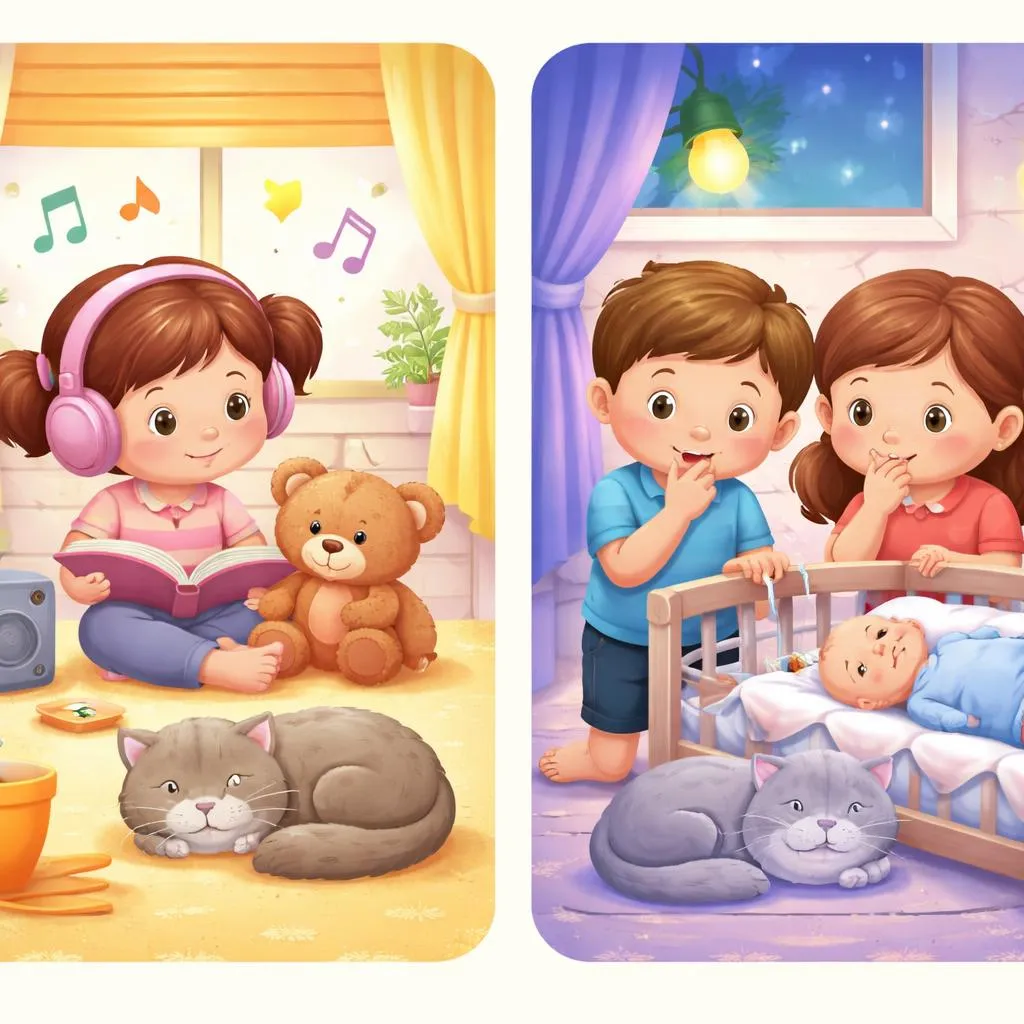

A child sits in a library. "This place is quiet," they whisper. Another child sits alone in a room. "The house is silent," they say. Two words. Both mean "not loud or making little sound." But one is about low sound with possible soft noises. One is about complete absence of sound.
Children experience quiet and silent places every day. Understanding the difference helps them describe sound conditions accurately.
This article helps families explore these low-sound words. Your child will learn when something is quiet and when it is silent.
What Do These Expressions Mean?
"Quiet to" means "making very little sound; not loud or noisy." The word describes low volume. It says "there is some sound, but it is soft and not disturbing."
For a child, think of a library. People whisper. Pages turn softly. It is quiet. You can hear small sounds, but they are gentle.
"Silent to" means "making no sound at all; completely without noise." The word describes total absence of sound. It says "there is no sound whatsoever."
For a child, think of a room with no one in it. No one is talking. No music is playing. No wind is blowing. It is silent. You hear nothing.
These two expressions seem similar because both describe low sound levels.
But one is about very little sound. One is about no sound at all.
What's the Difference?
The main difference lies in how much sound is present. "Quiet to" means some soft sound exists. "Silent to" means absolutely no sound.
One is about low volume. One is about complete absence.
"Quiet to" sounds like a bedroom at night, a forest with birds far away, or a room with a fan humming softly. You can hear something, but it is not loud.
"Silent to" sounds like an empty church, a vacuum of space, or a soundproof room. Your ears hear nothing. It can feel strange.
Another difference involves what you can hear. In a quiet place, you can hear soft sounds. In a silent place, you hear nothing.
Also, "silent" is stronger and more absolute than "quiet."
So remember: quiet to = very little sound (soft sounds present). silent to = no sound at all.
When Do We Use Each One?
Use "quiet to" for low-volume environments. Use it for libraries. Use it for bedrooms. Use it for early mornings. Use it for whispered conversations.
For example, a child goes to the library to study. "The library is quiet." People are speaking softly. Pages are turning.
Use "quiet to" for a calm voice. "She spoke in a quiet voice."
Use "silent to" for complete absence of sound. Use it for empty rooms. Use it for deep space. Use it for soundproof places. Use it for a person not speaking.
For example, a child sits alone in a room with no electronics on. "The room was completely silent." There was no sound at all.
Use "silent to" for a person who does not speak. "He remained silent during the meeting."
Also use "silent" for movies without sound. "Silent film."
Remember: very little soft sound = "quiet to." no sound at all = "silent to."
Example Sentences for Kids
Here are simple sentences for "quiet to":
The classroom was quiet while the students took their test.
(Low volume, some soft sounds like pencils writing.)
Please be quiet so the baby can sleep.
(Make very little sound.)
The forest was quiet except for the sound of leaves rustling.
(Soft sounds present.)
Here are simple sentences for "silent to":
The house was silent after everyone went to bed.
(No sound at all.)
She remained silent when asked the question; she did not say a word.
(Not speaking.)
The old movie theater was completely silent between shows.
(No noise whatsoever.)
Notice how "quiet to" allows for soft sounds. "Silent to" means no sound at all.
Common Mistakes to Avoid
Many people say "silent to" for quiet places. This is too strong. A library is not silent. It is quiet. You say "the library is silent."
Incorrect: Library with soft sounds. "Silent."
Correct: "The library is quiet."
Places with soft sounds are quiet, not silent.
Another mistake: using "quiet to" for complete silence. This is too weak. A room with no sound is not just quiet. It is silent. You say "the room is quiet."
Incorrect: No sound. "Quiet."
Correct: "The room is silent."
Complete absence of sound uses "silent."
A third mistake: forgetting that "silent" can describe a person who does not speak. "He was silent" means he did not talk. "He was quiet" could mean he spoke softly. Teach your child the nuance.
Easy Memory Tips
Here is a fun trick for kids. Think of a library and an empty room.
"Quiet to" = a library. People whisper. Books open. It is quiet. You can hear soft sounds.
"Silent to" = an empty room with no one inside. No sounds at all. It is silent.
Another memory tip: look at the first letters. "Quiet" starts with Q like "Quite low." "Silent" starts with S like "Still and soundless."
Draw a simple picture. Draw a library with people whispering next to "quiet to." Draw an empty, soundless room next to "silent to." The images help children feel the difference.
Also try this question: "Are there any soft sounds, or is there no sound at all?" If soft sounds, say "quiet to." If no sound, say "silent to."
Quick Practice Time
Try these easy exercises with your child. Fill in the blank with "quiet" or "silent."
The museum was ________________, with only the soft footsteps of visitors.
The empty cave was completely ________________; we could hear nothing.
Please be ________________ during the movie.
He stood ________________ and did not answer the question.
Answers:
Quiet (soft sounds present)
Silent (no sound at all)
Quiet (make very little sound)
Silent (did not speak)
Now practice using both phrases at home. When there are soft sounds, say "quiet." When there is no sound at all, say "silent." Your child will learn the difference between a library and an empty room.
Wrap-up
Use "quiet to" for environments with very little soft sound, like a library or a bedroom at night. Use "silent to" for complete absence of sound, like an empty room or a person not speaking. Both describe low sound, but one has whispers while one has nothing at all.