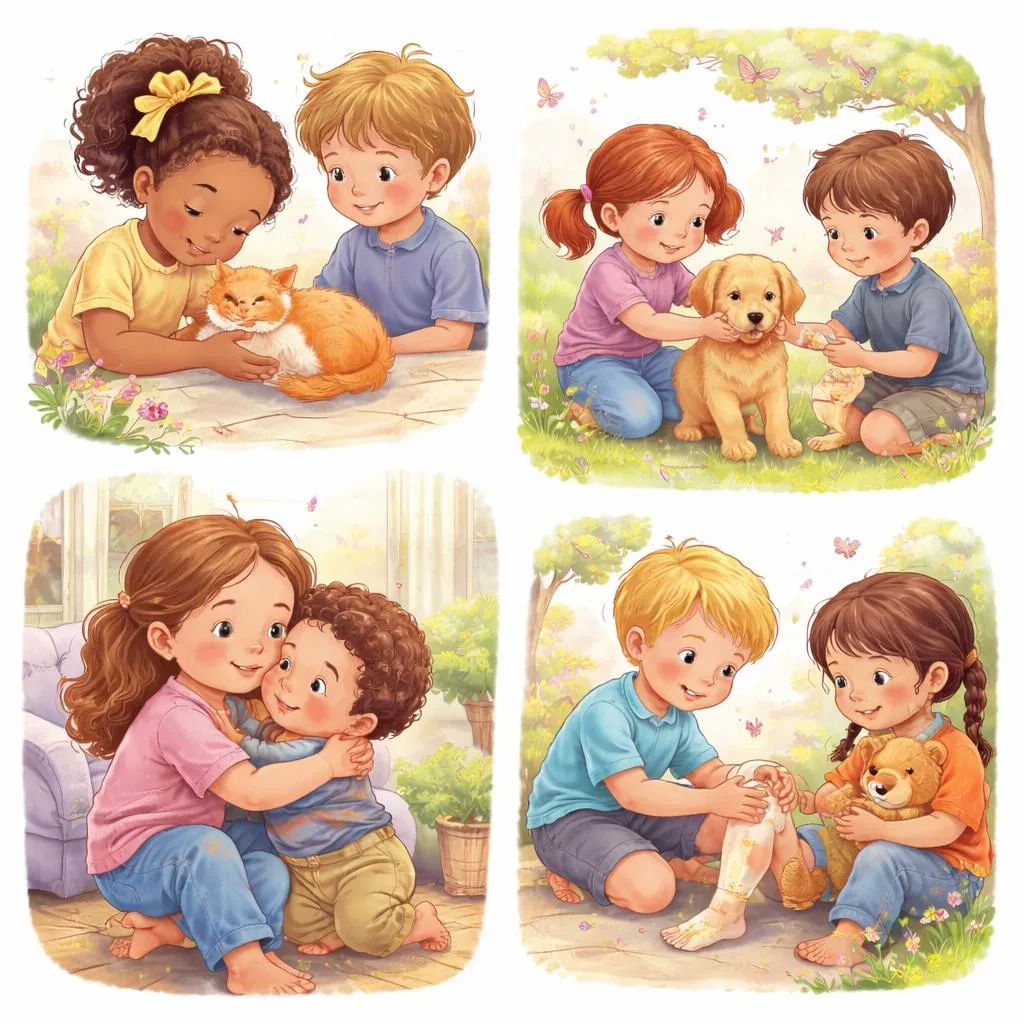

A child snuggles a stuffed animal. "This bunny is so soft," they say. Another child feels a light breeze. "The wind is gentle today," they say. Two words. Both mean "not hard or rough." But one is about how something feels to touch. One is about how something acts.
Children feel soft and gentle things every day. Understanding the difference helps them describe textures and actions.
This article helps families explore these tenderness words. Your child will learn when something is soft and when it is gentle.
What Do These Expressions Mean?
"Soft to" means "easy to press, bend, or squish, not hard or rough." The word describes texture. It says "this thing gives way when you touch it."
For a child, think of a pillow. You push your hand into it. It gives way. It is soft. Soft is about how something feels.
"Gentle to" means "kind, mild, or not using much force." The word describes actions or behavior. It says "this person or thing is careful and not rough."
For a child, think of a parent petting a baby's head. The touch is gentle. Gentle is about how someone acts.
These two expressions seem similar because both are the opposite of rough or harsh.
But one is about texture. One is about action.
What's the Difference?
The main difference lies in what is being described. "Soft to" describes texture or feel. "Gentle to" describes actions or force.
One is about touch. One is about behavior.
"Soft to" sounds like materials. A soft blanket. Soft fur. Soft bread. You can press it. It changes shape.
"Gentle to" sounds like actions. A gentle pat. A gentle voice. A gentle breeze. The focus is on how much force is used.
Another difference involves what can be described. Objects can be soft. People and animals can be gentle.
Also, you can have a soft touch (texture) or a gentle touch (action). The words can overlap but have different focuses.
So remember: soft to = texture, easy to press. gentle to = action, using little force.
When Do We Use Each One?
Use "soft to" for textures and materials. Use it for pillows. Use it for blankets. Use it for fur. Use it for food.
For example, a child touches a kitten's fur. "The kitten's fur is soft." The texture is smooth and pleasant.
Use "soft to" for bread. "The fresh bread has a soft inside."
Use "gentle to" for actions and behavior. Use it for touches. Use it for voices. Use it for winds. Use it for people.
For example, a child is crying. A parent speaks quietly. "Her voice was gentle." The action was kind and calm.
Use "gentle to" for handling things. "Be gentle with the baby bird."
Also use "gentle to" for natural forces. "A gentle breeze blew through the trees."
Remember: texture and feel = "soft to." actions and force = "gentle to."
Example Sentences for Kids
Here are simple sentences for "soft to":
The baby's blanket was soft and cuddly.
(Texture of the blanket.)
The dog's ears felt soft like velvet.
(Texture of the fur.)
This pillow is so soft that my head sinks into it.
(Material gives way.)
Here are simple sentences for "gentle to":
The mother spoke in a gentle voice to calm her child.
(Action of speaking kindly.)
Be gentle with the fragile glass ornament.
(Action of handling carefully.)
A gentle rain fell on the flowers.
(Natural force with little intensity.)
Notice how "soft to" is about how something feels. "Gentle to" is about how someone or something acts.
Common Mistakes to Avoid
Many people say "gentle to" for textures. This sounds odd. A pillow is soft. You say "the pillow is gentle."
Incorrect: Pillow texture. "Gentle."
Correct: "The pillow is soft."
Textures use "soft."
Another mistake: using "soft to" for actions. A kind touch is gentle. You say "the touch was soft."
Incorrect: Not wrong, but "gentle" is more precise for actions.
Better: "The touch was gentle."
Gentle actions use "gentle" for the action itself. "Soft" works for the feeling of the touch.
A third mistake: forgetting that "soft" can also describe sound. "Soft music" means quiet music. "Gentle music" also works but has a different feel. Teach your child that "soft" is for texture, sound level, and sometimes action. "Gentle" is specifically for kind, careful actions.
Easy Memory Tips
Here is a fun trick for kids. Think of a pillow and a hug.
"Soft to" = a pillow. You squish it. It is soft to touch. Soft is about texture.
"Gentle to" = a hug. A gentle hug is not too tight. It is kind. Gentle is about action.
Another memory tip: look at the first letters. "Soft" starts with S like "Squish." "Gentle" starts with G like "Good touch."
Draw a simple picture. Draw a squishy pillow next to "soft to." Draw a person giving a gentle hug next to "gentle to." The images help children feel the difference.
Also try this question: "Is this about how something feels or how someone acts?" If about feel, say "soft to." If about action, say "gentle to."
Quick Practice Time
Try these easy exercises with your child. Fill in the blank with "soft" or "gentle."
The cat's fur was very ________________ to touch.
Please be ________________ with the puppy. Do not squeeze it.
She spoke in a ________________ voice so she would not wake the baby.
The fresh bread had a ________________, fluffy inside.
Answers:
Soft (texture of fur)
Gentle (action of handling carefully)
Gentle (action of speaking quietly and kindly)
Soft (texture of bread)
Now practice using both phrases at home. When you touch a smooth, squishy texture, say "soft." When you act with care and little force, say "gentle." Your child will learn the difference between a pillow and a kind touch.
Wrap-up
Use "soft to" to describe textures that are easy to press, squish, or bend, like pillows, fur, or bread. Use "gentle to" to describe actions that use little force, are kind, or are careful, like a pat, a voice, or a breeze. Both are tender, but one is a pillow while one is a kind hug.