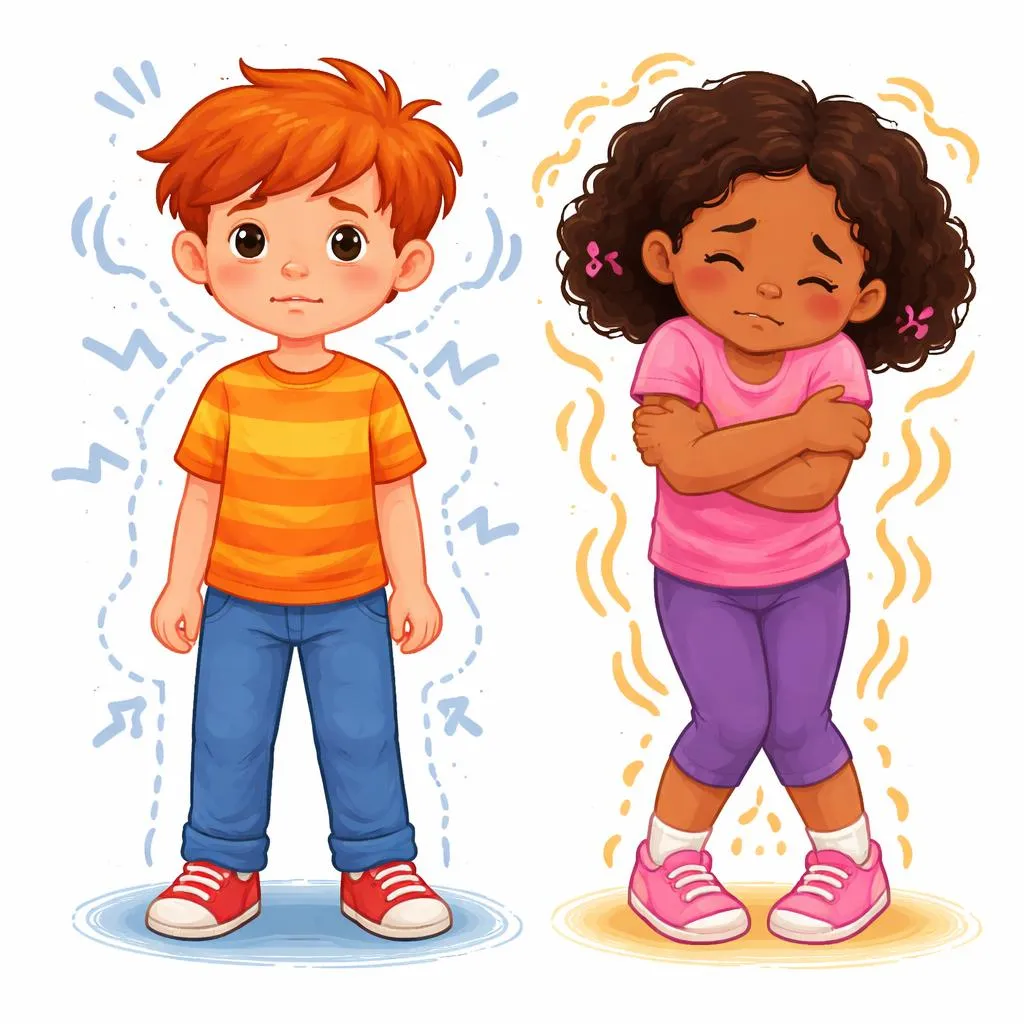

A child wakes up after sleeping in a funny position. "My neck feels stiff," they say. Another child puts on new shoes. "The laces are too tight," they say. Two words. Both mean "hard to move or uncomfortable." But one is about joints and muscles. One is about fit and pressure.
Children feel stiff and tight in different ways. Understanding the difference helps them describe what their bodies feel.
This article helps families explore these body feeling phrases. Your child will learn when they feel stiff and when they feel tight.
What Do These Expressions Mean?
"Stiff to" means "hard to move or bend because of cold, soreness, or lack of use." The word suggests difficulty moving a body part. It says "this part of my body does not want to bend easily."
For a child, think of a cold morning. Your fingers feel stiff. They do not move as fast. Stiffness is about movement.
"Right to" means "held too closely, with no extra space." The word suggests pressure or constriction. It says "this is squeezing me. It does not have enough room."
For a child, think of a belt that is too tight. It presses on your stomach. Tightness is about pressure and fit.
These two expressions seem similar because both describe uncomfortable physical sensations.
But one is about movement. One is about pressure.
What's the Difference?
The main difference lies in what the sensation affects. "Stiff to" affects movement. "Tight to" affects fit and pressure.
One is about bending. One is about squeezing.
"Stiff to" sounds like joints, muscles, and body parts that should bend but do not. Your neck is stiff. Your legs are stiff after sitting. You can still move, but it is hard.
"Tight to" sounds like something squeezing your body. Tight shoes press on your feet. A tight shirt presses on your chest. The discomfort is from constriction.
Another difference involves what causes the feeling. Stiffness comes from cold, soreness, or sitting still. Tightness comes from clothing, fasteners, or swelling.
Also, you can stretch to relieve stiffness. You can loosen to relieve tightness.
So remember: stiff to = hard to move (joints, muscles). tight to = squeezed by pressure (clothing, fit).
When Do We Use Each One?
Use "stiff to" for body parts that do not bend easily. Use it for necks. Use it for legs. Use it for fingers. Use it for backs.
For example, a child sits on the floor for a long time. When they stand up, their legs are hard to move. "My legs feel stiff." The difficulty is in movement.
Use "stiff to" for cold fingers. "My fingers are stiff from the snow."
Use "tight to" for clothing and fasteners. Use it for shoes. Use it for belts. Use it for shirts. Use it for knots.
For example, a child's new shoes press on their feet. "These shoes are too tight." The pressure is uncomfortable.
Use "tight to" for lid or jar. "The jar lid is tight."
Also use "tight to" for muscles that feel tense. "My shoulders feel tight." (Here, tight can also mean stiff, but it is a different feeling of tension.)
Remember: hard to move (joints, muscles) = "stiff to." squeezed by pressure (clothing, fit) = "tight to."
Example Sentences for Kids
Here are simple sentences for "stiff to":
His neck was stiff after sleeping on the couch.
(Hard to turn the neck.)
My legs feel stiff after sitting in the car for three hours.
(Difficulty moving legs.)
Her fingers were stiff from playing outside in the cold.
(Fingers hard to bend.)
Here are simple sentences for "tight to":
The shoes were too tight and pinched her toes.
(Squeezing pressure on feet.)
He pulled the rope tight to secure the knot.
(No extra space.)
The jar lid was so tight that she could not open it.
(Hard to turn due to pressure.)
Notice how "stiff to" is for body parts that are hard to move. "Tight to" is for squeezing or lack of space.
Common Mistakes to Avoid
Many people say "tight to" for stiff muscles. This is common but slightly different. A child's neck is hard to turn. You say "my neck is tight."
Incorrect: Not wrong, but "stiff" is more precise for movement.
Better: "My neck is stiff."
Stiffness is about movement. Tightness is about pressure.
Another mistake: using "stiff to" for tight clothing. This sounds odd. Shoes squeeze your feet. You say "the shoes are stiff."
Incorrect: Tight shoes. "Stiff."
Correct: "The shoes are tight."
Clothing fit uses "tight."
A third mistake: forgetting that "stiff" can also describe objects like cardboard. "The paper is stiff" means it does not bend easily. That is okay. "The paper is tight" does not make sense. Teach your child the difference between body stiffness and object stiffness.
Easy Memory Tips
Here is a fun trick for kids. Think of a robot and a belt.
"Stiff to" = a robot. Robots move slowly. Their joints are hard to bend. Stiff is about movement.
"Right to" = a belt. A belt squeezes your waist. It is tight. Tight is about pressure and fit.
Another memory tip: look at the first letters. "Stiff" starts with S like "Slow movement." "Tight" starts with T like "Tension" (squeezing).
Draw a simple picture. Draw a robot with stiff arms next to "stiff to." Draw a belt squeezing a waist next to "tight to." The images help children feel the difference.
Also try this question: "Is this about hard to move or about squeezing pressure?" If hard to move, say "stiff to." If squeezing pressure, say "tight to."
Quick Practice Time
Try these easy exercises with your child. Fill in the blank with "stiff" or "tight."
After the long flight, his legs felt ________________.
The new jeans were too ________________ around her waist.
Her fingers were ________________ from the cold weather.
He pulled the drawstring ________________ so the bag would stay closed.
Answers:
Stiff (legs hard to move)
Tight (clothing squeezing)
Stiff (fingers hard to bend from cold)
Tight (no extra space on the drawstring)
Now practice using both phrases at home. When your child's joints or muscles are hard to move, say "stiff." When clothing or fasteners squeeze with no extra space, say "tight." Your child will learn the difference between a robot's movement and a belt's squeeze.
Wrap-up
Use "stiff to" when body parts like joints or muscles are hard to move or bend. Use "tight to" when something squeezes with no extra space, like clothing, fasteners, or lids. Both describe physical discomfort, but one moves like a robot while one squeezes like a belt.