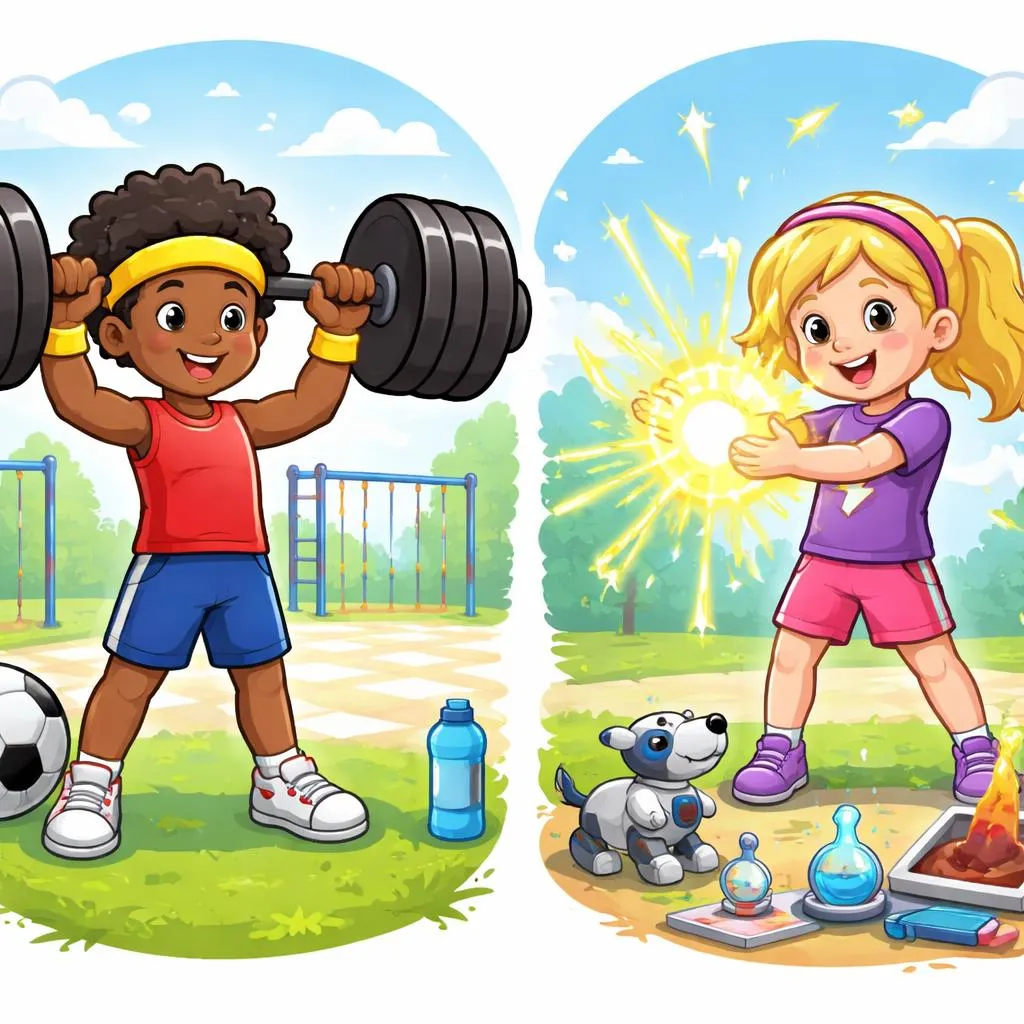

A child lifts a heavy box. "I am strong," they say. Another child watches a giant truck. "That engine is powerful," they say. Two words. Both mean "having great force or strength." But one is about personal physical strength. One is about the ability to affect things.
Children see strong and powerful things every day. Understanding the difference helps them describe strength accurately.
This article helps families explore these strength words. Your child will learn when something is strong and when it is powerful.
What Do These Expressions Mean?
"Strong to" means "having great physical force, energy, or durability." The word describes the ability to lift, hold, or resist force. It says "this person or thing can handle a lot of pressure."
For a child, think of a weightlifter. They can lift heavy weights. They are strong. Strong is about physical power and toughness.
"Powerful to" means "having great ability to affect, control, or influence things." The word describes impact or influence. It says "this thing can cause big changes."
For a child, think of an engine. A powerful engine can pull a heavy train. Powerful is about the ability to make things happen.
These two expressions seem similar because both describe great force.
But one is about personal physical strength. One is about impact and influence.
What's the Difference?
The main difference lies in what the strength does. "Strong to" describes physical force and durability. "Powerful to" describes the ability to create an effect.
One is about capacity. One is about impact.
"Strong to" sounds like a strong person, a strong rope, or a strong wall. The focus is on how much force it can take or apply.
"Powerful to" sounds like a powerful storm, a powerful speech, or a powerful engine. The focus is on the effect or change it creates.
Another difference involves the subject. People and objects can be strong. Powerful is often for forces, machines, and influential things.
Also, "strong" can describe flavor, smell, or opinion. "Powerful" can describe emotion or effect.
So remember: strong to = physical strength and durability. powerful to = ability to create impact or change.
When Do We Use Each One?
Use "strong to" for physical strength. Use it for people. Use it for animals. Use it for materials. Use it for muscles.
For example, a child helps move furniture. "He is strong enough to lift the chair." The focus is on physical ability.
Use "strong to" for flavor. "This cheese has a strong taste."
Use "powerful to" for impact and influence. Use it for engines. Use it for storms. Use it for speeches. Use it for leaders.
For example, a child watches a storm. "The hurricane was powerful, knocking down trees." The focus is on the effect.
Use "powerful to" for emotions. "She felt a powerful sense of joy."
Also use "powerful" for tools or machines. "The powerful drill cut through the metal."
Remember: physical strength/durability = "strong to." impact/influence = "powerful to."
Example Sentences for Kids
Here are simple sentences for "strong to":
The rope was strong enough to hold the swing.
(Durable, can resist breaking.)
He has strong legs from running every day.
(Physical strength.)
The strong wind blew the leaves off the trees.
(Here "strong" describes intensity. "Powerful" could also work.)
Here are simple sentences for "powerful to":
The powerful engine pulled the train up the mountain.
(Ability to create force and movement.)
Her speech was so powerful that it changed people's minds.
(Influence and impact.)
The powerful medicine made him feel better quickly.
(Strong effect.)
Notice how "strong to" is for physical durability. "Powerful to" is for impact and influence.
Common Mistakes to Avoid
Many people say "powerful to" for simple physical strength. This is not wrong, but "strong" is more common for people. A weightlifter is strong. You say "he is powerful."
Incorrect: Not wrong, but less common.
Better: "He is strong."
Personal physical strength uses "strong."
Another mistake: using "strong to" for impactful force. A storm can be powerful. You say "the storm is strong."
Incorrect: Not wrong, but "powerful" emphasizes the effect.
Better: "The storm is powerful."
Impact and effect fit "powerful" better.
A third mistake: forgetting that "strong" can describe many things (taste, smell, opinion). "Powerful" can describe emotions and effects. Both are positive words. Teach your child the subtle difference.
Easy Memory Tips
Here is a fun trick for kids. Think of a weightlifter and a hurricane.
"Strong to" = a weightlifter. They lift heavy weights. Strong is about personal physical power.
"Powerful to" = a hurricane. It destroys houses and moves trees. Powerful is about impact and effect.
Another memory tip: look at the first letters. "Strong" starts with S like "Strength." "Powerful" starts with P like "Push" (impact).
Draw a simple picture. Draw a weightlifter lifting a barbell next to "strong to." Draw a hurricane with wind lines next to "powerful to." The images help children feel the difference.
Also try this question: "Is this about physical strength/durability or about impact/influence?" If physical strength/durability, say "strong to." If impact/influence, say "powerful to."
Quick Practice Time
Try these easy exercises with your child. Fill in the blank with "strong" or "powerful."
The ________________ magnet pulled the paper clips across the table.
He has ________________ arms from swimming every day.
The ________________ speech moved the audience to tears.
The ________________ coffee kept her awake all night.
Answers:
Powerful (magnet's pulling effect)
Strong (physical arm strength)
Powerful (speech's emotional impact)
Strong (coffee's intense effect, though "powerful" also works)
Now practice using both phrases at home. When you talk about physical strength or durability, say "strong." When you talk about impact or influence, say "powerful." Your child will learn the difference between a weightlifter and a hurricane.
Wrap-up
Use "strong to" for physical strength, durability, and intensity, like a strong person, a strong rope, or strong coffee. Use "powerful to" for the ability to create impact, change, or influence, like a powerful engine, a powerful speech, or a powerful storm. Both describe great force, but one lifts weights while one moves mountains.