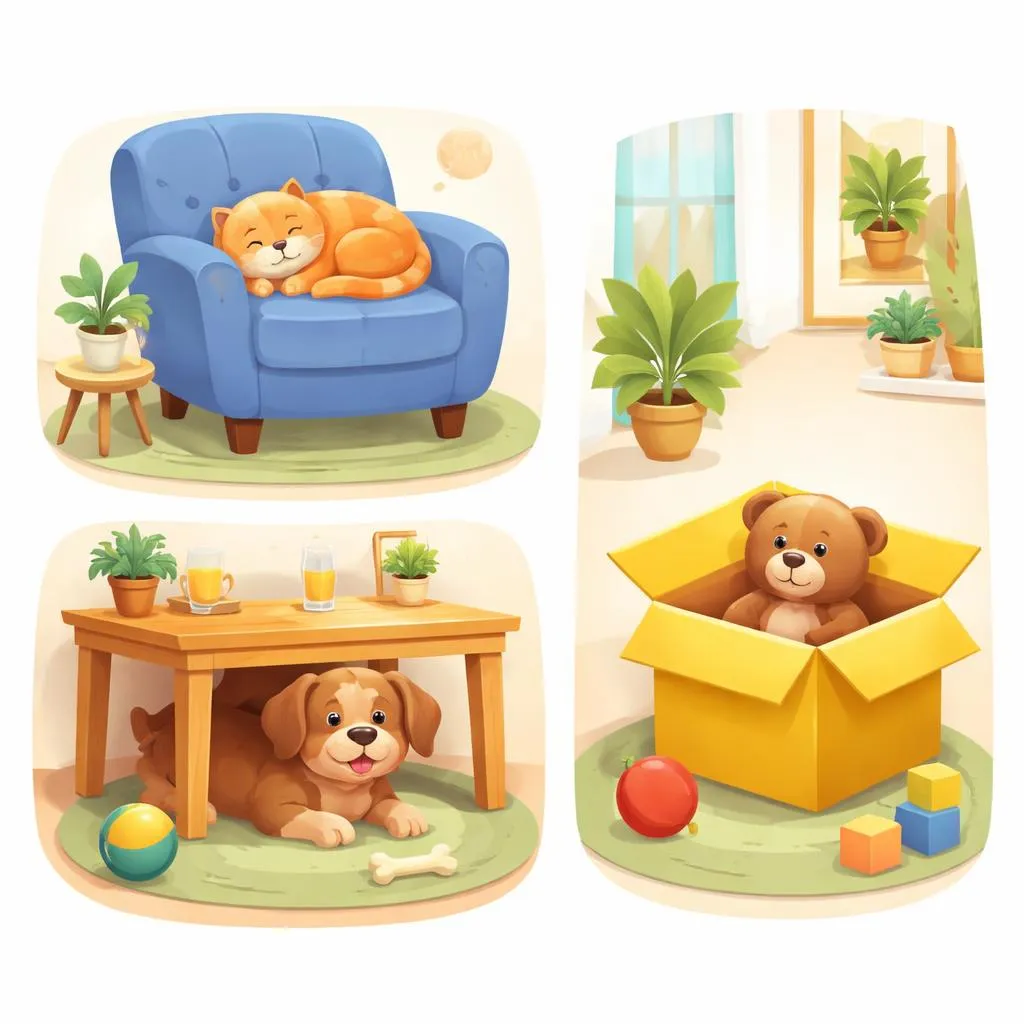

Hello, young explorers! Welcome to our grammar classroom. Today we learn about location words. We discover how to use on under in. These little words tell us where things are.
Where is the cat? It might be on the chair. It could be under the table. Perhaps it is in the box. These words help us describe positions clearly.
Let us open our grammar books. Let us learn these important position words. By the end of this lesson, describing where things are will feel natural and easy.
Meaning
The words on under in are prepositions of place. They show the position of one thing compared to another.
On means touching the top surface of something. The book is on the table. The picture is on the wall. The cup is on the shelf. The object rests above and touches the surface.
Under means below something, often covered or hidden. The cat is under the bed. The shoes are under the chair. The treasure is under the ground. One thing is lower than another.
In means inside an enclosed space. The pencil is in the case. The fish is in the water. The toys are in the box. The object is surrounded by something.
These three words are very common. Children use them every day. Learning them helps give clear directions and descriptions.
Conjugation
Now let us look at conjugation. Conjugation means changing words for different people. But prepositions like on under in never change.
They stay the same no matter what. The book is on the table. The books are on the table. The cat is under the chair. The cats are under the chair. The pencil is in the case. The pencils are in the case.
Prepositions do not have past or future forms. They do not change for I, you, he, or they. They are always the same words. This makes them easy to learn.
The verbs before them change, but the prepositions stay fixed. I am in the room. You are in the room. He was in the room. They will be in the room. The word "in" never changes.
Present Tense
Let us focus on the present tense with on under in. The present tense means right now.
We use these prepositions to say where things are at this moment.
The apple is on the desk.
Your shoes are under the bed.
The milk is in the refrigerator.
The picture is on the wall.
The dog is under the table.
The toys are in the box.
We also use them to describe where people are.
I am in the kitchen.
You are on the bus.
She is under the umbrella.
We are in the classroom.
They are on the playground.
The pattern is simple. Subject + verb be + preposition + location. The verb be changes for different subjects, but the preposition stays the same.
Past Tense
Now we move to the past tense with on under in. The past tense means before now.
We use these prepositions to say where things were earlier.
The apple was on the desk this morning.
Your shoes were under the bed yesterday.
The milk was in the refrigerator an hour ago.
The picture was on the wall last week.
The dog was under the table during dinner.
The toys were in the box before playtime.
We also use them to describe where people were.
I was in the kitchen.
You were on the bus.
She was under the umbrella.
We were in the classroom.
They were on the playground.
In the past, the verb be changes to was or were. The prepositions on, under, in stay exactly the same.
Future Tense
Let us look at the future tense with on under in. The future tense means later, not yet happened.
We use these prepositions to say where things will be.
The apple will be on the desk tomorrow.
Your shoes will be under the bed tonight.
The milk will be in the refrigerator later.
The picture will be on the wall next week.
The dog will be under the table at dinner.
The toys will be in the box after playtime.
We also use them to describe where people will be.
I will be in the kitchen.
You will be on the bus.
She will be under the umbrella.
We will be in the classroom.
They will be on the playground.
In the future, we use will be before the preposition. The prepositions on, under, in stay exactly the same.
Questions
Now let us make questions with on under in. Questions ask where things are.
For yes/no questions in present, move the verb be to the front.
The book is on the table. becomes Is the book on the table?
The cat is under the chair. becomes Is the cat under the chair?
The pencils are in the case. becomes Are the pencils in the case?
For questions in past, move was or were to the front.
The book was on the table. becomes Was the book on the table?
The cats were under the chair. becomes Were the cats under the chair?
For questions in future, move will to the front.
The book will be on the table. becomes Will the book be on the table?
For information questions, use where.
Where is the book? It is on the table.
Where are the cats? They are under the chair.
Where were the pencils? They were in the case.
Where will the dog be? It will be under the table.
Short answers use the verb be. Is the book on the table? Yes, it is. Are the cats under the chair? No, they aren't.
Other Uses
The words on under in have other uses too. They are not just for physical location.
On can mean about a topic. I read a book on dinosaurs. This means the book is about dinosaurs.
On can mean working or functioning. The TV is on. The light is on.
On can mean a day. On Monday, on my birthday.
Under can mean less than. Children under ten get a discount. This means younger than ten.
Under can mean controlled by. The team played well under their new coach.
Under can mean going through. The road is under construction.
In can mean wearing. The girl in the red dress. This describes what someone wears.
In can mean part of something. She is in the soccer team.
In can mean using a language. Say it in English.
In can mean after a time. I will see you in five minutes.
These other uses show how flexible prepositions are. The same words work in many situations.
Learning Tips
Here are some helpful tips for mastering on under in. These tips will make learning faster and easier.
Tip 1: Use Real Objects
Get a box and a small toy. Practice putting the toy in the box, on the box, under the box. Say each position as you do it. This connects words to real actions.
Tip 2: Draw Pictures
Draw simple pictures showing the meanings. A ball on a table, under a table, in a box. Seeing the meaning helps memory.
Tip 3: Use Your Body
Act out the prepositions with your body. Stand on a mat. Crawl under a table. Sit in a chair. Moving helps the brain remember.
Tip 4: Practice Questions and Answers
Ask and answer where questions. Where is the pencil? It is on the desk. Where is the cat? It is under the bed. This builds conversation skills.
Tip 5: Listen for Prepositions
When watching shows or listening to stories, listen for on, under, in. Notice how characters use them. Listening practice helps a lot.
Educational Games
Games make learning prepositions fun. Here are some games to help understand on under in.
Game 1: Simon Says with Prepositions
Play Simon Says using prepositions. Simon says put your hand on your head. Simon says put your foot under the chair. Simon says sit in your seat. This teaches prepositions through movement.
Game 2: Where Is the Toy?
Hide a small toy somewhere in the room. Give clues using prepositions. It is on something red. It is under something soft. It is in something square. Children guess where it is.
Game 3: Preposition Bingo
Make bingo cards with pictures showing prepositions. A cat on a chair, a dog under a table, a bird in a cage. Call out the prepositional phrases. "The cat is on the chair." Children cover the matching picture.
Game 4: Follow the Directions
Give children directions using prepositions. Put your book on your head. Stand under the clock. Put your pencil in your shoe. This builds listening and following directions.
Game 5: Preposition Sorting
Make three signs. On, Under, In. Give children picture cards showing different positions. They sort each card under the correct preposition. This builds category knowledge.
Game 6: Draw That Position
Call out a position. Draw a ball on a table. Draw a cat under a bed. Draw a fish in a bowl. Children draw what you describe. Compare drawings at the end.
Game 7: Preposition Memory
Make pairs of cards. One card has a written phrase like "on the table." Another card has a picture of a ball on a table. Players match the phrase to the picture.
Game 8: Classroom Scavenger Hunt
Give children a list of things to find using prepositions. Find something on a shelf. Find something under a desk. Find something in a drawer. They search and share what they found.
Game 9: Preposition Song
Sing a simple song about prepositions to a familiar tune. "On, on, on the table. Under, under, under the chair. In, in, in the box. Prepositions everywhere!" Repetition helps memory.
Game 10: Error Hunt
Write sentences with mistakes on the board. The book is on the box? (but picture shows in) The cat is in the chair? (but picture shows under) Children find and fix the errors.
Game 11: Preposition Charades
Act out being in a position. Curl up small to be in a box. Stretch out to be on a bed. Crouch down to be under a table. Others guess the preposition and object.
Game 12: What's Missing?
Arrange several objects in different positions. A book on the table, a pencil under the book, a toy in the box. Let children look for one minute. Change one position. Ask what changed.
Game 13: Preposition Hop
Place three signs on the floor. On, Under, In. Call out a phrase. "The cat is under the chair." Children hop to the Under sign. This combines movement with learning.
Game 14: Picture Description
Show a busy picture with many objects. Children make sentences using prepositions. The lamp is on the table. The rug is under the chair. The books are in the shelf.
Game 15: Preposition Relay Race
Divide into teams. Place objects at one end of the room. Call out a direction. "Put the ball on the chair!" One player from each team runs and follows the direction. First to do it correctly wins a point.
Game 16: Story Time with Prepositions
Tell a simple story using many prepositions. "Once upon a time, a little mouse lived in a hole. One day, it climbed onto a table. A cat was under the table. The mouse ran under the chair." Children listen and act out the story.
Game 17: Preposition Puzzles
Make simple puzzles with pictures. Cut them into pieces. Children put them together and describe what they see. "The bird is in the cage." "The apple is on the tree."
Game 18: Find the Difference
Show two similar pictures with small differences in positions. In one, the ball is on the table. In the other, the ball is under the table. Children spot and describe the differences.
Game 19: Preposition Craft
Give children paper and crayons. They create a scene with many objects in different positions. Then they describe their picture to a partner using on, under, in.
Game 20: Where Am I? Game
One child closes their eyes. Another child hides an object. The first child opens eyes and asks questions. Is it on something? Is it under something? Is it in something? They guess the location.
The words on under in are small but powerful. They help us describe exactly where things are. They work for present, past, and future. They never change form. They have many other uses too.
Practice using these prepositions every day. Look around and describe where things are. The book is on the shelf. The cat is under the chair. The milk is in the refrigerator. Soon using them will feel natural.
These little words will be your friends in English, not challenges. Keep learning and growing every single day. Happy grammar learning, everyone