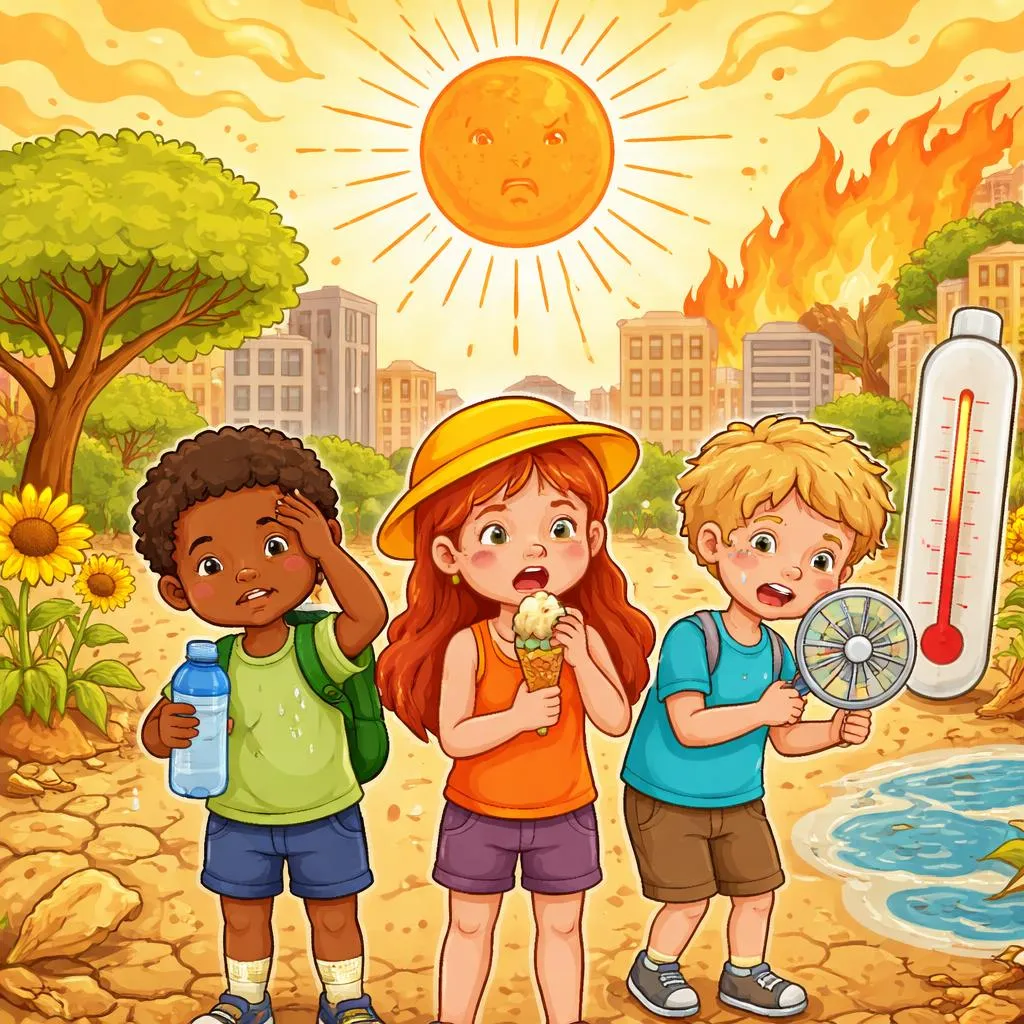

Hello, young climate explorers! Have you felt the weather getting hotter? The world is experiencing something big. It is called the Global Heatwave 2026. This is a time of very high temperatures. Many places are breaking records. Let us learn about this together. We will use simple English words. We will understand our planet better. Are you ready to be a climate hero? Let us go!
A Very Hot Planet
In May 2026, many parts of the world got very hot. Europe and India were especially hot. A weather event called a "heat dome" happened over Europe. A heat dome is like a lid on a pot. It traps hot air in one place. This caused long periods of extreme heat. France had its hottest May ever. Many towns in southwest France saw temperatures over 37°C. Some places were close to 39°C. More than 350 towns broke their local May records.
The United Kingdom also felt the heat. London's Kew Gardens recorded 35.1°C on May 26th. This broke the UK's May record by two whole degrees. Portugal saw temperatures near 42°C. India faced even more extreme heat. Northern India recorded a scorching 48.2°C. This set a new national record. The capital city, New Delhi, reached 45°C. This Global Heatwave 2026 is very serious.
Scientists are giving warnings. The World Meteorological Organization spoke on May 28th. They said there is an 86% chance. The years from 2026 to 2030 could be hotter than 2024. There is a 75% probability. The world's average temperature will be 1.5°C above pre-industrial levels. This is a key limit. The heat has already caused harm. In France, at least seven people died. Five people drowned. Two people had heatstroke during sports. The Global Heatwave 2026 shows us a changing climate.
Why This Topic Helps You Learn English and Grow
Learning about the Global Heatwave 2026 is great for your English. You will learn real science words. You will learn about meteorology. Words like heat dome and El Ni?o are important. You will learn about environmental science. Words like global warming and carbon emissions are key. This gives you real context for learning. You learn English through important topics.
You will understand a big global issue. Climate change is a challenge for everyone. By studying heatwaves, you see the bigger picture. You learn about causes and effects. You learn about solutions. This builds your thinking skills. You learn to analyze problems. You learn to think critically. The Global Heatwave 2026 is a case study for your mind.
You will get better with data and pictures. You can learn to read temperature charts. You can learn to understand weather maps. You can read scientific reports in simple English. This improves your information skills. You learn to communicate science. You learn to share what you know. These are powerful skills for the future.
You will develop a sense of care for our planet. You see how extreme weather connects to human actions. This can inspire you to act. You learn about sustainability. You learn about your own responsibility. The Global Heatwave 2026 is not just news. It is a call to action. You can be part of the solution.
What You Gain and What You Can Do
You will gain important knowledge. You will understand core ideas. You will know what a heatwave is. You will learn about climate change. You will learn about extreme weather events. You will learn about groups like the World Meteorological Organization. You will also learn interesting facts. You will learn why some European buildings get so hot. Their design keeps heat in. You will learn about energy policies. High electricity costs can limit air conditioner use. This knowledge makes you an informed citizen.
You will also build great skills. Your research skills will improve. You can analyze weather data. Your writing skills will get better. You can write a simple climate report. Your speaking skills will grow. You can role-play a climate negotiation. You learn to advocate for our planet. These skills help you in school. They help you in your community.
Now, let us make a plan for action. Start with your own life. You can calculate your family's carbon footprint. It is like a score for your environmental impact. You can make a plan to save energy at home. You can also learn how to stay safe in a heatwave. Learn about heat stroke prevention. Make a simple safety guide in English. Share it with your friends.
Then, think about your community. You can start a "Cool Down" project at your school. You can design ideas for a green roof. You can plan to plant more trees for shade. You can organize an English debate about climate change. Discuss a topic like personal responsibility versus government policy. This helps everyone learn.
Also, look at the whole world. You can follow big climate meetings. A major meeting called COP31 will happen in November 2026. It will be in Antalya, Turkey. You can track its progress. You can join international youth climate networks. You can share your local observations in English. You can share your actions. Your voice matters.
Think about the long term. Keep learning about climate science. Follow the news about the Global Heatwave 2026 and its effects. Your understanding of English and the world will grow together. Maybe you will become a scientist. Maybe you will become a policy maker. The choices we make now shape our future.
Build some good daily habits. Learn one new climate word each day. Read one short English article about the environment each week. Practice explaining a weather chart for two minutes. Do one creative project each month. Draw a picture of a cooler city. Write a story about a climate hero. Make a short video about saving energy. Use English in your project. These small steps build big change. The Global Heatwave 2026 is a challenge. But it is also an opportunity. We can learn. We can adapt. We can act.
What You Can Learn from This Article
You learn about the serious Global Heatwave 2026. You know where and when it happened. You understand the science behind a heat dome. You see the record temperatures in Europe and India. You learn the warnings from world scientists. You discover how this event connects to your English learning and your future. You get a clear and positive plan for personal and community action. This knowledge makes you a prepared and caring global citizen.
Life Practice Application
Look at a thermometer today. Read the temperature. Learn to say it in English. "It is 30 degrees Celsius today." Find a world map. Point to Europe and India. Say "These places had a heatwave in 2026." Talk to your family about saving energy. Turn off one light you do not need. Write one sentence in English about it. "I turned off the light to save energy." Draw a picture of a happy Earth. Write "We can cool our planet" in English. Start your climate action today. Every small step is powerful. You can make a difference. Our world needs your help.