
Opening Introduction
Lily is building a tower with blocks. Her little brother runs by. Crash! The tower falls. Lily feels a hot wave inside. Her face gets red. She wants to shout. But she does not have the words. Her dad sees her face. He knows that feeling. "You look like a volcano about to erupt," Dad says softly. "Let's measure that feeling."
Dad shows Lily a picture. It looks like a thermometer, the one we use for body temperature. But this one has words, not numbers. At the bottom, it says "Calm". At the top, it says "Furious". "This is a feelings thermometer," Dad explains. "We can make our own. We can create DIY feeling thermometers printable. It helps us see our feelings, like checking the weather inside." Lily is curious. A thermometer for feelings? Let's learn how to make one and understand our emotional weather.
Core Knowledge Explanation
What is a thermometer? A thermometer is a tool that measures temperature. It tells us if something is hot or cold. When you are sick, your mom uses a thermometer to check your body temperature. A feelings thermometer is a special kind of thermometer. It does not measure body heat. It measures the heat of your emotions. Emotions are your feelings. Happy, sad, angry, scared, excited.
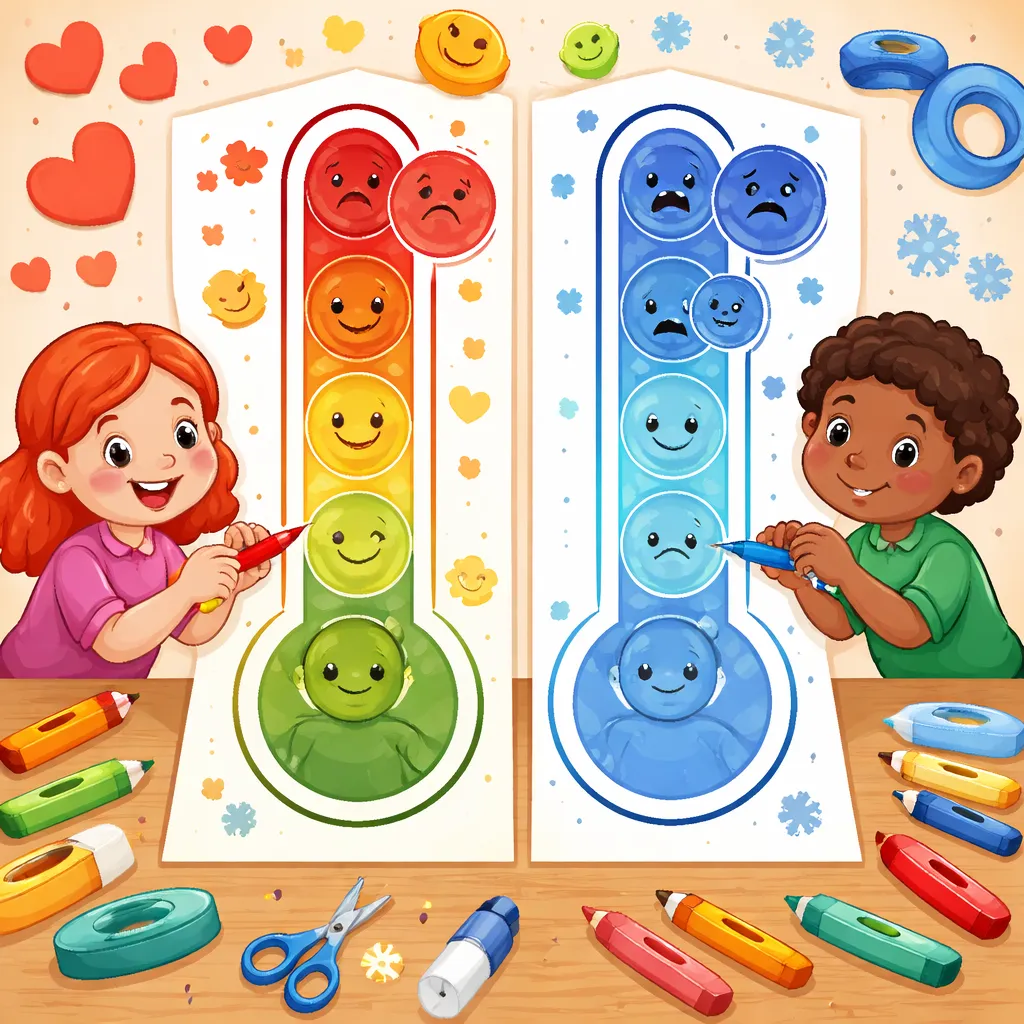
Your DIY feeling thermometers printable is a picture of a thermometer. It is a long, vertical rectangle. At the bottom, it is wide. At the top, it is pointy. There is a line inside it, like mercury. The bottom of the thermometer is the "cool" zone. The top is the "hot" zone. Cool feelings are calm, peaceful, relaxed. Hot feelings are strong, like angry, frustrated, or very, very excited.
Why do we need this? Because sometimes feelings are confusing. You might feel a little annoyed. Or you might feel very, very angry. They are both "angry", but they are different levels. The thermometer helps you see the level. Level one is a little annoyed. Level five is furious. When you can see the level, you can talk about it. You can say, "My anger is at level four right now." This helps other people understand you. It helps you understand yourself.
Let's look at the parts. The thermometer has a scale. A scale is a set of steps. Often, it goes from 1 to 5. Number 1 is at the bottom. It is for calm feelings. Words for level 1 are: calm, peaceful, fine, okay. Number 2 is a little higher. Feelings here are: bothered, annoyed, worried. Number 3 is in the middle. Feelings are: upset, frustrated, nervous. Number 4 is high. Feelings are: angry, scared, very sad. Number 5 is at the very top. Feelings are: furious, terrified, panicked.
You can also use colors. Many people use a traffic light system. Green for the bottom (calm, go ahead). Yellow for the middle (caution, slow down). Red for the top (stop, you need help). Your DIY feeling thermometers printable might have these colors. You can color it yourself. Green at the bottom, then yellow, then orange, then red at the top.
How do you use it? You print the thermometer. You color it. Then, you think about your feeling. "How do I feel right now?" You look at the words. You find the word that matches. Maybe you feel "frustrated". That is level 3. You can draw a line on the thermometer at level 3. Or you can put a clothespin there. This shows you the temperature of your feeling.
This tool is very powerful. It is not just for bad feelings. It is for all feelings. You can have a thermometer for happiness. Level 1 is "content". Level 5 is "overjoyed". You can track your excitement before a birthday party. It starts at level 2, then 3, then 4, then 5 on the day of the party. Your DIY feeling thermometers printable helps you notice all the shades of your emotions. Shades are different strengths of the same color.
Fun Interactive Learning
Let's make a feelings thermometer. First, print your DIY feeling thermometers printable. You will see a blank thermometer shape. Get your crayons. Color the bottom part green. Color the next part light green. Color the middle part yellow. Color the next part orange. Color the top part red. Now, write the numbers 1 to 5 on the side. 1 at the green bottom. 5 at the red top.
Now, let's write feeling words. At level 1 (green), write: calm, happy, fine. At level 2 (light green), write: annoyed, worried, silly. At level 3 (yellow), write: upset, frustrated, excited. At level 4 (orange), write: angry, scared, very happy. At level 5 (red), write: furious, terrified, overjoyed. Your thermometer is ready.
Let's play "Feeling Weather Report". In the morning, look at your thermometer. How do you feel? Are you "calm" like a sunny day? Are you "a little worried" like a cloudy day? Are you "angry" like a thunderstorm? Move a clothespin or a paper clip to the right level. Say it out loud. "My feeling weather today is sunny and calm. I am at level 1." Do this again in the afternoon and evening. See how your emotional weather changes.
Another game is "What Would You Do?". Use your thermometer with a friend. Your friend says, "My feeling is at level 4. I am very angry because I lost my toy." Look at the thermometer. Level 4 is in the orange zone. This is a high level. What are some calming strategies? Strategies are plans to help. You can say, "Take three deep breaths. That might bring you to level 3." Or, "Ask a grown-up for help." This game teaches you to help yourself and others.
Expanded Learning
Feelings are universal. Universal means everyone has them. People all over the world feel happy, sad, angry, and scared. But we might show them differently. Some people are loud when they are happy. Some people are quiet. Your DIY feeling thermometers printable is a tool that can help anyone, anywhere, understand their feelings better.
The idea of measuring feelings is not new. Long ago, people used art, music, and writing to express the size of their feelings. A big, fast song might show anger. A soft, slow painting might show calm. Your thermometer is a simple, clear way to do the same thing. It turns a big, messy feeling into something you can see and talk about.
Let's make a feelings thermometer song. Songs help us remember. Sing this to the tune of "If You're Happy and You Know It".
If you're calm and cool and know it, that's level one! (Clap, clap) If you're bothered, just a little, that's level two! (Clap, clap) If you're getting really upset, that is level three! If you're feeling very angry, that is level four! If you're furious or panicked, that is level five! Now, take a breath and calm yourself, and let the feeling guide!
You can point to your thermometer as you sing each level. It is a fun way to review.
What You Will Learn
You are learning a new language. The language of emotions. You are learning feeling words: calm, happy, sad, angry, scared, excited, frustrated, annoyed, furious, terrified, overjoyed. You are learning scale words: level, degree, intensity, zone. You are learning color words associated with feelings: green for calm, red for hot emotions.
You are learning powerful sentences. You can say, "I am feeling at level 3 right now." You can ask, "What level is your anger?" You can describe, "My happiness is at the top of the thermometer!" You are learning to express the intensity of your feelings, not just the name. This is advanced communication.
You are building essential life skills. You are building emotional awareness. You know what you feel. You are building self-regulation skills. You learn ways to calm down from a high level. You are building empathy. You understand that others have feeling levels too. You are building problem-solving skills. You can find solutions based on your feeling level.
You are forming a crucial habit. The habit of checking in with yourself. Just like you check the weather before going out, you check your emotional weather. This habit of self-awareness will help you your whole life. It helps you make good choices and understand others. Your DIY feeling thermometers printable is your personal emotional weather station.
Using What You Learned in Life
Use your thermometer every day. At school, if you feel nervous about a test, find the level. "I am at a level 3 nervous." Tell your teacher, "I am feeling a level 3 about the test." Your teacher can help you feel more calm. You are advocating for yourself in a clear way.
At home, when you are arguing with a sibling, stop. Say, "My frustration is at a level 4. I need to cool down." Then, go to your calm-down corner. Use a strategy. This prevents big fights. It makes home more peaceful.
When you are reading a book or watching a movie, think about the characters. "The dragon is at a level 5 angry!" "The princess is at a level 1 calm." This makes stories more interesting. You are understanding characters deeply.
With friends, you can share your thermometers. "I was at a level 5 excited for the party!" This helps you connect. You can also help a friend. "You look like you are at a level 4. Do you want to talk?" You are being a kind and understanding friend.
Closing Encouragement
You have done something wonderful. You are an emotion scientist. You are a self-awareness expert. You are a feelings communicator. I am so incredibly proud of you. Your DIY feeling thermometer is more than a craft. It is a bridge. A bridge between your heart and your words.
Keep your thermometer. Use it often. Make new ones for different feelings. Decorate them. The more you use it, the better you will understand yourself and others.
Remember, all feelings are okay. There are no bad feelings. But some feelings are uncomfortable. Your thermometer helps you with those. It gives you a map of your inner world. You are brave, you are smart, and you are emotionally intelligent. Outstanding work, my wonderful feelings explorer.