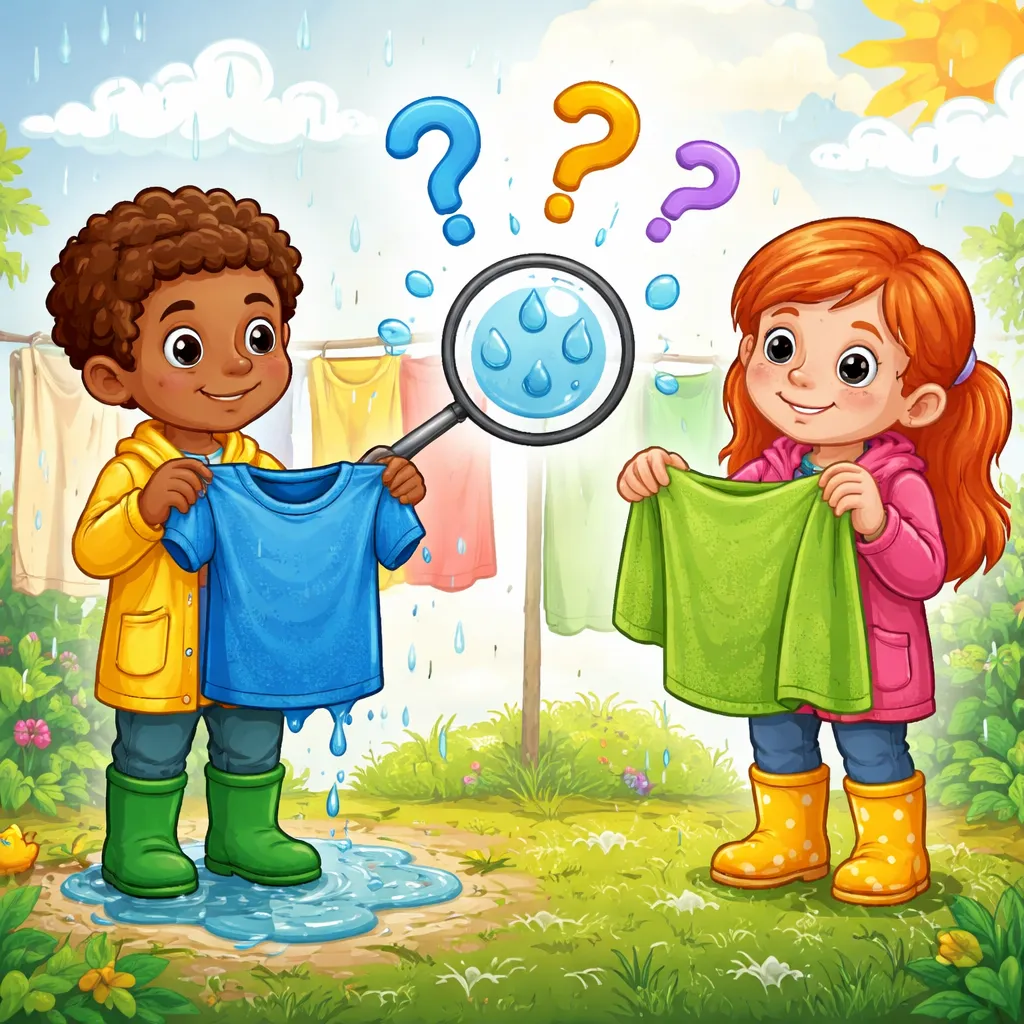

Are Similar Words Really Interchangeable?
Children often meet words that look similar in meaning. “Wet and damp” is a helpful pair to explore. Both words describe something with water or moisture.
At first, many learners think they mean the same. However, they are not always interchangeable. Each word carries a different level of meaning.
“Wet” usually means covered with water. “Damp” means slightly wet, often not fully soaked.
Understanding this difference helps children describe the world more clearly. It also improves their speaking and writing skills.
Parents can support this learning by using real-life examples. Small differences become easier to notice over time.
Set 1: wet vs damp — Which One Is More Common?
“Wet” is more common in everyday English. Children learn it early. It appears in many daily situations.
For example:
“My clothes are wet.” “The ground is wet after rain.”
“Damp” is less common. It appears more in descriptive language.
For example:
“The towel is still damp.”
Because “wet” is used more often, children feel more comfortable using it.
Parents can explain that “damp” adds a more specific meaning.
This helps children understand when each word fits best.
Set 2: wet vs damp — Same Meaning, Different Contexts
“Wet and damp” both describe moisture. However, they are used in different contexts.
“Wet” suggests a larger amount of water. Something wet may be soaked or dripping.
“Damp” suggests a small amount of moisture. Something damp feels slightly wet but not fully soaked.
For example:
“My shoes are wet.” (very wet) “My shoes are damp.” (a little wet)
Children can learn to ask: How much water is there?
This simple question helps them choose the right word.
Set 3: wet vs damp — Which Word Is “Bigger” or More Emphatic?
“Wet” is more emphatic than “damp.” It describes a stronger condition.
When something is wet, it often needs drying. The water is easy to notice.
“Damp” is softer. It describes a light level of moisture.
For example:
“The shirt is wet.” (very noticeable) “The shirt is damp.” (slightly moist)
Children can think of “wet” as the bigger word.
“Damp” sits between dry and wet.
This understanding helps children describe situations more accurately.
Set 4: wet vs damp — Concrete vs Abstract
“Wet” is mostly concrete. It describes physical conditions.
For example:
“The floor is wet.” “The dog is wet.”
“Damp” is also concrete, but it sometimes appears in abstract ways. It can describe feelings or moods.
For example:
“The damp weather made the day feel gloomy.”
This use is more advanced. Children may focus first on physical meaning.
Understanding real-world examples builds a strong foundation.
Later, children can explore more abstract uses.
Set 5: wet vs damp — Verb or Noun? First Understand the Role
“Wet” and “damp” are adjectives. They describe nouns.
For example:
“wet clothes” “damp towel”
They answer the question: “What kind?”
“Wet” can also appear as a verb in advanced use, such as “to wet something.” However, children do not need to focus on this early.
“Damp” mainly stays as an adjective.
Simple sentences help learning: “The ground is wet.” “The towel is damp.”
These patterns support clear communication.
Set 6: wet vs damp — American English vs British English
Both “wet and damp” appear in American and British English. Their meanings stay consistent.
“Wet” is very common in both regions. It appears in daily conversation and weather descriptions.
“Damp” also appears in both, but it may be slightly more common in British English, especially when describing weather.
For example:
“It is a damp day.”
Children benefit from hearing both forms. This builds flexibility in understanding English.
Parents can explain that usage may vary slightly by region.
Set 7: wet vs damp — Which Fits Formal Situations?
In formal contexts, word choice matters.
“Damp” often fits better in formal or descriptive writing. It sounds more precise.
For example:
“The walls feel damp.”
“Wet” works in both formal and informal situations. However, it may sound less specific.
For example:
“The floor is wet.”
Children can learn that “damp” adds detail and precision.
This helps improve writing and description skills.
Set 8: wet vs damp — Which One Is Easier for Kids to Remember?
“Wet” is easier for children to remember. It is short and commonly used.
Children hear it often in daily life. This repetition supports memory.
“Damp” is less common and slightly harder to remember.
However, it becomes easier when linked to real examples. For example, a towel that is not fully dry.
Parents can create simple connections:
Wet = lots of water Damp = a little water
These associations help children understand quickly.
Mini Exercise: Can You Spot the Differences Between These Similar Words?
Try these simple exercises together.
Choose the correct word: “My socks are ___ after walking in the rain.” Answer: wet Choose the correct word: “The towel is still ___ after drying.” Answer: damp Fill in the blank: “The grass feels ___ in the morning.” Answer: damp True or False: “Damp” means completely soaked. Answer: False True or False: “Wet” usually describes a larger amount of water. Answer: True
These exercises help children practice meaning and usage.
They also make learning interactive and enjoyable.
Parent Tips: How to Help Kids Learn and Remember Similar Words
Children learn best through daily experiences. Everyday situations offer many opportunities.
After rain, ask simple questions: “Is the ground wet or damp?”
Encourage children to explain their answers. This builds vocabulary and thinking skills.
Use repetition in real-life contexts. Talk about clothes, weather, and objects.
Read books together. Notice how authors describe weather or objects. Discuss why they choose “wet” or “damp.”
Use touch and observation. Let children feel the difference between wet and damp objects.
Create small games. For example, sorting items into “wet” and “damp.”
Avoid strong correction. Guide gently with questions and examples.
Celebrate effort and progress. Confidence grows step by step.
Over time, children begin to notice subtle differences. “Wet and damp” become useful tools for describing the world with clarity and detail.