
Are Similar Words Really Interchangeable?
Children often meet word pairs that look very similar. “Blunt and dull” is a helpful example. Both words can describe something that is not sharp.
At first, many learners think these words mean the same. However, they are not always interchangeable. Each word carries its own focus and tone.
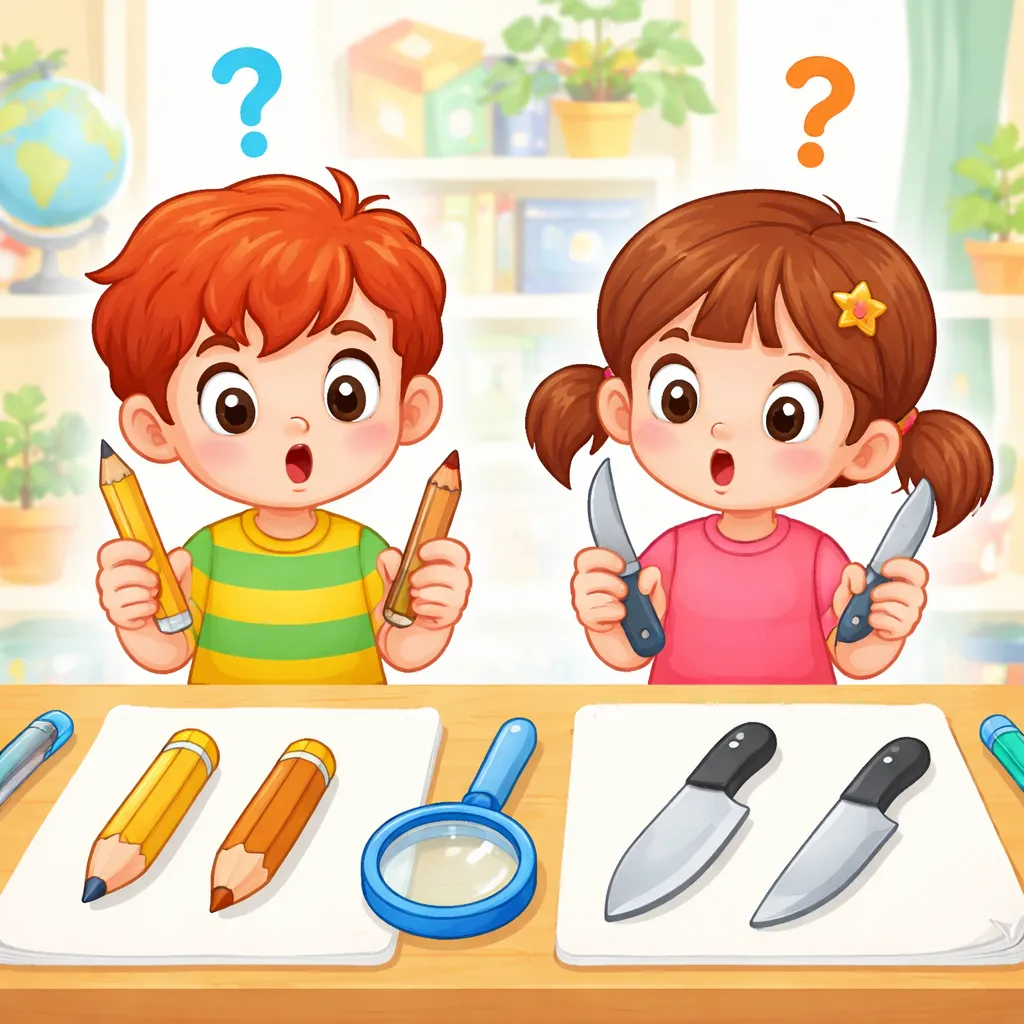
“Blunt” often describes shape. It means something does not have a sharp point. “Dull” often describes function. It means something cannot cut well.
Understanding this difference helps children describe objects clearly. It also supports safe and accurate communication.
Parents can guide children by using real-life examples. This makes learning practical and meaningful.
Set 1: blunt vs dull — Which One Is More Common?
“Dull” is more common in everyday English. Children hear it in many situations.
For example:
“The knife is dull.” “This color looks dull.”
“Blunt” is less common. It appears more in specific descriptions, especially about tools or shapes.
For example:
“The pencil is blunt.”
Because “dull” has more uses, children learn it more quickly.
Parents can explain that “blunt” is more specific. It focuses on shape rather than ability.
Set 2: blunt vs dull — Same Meaning, Different Contexts
“Blunt and dull” can both describe objects like knives or pencils. However, they focus on different aspects.
“Blunt” describes shape. It means the tip is not sharp or pointed.
“Dull” describes function. It means the edge does not cut well.
For example:
“The pencil is blunt.” (shape) “The knife is dull.” (function)
Children can ask: Does it look rounded, or does it not work well?
This helps them choose the correct word.
Set 3: blunt vs dull — Which Word Is “Bigger” or More Emphatic?
Neither word is strongly emotional, but they differ in tone.
“Dull” can feel broader and stronger. It applies to many situations beyond physical objects.
“Blunt” feels more specific. It focuses on shape and sometimes behavior.
For example:
“The blade is dull.” (cannot cut) “The end is blunt.” (not pointed)
“Dull” can also describe feelings, sounds, or colors.
Children can think of “dull” as a wider word.
Set 4: blunt vs dull — Concrete vs Abstract
“Blunt” is mostly concrete. It describes physical shape that we can see.
For example:
“The knife has a blunt edge.”
“Dull” can be both concrete and abstract.
For example:
“The scissors are dull.” (physical) “The movie is dull.” (boring)
This makes “dull” more flexible in language.
Children should first learn the physical meaning. Then they can explore abstract uses.
Set 5: blunt vs dull — Verb or Noun? First Understand the Role
“Blunt” and “dull” are adjectives. They describe nouns.
For example:
“blunt pencil” “dull knife”
“Dull” can also appear as a verb in advanced use, such as “to dull something.”
“Blunt” can connect to other forms, but children do not need to learn them early.
Simple sentence patterns help: “The knife is dull.” “The pencil is blunt.”
These patterns support clear communication.
Set 6: blunt vs dull — American English vs British English
Both “blunt and dull” appear in American and British English. Their meanings remain consistent.
“Dull” is very common in both regions. It appears in daily speech and many contexts.
“Blunt” is also used in both regions, especially in descriptions of tools or behavior.
There are no major differences in meaning between regions.
Children can focus on understanding context and usage.
Parents can explain that both words are widely accepted.
Set 7: blunt vs dull — Which Fits Formal Situations?
In formal contexts, both words can be used, but their roles differ.
“Blunt” often fits better in precise descriptions of shape.
For example:
“The object has a blunt edge.”
“Dull” works in both formal and informal contexts. It can describe tools, colors, sounds, and ideas.
For example:
“The blade is dull.”
Children can learn that “blunt” is more specific, while “dull” is more flexible.
This helps improve writing clarity.
Set 8: blunt vs dull — Which One Is Easier for Kids to Remember?
“Dull” is easier for children to remember. It is common and used in many situations.
Children hear it in daily life, such as describing colors or activities.
“Blunt” is less common and more specific. It may take more time to learn.
However, it becomes easier when linked to clear examples like pencils.
Parents can create simple connections:
Blunt = not pointed Dull = does not cut
These associations help children remember both words clearly.
Mini Exercise: Can You Spot the Differences Between These Similar Words?
Try these simple exercises together.
Choose the correct word: “The knife cannot cut. It is ___.” Answer: dull Choose the correct word: “The pencil is not sharp. It is ___.” Answer: blunt Fill in the blank: “The movie was boring and ___.” Answer: dull True or False: “Blunt” describes shape. Answer: True True or False: “Dull” can describe both objects and feelings. Answer: True
These exercises help children practice meaning and usage.
They also make learning interactive and engaging.
Parent Tips: How to Help Kids Learn and Remember Similar Words
Children learn vocabulary best through real-life experiences. Everyday objects offer many opportunities.
Show safe examples. For example, a pencil with a blunt tip. Ask: “Is it blunt or dull?”
Explain function clearly. Show how a dull knife does not cut well.
Encourage children to describe what they see. This builds vocabulary and thinking skills.
Use repetition in daily conversations. Describe tools, objects, and experiences.
Read books together. Notice descriptive words and discuss their meanings.
Use drawing or role-play. Ask children to draw a blunt object or a dull scene.
Create simple games. Sort examples into “blunt” and “dull.”
Avoid strong correction. Guide gently with questions and examples.
Celebrate effort and progress. Confidence grows step by step.
With practice, children begin to notice subtle differences. “Blunt and dull” become useful tools for describing both shape and function with clarity and confidence.