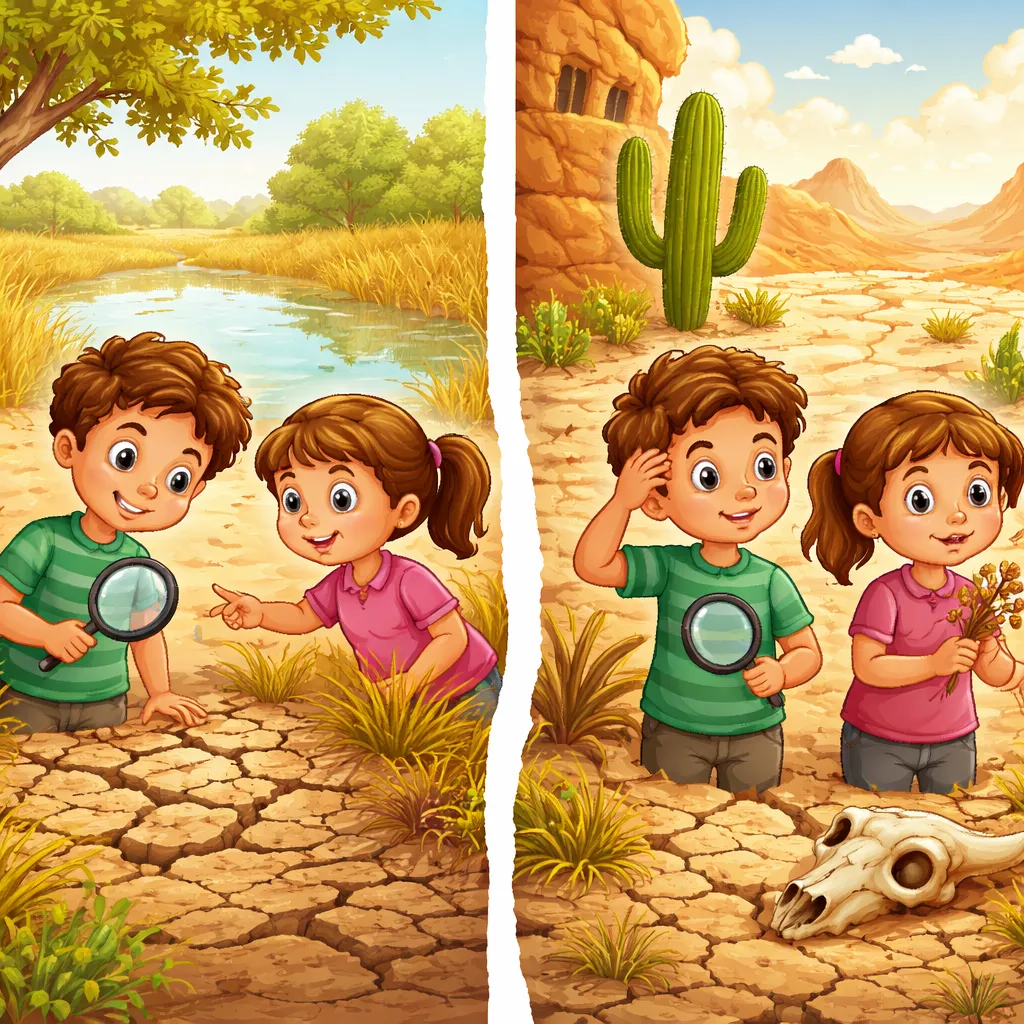

Are Similar Words Really Interchangeable?
Children often meet words that seem similar in meaning. “Dry and arid” is a useful pair to explore. Both words describe a lack of water. Both often appear in conversations about weather, land, and climate.
At first, many learners think these words are the same. However, they are not always interchangeable. Each word carries its own level of meaning and tone.
“Dry” is common and general. It describes something without water. “Arid” is more specific. It often describes very dry land or climate.
Understanding this difference helps children describe the world more clearly. It also improves reading and listening skills.
Parents can guide children by connecting these words to real-life examples. This builds strong vocabulary step by step.
Set 1: dry vs arid — Which One Is More Common?
“Dry” is much more common in everyday English. Children hear it early and often. It appears in many daily situations.
For example:
“My clothes are dry.” “The ground is dry.”
“Arid” is less common. It appears more in books, science topics, or geography lessons.
For example:
“The desert is arid.”
Because “dry” appears more frequently, children learn it first. It becomes part of their basic vocabulary.
Parents can explain that “arid” adds a stronger and more specific meaning.
Set 2: dry vs arid — Same Meaning, Different Contexts
“Dry and arid” both describe a lack of water. However, they are used in different contexts.
“Dry” works in many situations. It can describe clothes, weather, skin, or objects.
“Arid” usually describes land or climate. It often refers to places with very little rain.
For example:
“The towel is dry.” “The region is arid.”
Children can learn to ask: What am I describing? An object or a place?
This simple question helps them choose the correct word.
Set 3: dry vs arid — Which Word Is “Bigger” or More Emphatic?
“Arid” is more emphatic than “dry.” It describes a stronger level of dryness.
When something is “arid,” it often means extremely dry, with little or no moisture.
“Dry” is more general. It can describe anything without water, even slightly dry things.
For example:
“The soil is dry.” (normal dryness) “The desert is arid.” (extreme dryness)
Children can think of “arid” as a stronger word. It adds intensity and detail.
This helps them describe environments more accurately.
Set 4: dry vs arid — Concrete vs Abstract
“Dry” is both concrete and abstract. It describes physical conditions and also ideas.
For example:
“The clothes are dry.” “The story feels dry.” (meaning boring)
“Arid” is mostly concrete. It describes physical environments, especially land and climate.
For example:
“The land is arid.”
Sometimes “arid” can describe ideas, such as “arid discussion,” but this is more advanced.
Children should first focus on physical meanings. This builds a clear foundation.
Set 5: dry vs arid — Verb or Noun? First Understand the Role
“Dry” and “arid” are adjectives. They describe nouns.
For example:
“dry air” “arid land”
“Dry” can also appear as a verb in more advanced use, such as “to dry clothes.”
“Arid” mainly stays as an adjective.
Children should first learn simple sentence patterns: “The clothes are dry.” “The land is arid.”
These patterns help children build clear and correct sentences.
Set 6: dry vs arid — American English vs British English
Both “dry and arid” appear in American and British English. Their meanings remain consistent.
“Dry” is very common in both regions. It appears in daily conversations and descriptions.
“Arid” appears in both as well, but it is less frequent. It often appears in academic or descriptive contexts.
Children may hear “arid” more in books or documentaries.
Parents can explain that both forms are correct. The difference lies in frequency and usage.
This helps children become flexible learners.
Set 7: dry vs arid — Which Fits Formal Situations?
In formal contexts, word choice matters.
“Arid” often fits better in formal or academic writing. It sounds more precise and descriptive.
For example:
“The region has an arid climate.”
“Dry” works in both formal and informal contexts. However, it may sound less specific.
For example:
“The air is dry.”
Children can learn that “arid” is useful when describing geography or science topics.
This helps improve writing and subject understanding.
Set 8: dry vs arid — Which One Is Easier for Kids to Remember?
“Dry” is easier for children to remember. It is short and commonly used.
Children hear it often in daily life. This repetition strengthens memory.
“Arid” is less common and slightly harder to pronounce. It may take more time to learn.
However, it becomes easier when linked to clear examples, such as deserts.
Parents can create simple connections:
Dry = no water Arid = very, very dry
These associations help children understand quickly.
Mini Exercise: Can You Spot the Differences Between These Similar Words?
Try these simple exercises together.
Choose the correct word: “My clothes are ___ after drying.” Answer: dry Choose the correct word: “The desert is very ___.” Answer: arid Fill in the blank: “The air feels ___ in winter.” Answer: dry True or False: “Arid” describes extremely dry land. Answer: True True or False: “Dry” can describe both objects and weather. Answer: True
These exercises help children practice meaning and usage.
They also make learning interactive and engaging.
Parent Tips: How to Help Kids Learn and Remember Similar Words
Children learn vocabulary best through real-life experiences. Everyday situations offer many opportunities.
Talk about weather and nature. Ask simple questions: “Is the ground dry or arid?”
Encourage children to explain their answers. This builds vocabulary and thinking skills.
Use repetition in daily conversations. Describe objects, weather, and environments.
Read books together. Notice descriptive words like “arid.” Discuss why they are used.
Use visuals. Show pictures of deserts and compare them with normal dry places.
Create small games. For example, sorting examples into “dry” and “arid.”
Avoid strong correction. Guide gently with questions and examples.
Celebrate effort and progress. Confidence grows over time.
With practice, children begin to notice subtle differences. “Dry and arid” become useful tools for describing the world with clarity and detail.