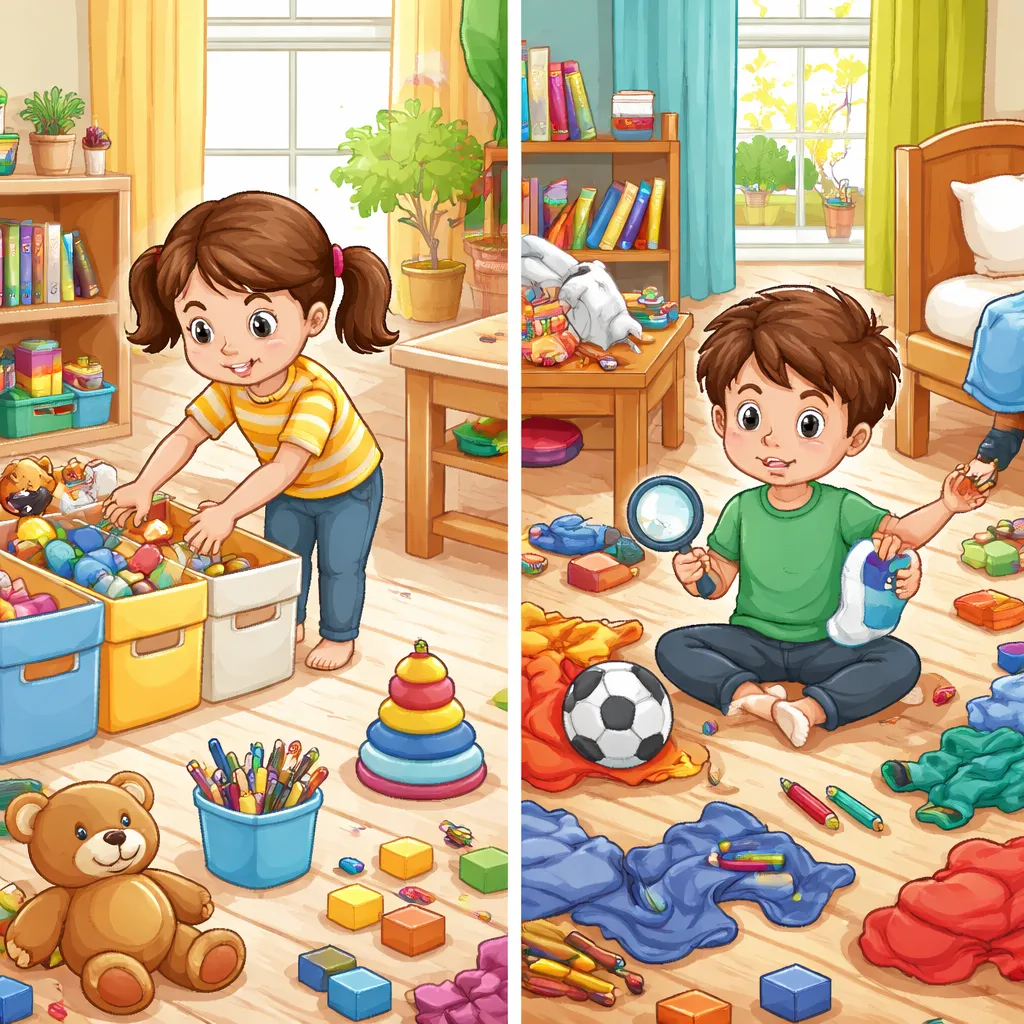

Are Similar Words Really Interchangeable?
Children often learn pairs of words that look similar in meaning. “Organized and orderly” is one such pair. Both words relate to structure and arrangement.
At first, they may seem interchangeable. However, they do not always express the same idea. Each word carries a slightly different focus.
“Organized” often describes planning and structure. “Orderly” often describes neat arrangement and calm sequence.
Understanding these differences helps children describe actions and spaces more clearly. It also supports thinking and problem-solving skills.
Parents can guide children by using real-life examples. This makes learning natural and meaningful.
Set 1: organized vs orderly — Which One Is More Common?
“Organized” is more common in everyday English. Children hear it often in school and at home.
For example:
“She is very organized.” “Keep your desk organized.”
“Orderly” is less common. It often appears in more formal or descriptive contexts.
For example:
“The line is orderly.”
Because “organized” appears more often, children usually learn it first.
Parents can introduce “orderly” as a more specific word for arrangement.
Set 2: organized vs orderly — Same Meaning, Different Contexts
“Organized and orderly” both describe structure. However, they apply to different contexts.
“Organized” often refers to systems, plans, or actions. It shows that something is arranged with purpose.
“Orderly” focuses on appearance and sequence. It shows that things follow a clear order.
For example:
“Her notes are organized.” (planned and structured) “The books are in an orderly line.” (neatly arranged)
Children can ask: Is it about planning or arrangement?
This helps them choose the correct word.
Set 3: organized vs orderly — Which Word Is “Bigger” or More Emphatic?
“Organized” often feels broader in meaning. It includes planning, thinking, and arranging.
“Orderly” is more specific. It focuses mainly on visible arrangement and calm order.
For example:
“He is organized.” (a general skill) “The room is orderly.” (a specific condition)
“Organized” can describe habits and personality.
Children can think of “organized” as a bigger concept.
Set 4: organized vs orderly — Concrete vs Abstract
“Orderly” is mostly concrete. It describes physical arrangement.
For example:
“The chairs are in an orderly row.”
“Organized” can be both concrete and abstract.
For example:
“The desk is organized.” (physical) “She has an organized plan.” (abstract)
This makes “organized” more flexible.
Children can start with physical examples before learning abstract uses.
Set 5: organized vs orderly — Verb or Noun? First Understand the Role
Both “organized” and “orderly” are adjectives. They describe nouns.
For example:
“organized schedule” “orderly room”
“Organized” comes from the verb “organize.” It connects to actions.
“Orderly” comes from the noun “order.” It connects to arrangement.
Children can practice simple sentences: “The desk is organized.” “The line is orderly.”
These patterns build strong language foundations.
Set 6: organized vs orderly — American English vs British English
Both “organized and orderly” are used in American and British English. Their meanings stay consistent.
“Organized” is very common in both regions. It appears in daily speech and writing.
“Orderly” is also used in both, but often in more formal or descriptive contexts.
There is no major regional difference in meaning.
Children can learn both words without confusion.
Set 7: organized vs orderly — Which Fits Formal Situations?
In formal contexts, both words can be useful. However, they serve different roles.
“Orderly” often sounds more formal. It fits descriptions of systems, environments, or behavior.
For example:
“The process is orderly and clear.”
“Organized” works in both formal and informal contexts. It is widely accepted.
For example:
“The report is well organized.”
Children can learn that “orderly” adds a formal tone.
This supports academic and professional language development.
Set 8: organized vs orderly — Which One Is Easier for Kids to Remember?
“Organized” is easier for many children. It connects to daily tasks like planning and cleaning.
Children hear it often from parents and teachers.
“Orderly” is slightly less familiar. It may take more time to remember.
However, it becomes easier when linked to simple ideas like lines or rows.
Parents can create clear connections:
Organized = planned and arranged Orderly = neat and in order
These simple links help children remember both words.
Mini Exercise: Can You Spot the Differences Between These Similar Words?
Try these simple exercises together.
Choose the correct word: “She plans her work well. She is very ___.” Answer: organized Choose the correct word: “The students stand in a straight line. It is ___.” Answer: orderly Fill in the blank: “The desk is clean and arranged. It is ___.” Answer: organized True or False: “Orderly” mainly describes physical arrangement. Answer: True True or False: “Organized” can describe both actions and ideas. Answer: True
These exercises help children practice meaning and usage.
They also make learning active and engaging.
Parent Tips: How to Help Kids Learn and Remember Similar Words
Children learn vocabulary best through real-life use. Daily routines provide many learning opportunities.
Encourage children to plan their tasks. Ask: “Is your work organized?”
When describing arrangement, introduce “orderly.”
Invite children to explain their choices. This builds both language and thinking skills.
Use repetition in daily conversations. Talk about schedules, rooms, and activities.
Read together and notice descriptive words. Discuss how they are used.
Use drawing or organizing games. Ask children to create something organized or orderly.
Keep guidance gentle and supportive. Avoid strong correction.
Celebrate small progress. Confidence grows with practice.
Over time, children begin to understand subtle differences. “Organized and orderly” become useful tools for expressing structure, clarity, and thoughtful arrangement in everyday life.