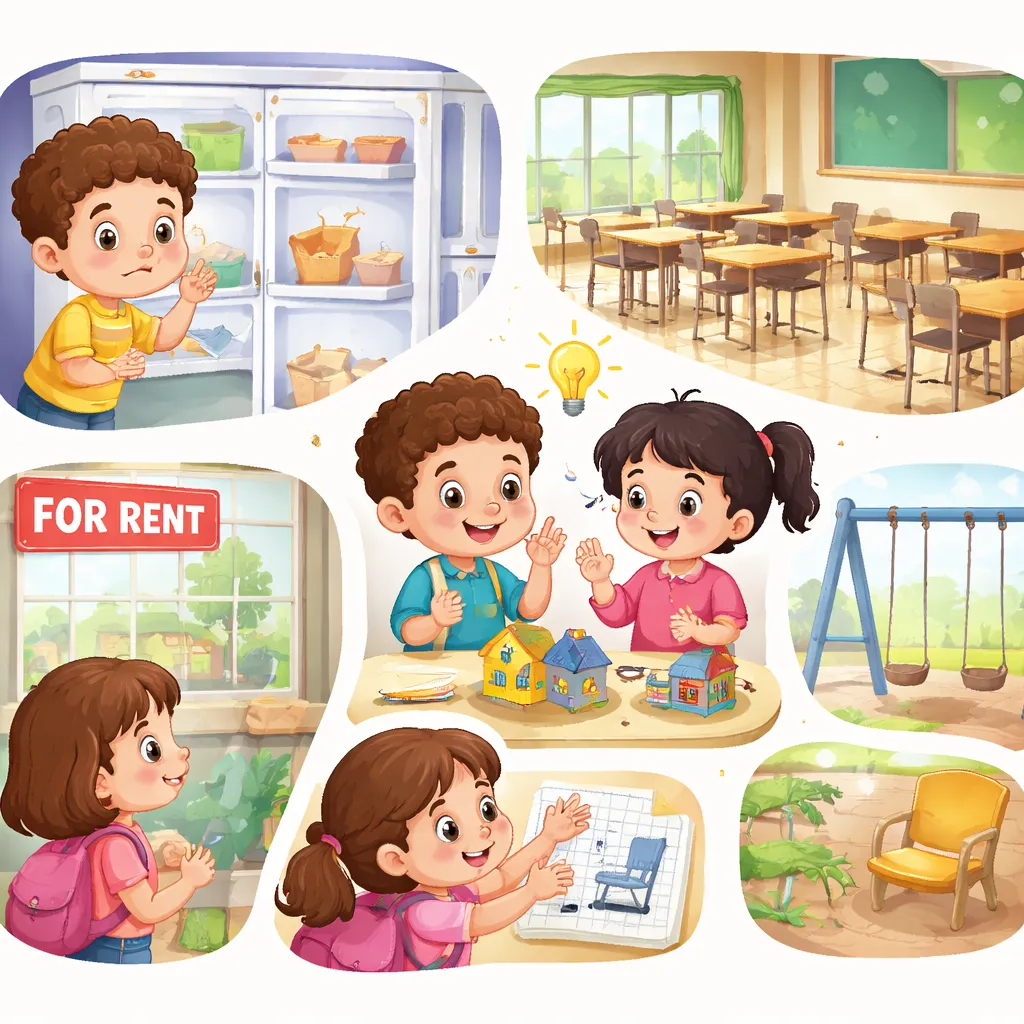

Are Similar Words Really Interchangeable?
Children often meet words that look similar in meaning. This can feel confusing at first. Words like “empty and vacant” both suggest that something has nothing inside.
However, these two words are not always interchangeable. They carry different tones and are used in different situations. Understanding this difference helps children speak more clearly.
For parents, this is also a good chance to guide children toward deeper vocabulary learning. When kids learn small differences, they gain confidence. They also become better readers and writers.
So, even though “empty and vacant” seem alike, they each have their own place in English.
Set 1: empty vs vacant — Which One Is More Common?
“Empty” is far more common in daily conversation. Children hear it often at home and school.
For example:
The glass is empty. My bag is empty.
These sentences are simple and easy to understand. That is why “empty” appears early in language learning.
“Vacant,” on the other hand, appears less often in casual speech. It is more common in signs or formal settings.
For example:
The room is vacant. The seat is vacant.
Children may notice “vacant” on hotel doors or parking signs. This shows that frequency matters. One word becomes familiar faster because people use it more often.
Set 2: empty vs vacant — Same Meaning, Different Contexts
Both words suggest a lack of content, but they fit different situations.
“Empty” works best for physical objects. It describes something that has nothing inside.
Examples include:
An empty box An empty bottle An empty plate
“Vacant” often describes spaces meant for people. It focuses on availability rather than physical emptiness.
Examples include:
A vacant apartment A vacant seat A vacant position
This difference helps children choose the right word. “Empty” feels concrete. “Vacant” feels more about use and purpose.
Set 3: empty vs vacant — Which Word Is “Bigger” or More Emphatic?
“Empty” is direct and neutral. It simply states a fact. There is nothing inside.
“Vacant” can feel slightly more formal and sometimes more expressive. It can also suggest a longer absence or a special kind of emptiness.
For example:
An empty chair just means no one sits there. A vacant chair can suggest that it is waiting for someone.
In some cases, “vacant” can even describe a feeling or expression.
Example:
She gave a vacant look.
This use shows that “vacant” can carry emotional meaning. It feels broader than “empty.”
Set 4: empty vs vacant — Concrete vs Abstract
“Empty” usually describes something you can see or touch. It connects to real objects.
Examples include:
Empty cup Empty room Empty jar
These are clear and easy for children to imagine.
“Vacant” can be more abstract. It often describes situations or conditions.
Examples include:
Vacant position Vacant house Vacant expression
When a child hears “vacant expression,” they must think about feelings, not objects. This makes “vacant” a bit more advanced.
Understanding this difference helps children grow from simple vocabulary to more complex ideas.
Set 5: empty vs vacant — Verb or Noun? First Understand the Role
Both “empty and vacant” are mainly adjectives. They describe nouns.
“Empty” can also act as a verb. This makes it more flexible.
Examples:
Please empty the box. He emptied his bag.
“Vacant” does not work as a verb in daily use. It stays as an adjective.
Example:
The room is vacant.
This difference is important. Children often try to use words in many ways. Knowing that only “empty” can act as a verb helps them avoid mistakes.
Set 6: empty vs vacant — American English vs British English
Both “empty and vacant” appear in American and British English. Their meanings stay mostly the same.
However, usage habits can differ slightly.
In American English, “vacant” often appears in real estate or public signs.
Examples:
Vacancy signs in hotels Vacant parking spaces
In British English, “vacant” also appears in similar contexts. But everyday speech still prefers “empty.”
Children learning global English should know both forms. This helps them understand signs, books, and conversations from different regions.
Set 7: empty vs vacant — Which Fits Formal Situations?
“Empty” works well in informal and neutral situations. It fits daily conversation easily.
Examples:
My lunchbox is empty. The classroom is empty now.
“Vacant” sounds more formal. It fits professional or official settings better.
Examples:
The position is vacant. The office remains vacant.
In writing, “vacant” often appears in notices or reports.
Teaching children this difference helps them adjust their language. They learn when to sound casual and when to sound formal.
Set 8: empty vs vacant — Which One Is Easier for Kids to Remember?
“Empty” is easier for children. It is short, common, and visual. Kids can quickly connect it to everyday objects.
They can see an empty cup or an empty bag. This makes learning natural.
“Vacant” takes more time. It is longer and less common. It also involves more abstract thinking.
To help children remember “vacant,” parents can connect it to real-life examples.
For instance:
A hotel sign that says “vacant” An empty seat in a theater
Using real-world connections makes the word more meaningful.
Mini Exercise: Can You Spot the Differences Between These Similar Words?
Try these simple exercises together. They help children notice the differences clearly.
Choose the correct word:
The bottle is (empty / vacant). The apartment is (empty / vacant). Please (empty / vacant) your bag. The chair is (empty / vacant). He had a (empty / vacant) look on his face.
Suggested answers:
empty vacant empty empty or vacant (both possible, but meaning differs slightly) vacant
You can also ask children to make their own sentences. This builds confidence and creativity.
Parent Tips: How to Help Kids Learn and Remember Similar Words
Parents play an important role in vocabulary learning. Small daily actions can make a big difference.
First, connect words to real life. Show children objects and spaces. Let them describe what they see using “empty and vacant.”
Second, read together. Storybooks often include descriptive words. Pause and talk about them. Ask simple questions like:
Why did the author use this word?
Third, encourage speaking. Let children try new words without fear. Mistakes are part of learning.
Fourth, use repetition in a natural way. Repeat words in different situations. This helps memory grow stronger.
Finally, keep the tone positive. Celebrate effort, not perfection. When children feel safe, they learn faster.
Language grows step by step. With patience and guidance, children can understand even small differences like “empty and vacant.” Over time, these small steps lead to strong and confident communication skills.