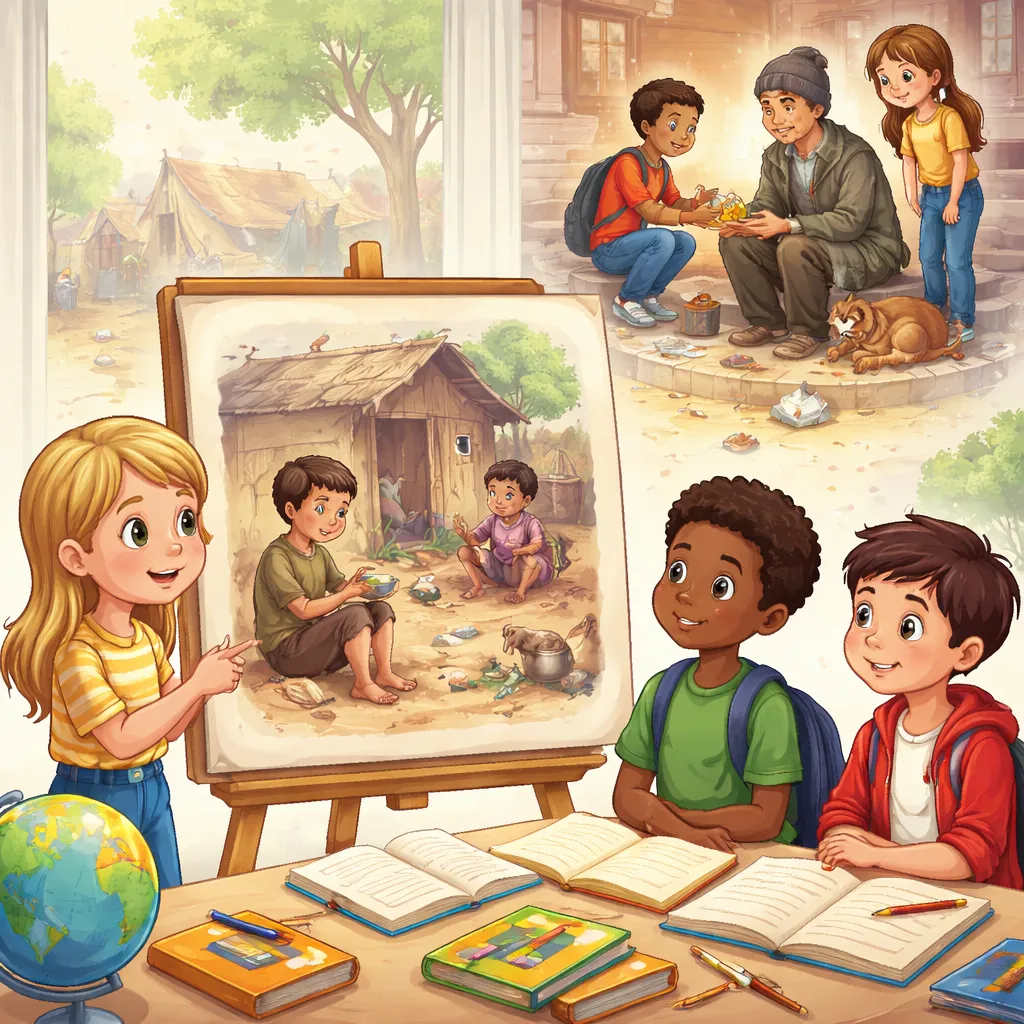

Are Similar Words Really Interchangeable?
Many English words share similar meanings. This can make learning both interesting and challenging. “Poor and impoverished” are two such words. Both describe a lack of money or resources. However, they are not always interchangeable.
“Poor” is simple and widely used. “Impoverished” is more formal and descriptive. These differences affect tone and meaning.
Children may use these words in the same way at first. This is natural. Over time, they begin to notice how each word fits different situations.
Understanding these differences helps children communicate clearly. It also builds empathy and awareness when talking about real-life topics.
Set 1: poor vs impoverished — Which One Is More Common?
“Poor” is much more common in daily language. Children hear it often in conversations and stories.
Examples:
a poor family a poor village a poor person
These examples are simple and direct.
“Impoverished” appears less often. It is more common in formal writing or serious discussions.
Examples:
an impoverished community an impoverished region
Because “poor” is more common, children learn it first. “Impoverished” usually comes later as vocabulary grows.
Set 2: poor vs impoverished — Same Meaning, Different Contexts
Both words describe a lack of money. However, they are used in different contexts.
“Poor” is flexible. It can describe people, places, or even quality.
Examples:
a poor family a poor area poor performance
“Impoverished” focuses on long-term lack of resources. It often describes groups or places.
Example:
an impoverished country
If a child says “an impoverished performance,” it sounds incorrect. The word does not fit that context.
Context helps children choose the correct word.
Set 3: poor vs impoverished — Which Word Is “Bigger” or More Emphatic?
Both words describe difficulty. However, “impoverished” often feels stronger.
“Poor” is general. It describes a basic lack of money.
“Impoverished” suggests deeper or long-term hardship. It often implies serious conditions.
Compare:
a poor neighborhood an impoverished neighborhood
The second suggests more severe conditions.
“Impoverished” adds depth and seriousness. It is more emphatic in many cases.
Set 4: poor vs impoverished — Concrete vs Abstract
Both “poor and impoverished” are abstract words. They describe conditions, not objects.
However, “poor” can connect to more everyday ideas. Children can relate to it more easily.
Examples:
a poor family a poor student
“Impoverished” often describes larger social situations.
Examples:
an impoverished region an impoverished population
These ideas require more understanding of the world.
Parents can explain: “Poor means not having much money.” “Impoverished means very poor for a long time.”
Simple explanations support learning.
Set 5: poor vs impoverished — Verb or Noun? First Understand the Role
Both “poor” and “impoverished” are adjectives. They describe nouns.
Examples:
a poor child an impoverished area
“Poor” also appears in different expressions:
the poor (meaning people without money)
“Impoverished” comes from the verb “impoverish.”
Example:
War can impoverish a country.
This connection helps children understand word families.
Learning related forms builds stronger vocabulary.
Set 6: poor vs impoverished — American English vs British English
Both words appear in American and British English. There are no spelling differences.
“Poor” is common in both regions. It appears in daily conversation and education.
“Impoverished” is also used in both varieties. It appears more in formal writing.
Usage patterns are similar. Learners can use both words in either variety.
The main difference lies in tone and context.
Set 7: poor vs impoverished — Which Fits Formal Situations?
“Impoverished” fits formal situations better. It sounds more precise and respectful.
Examples:
an impoverished community an impoverished nation
These phrases appear in reports and academic writing.
“Poor” is more casual. It works well in everyday conversation.
Examples:
a poor family a poor area
In formal contexts, “impoverished” often feels more appropriate.
Teaching this difference helps children use language thoughtfully.
Set 8: poor vs impoverished — Which One Is Easier for Kids to Remember?
“Poor” is easier for children. It is short and widely used.
Children hear it often in stories and daily life. This repetition helps memory.
“Impoverished” is longer and more complex. It may take more time to learn.
Adults can explain: “Poor means not having much money.” “Impoverished means very poor and often for a long time.”
Simple explanations and examples help children remember.
Mini Exercise: Can You Spot the Differences Between These Similar Words?
Practice helps children understand clearly.
Exercise 1: Choose the correct word
The family is very _____. (poor / impoverished) The region is deeply _____. (poor / impoverished) He gave a _____ performance. (poor / impoverished)
Answers:
poor impoverished poor
Exercise 2: Match the meaning
A. poor student B. impoverished area
lacks resources for a long time low quality or weak
Answers: A → 2 B → 1
Exercise 3: Create your own sentences
Ask children to write:
one sentence with “poor” one sentence with “impoverished”
Encourage simple and clear ideas.
Parent Tips: How to Help Kids Learn and Remember Similar Words
Parents can support vocabulary learning through daily interaction. Simple habits are very effective.
Use real-life examples. Talk about situations in a respectful way. Use “poor” in simple contexts.
Then introduce “impoverished” in more serious or formal situations: “This family is poor.” “This region is impoverished.”
Keep explanations short and clear. Avoid complex language.
Read books together. Stories provide natural examples.
Encourage children to ask questions. Curiosity supports learning.
Repeat words in daily conversation. Repetition builds memory.
Use games and simple exercises. Matching and sentence building make learning enjoyable.
Be patient. Language learning takes time. Each new word builds understanding.
As children continue to learn, they begin to understand the difference between “poor and impoverished.” They learn to choose words based on tone, meaning, and context. This awareness helps them communicate clearly, respectfully, and thoughtfully in English.