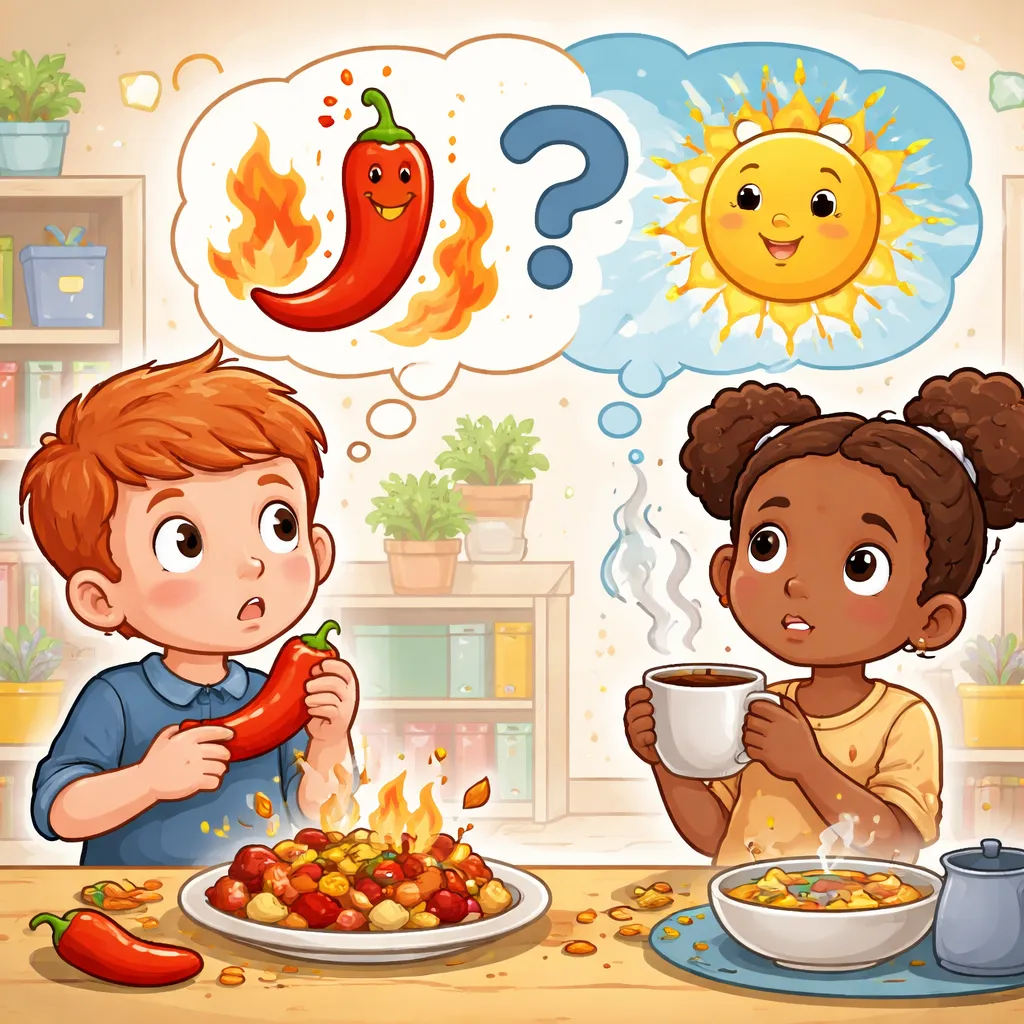

Are Similar Words Really Interchangeable?
Many English words seem similar at first glance. Children often learn them as pairs. “Spicy” and “hot” are a good example. Both words relate to food and taste. Both can describe strong flavors.
However, similar does not always mean the same. Words carry subtle differences. These differences matter in real communication.
For young learners, understanding these distinctions builds confidence. It also prevents confusion. Parents can guide children to notice small changes in meaning. This helps children use English more naturally.
“Spicy and hot” may overlap in meaning, but they are not always interchangeable. Let us explore how they compare across different situations.
Set 1: spicy vs hot — Which One Is More Common?
“Hot” is more common in everyday English. Children hear it early. It appears in many contexts. For example: hot weather, hot soup, hot tea.
“Spicy” is more specific. It mainly describes food with strong flavors from spices. It does not apply to temperature.
Children often say “This soup is hot” when it burns their tongue. This refers to heat. But if the soup contains chili or pepper, “spicy” becomes more accurate.
Parents can highlight this difference. Ask children: Is it hot because of temperature, or spicy because of ingredients?
In daily conversation, “hot” appears more often. “Spicy” appears when talking about food flavors.
Set 2: spicy vs hot — Same Meaning, Different Contexts
Sometimes “spicy and hot” seem to mean the same thing. This often happens when food has a burning taste.
In some contexts, “hot” can describe spicy food. For example, “This curry is very hot.” Here, “hot” refers to the spice level.
However, “spicy” always refers to flavor, not temperature. You cannot say “The weather is spicy.”
Context decides meaning.
Children should learn to ask: What is being described? Food? Weather? A drink?
“Hot” changes meaning based on context. “Spicy” stays focused on taste.
This difference helps children choose the correct word.
Set 3: spicy vs hot — Which Word Is “Bigger” or More Emphatic?
“Hot” has a broader meaning. It covers more situations. It can describe temperature, popularity, and even emotions.
“Spicy” is narrower. It focuses on food flavor.
In terms of intensity, “spicy” often feels more descriptive. It tells us about ingredients like chili, pepper, or curry spices.
“Hot” can be vague. It may mean warm or burning. It depends on context.
For example:
“This dish is hot.” (unclear meaning) “This dish is spicy.” (clear meaning)
“Spicy” gives more detail. “Hot” gives a general idea.
Children benefit from using specific words. It improves clarity in communication.
Set 4: spicy vs hot — Concrete vs Abstract
Both “spicy” and “hot” can describe physical experiences. However, “hot” also has abstract meanings.
“Hot” can describe popularity. For example: “That song is hot.” It can also describe emotions: “He feels hot with anger.”
“Spicy” rarely works in abstract ways. It mostly stays connected to food.
There is one exception. Sometimes people say “a spicy story.” This means exciting or bold. But this usage is less common for children.
For young learners, it is best to focus on the concrete meaning:
“Spicy” = flavor “Hot” = temperature (and sometimes flavor)
This clear distinction supports early learning.
Set 5: spicy vs hot — Verb or Noun? First Understand the Role
Both “spicy” and “hot” are adjectives. They describe nouns.
For example:
“spicy noodles” “hot soup”
However, “hot” appears in more grammatical forms. It can act as part of idioms and phrases.
Examples:
“hot day” “hot topic” “feel hot”
“Spicy” rarely changes roles. It remains an adjective in most cases.
Children should first understand that both words describe things. They answer the question: “What kind?”
Parents can practice by asking: “What kind of food is it?” Children can answer: “It is spicy.” or “It is hot.”
This builds sentence structure and vocabulary at the same time.
Set 6: spicy vs hot — American English vs British English
In both American and British English, “spicy and hot” are widely understood. However, usage patterns may vary slightly.
In American English, “spicy” is very common when talking about food. People often say “spicy food” to describe dishes with chili or strong seasoning.
In British English, “hot” is sometimes used more often to describe spicy food. For example: “This dish is quite hot.”
Both forms are correct. Children should learn to understand both.
Parents can explain that English changes slightly across regions. This helps children become flexible learners.
Exposure to different usages improves listening skills.
Set 7: spicy vs hot — Which Fits Formal Situations?
In formal writing, clarity is important. “Spicy” is more precise when describing food flavor.
For example:
“The dish has a spicy flavor.” (clear and formal)
“Hot” can be less precise in formal contexts. It may confuse readers if the meaning is unclear.
For academic or descriptive writing, “spicy” is often preferred when discussing taste.
However, “hot” works well when describing temperature in formal contexts.
For example:
“The liquid is hot.”
Children can learn that formal language prefers accuracy. Choosing the right word improves writing quality.
Set 8: spicy vs hot — Which One Is Easier for Kids to Remember?
“Hot” is easier for beginners. It is short and common. Children learn it early.
“Spicy” is slightly longer and more specific. It may take more time to remember.
However, “spicy” connects strongly to real experiences. Children remember it when they taste something with chili or pepper.
Parents can use real-life examples. For example: “Is this soup hot or spicy?”
This simple question helps children connect words to experiences.
Using both words in daily conversation builds strong memory.
Mini Exercise: Can You Spot the Differences Between These Similar Words?
Try these short exercises with children.
Choose the correct word: “The tea is too ___ to drink.” Answer: hot Choose the correct word: “The noodles are very ___ because of the chili.” Answer: spicy Fill in the blank: “I like ___ food, but not too hot.” Answer: spicy True or False: “Spicy” can describe weather. Answer: False True or False: “Hot” can describe both temperature and taste. Answer: True
These exercises help children practice in a fun way.
Parent Tips: How to Help Kids Learn and Remember Similar Words
Children learn best through experience. Parents can make learning natural and enjoyable.
Start with real-life situations. During meals, talk about flavors. Ask simple questions. Encourage children to describe what they taste.
Use repetition. Repeat “spicy and hot” in different contexts. This builds familiarity.
Read books together. Point out these words when they appear. Discuss their meaning.
Use visuals. Show pictures of food. Ask children to label them as “spicy” or “hot.”
Encourage speaking. Let children form simple sentences. For example: “This is spicy.”
Avoid correction that feels harsh. Instead, guide gently. If a child says “spicy tea,” ask: “Is it spicy or just hot?”
Create small games. For example, sorting foods into “spicy” and “hot.”
Celebrate small progress. Each correct use builds confidence.
Language learning takes time. With patience and support, children learn to notice differences. Over time, “spicy and hot” will feel natural and easy to use.