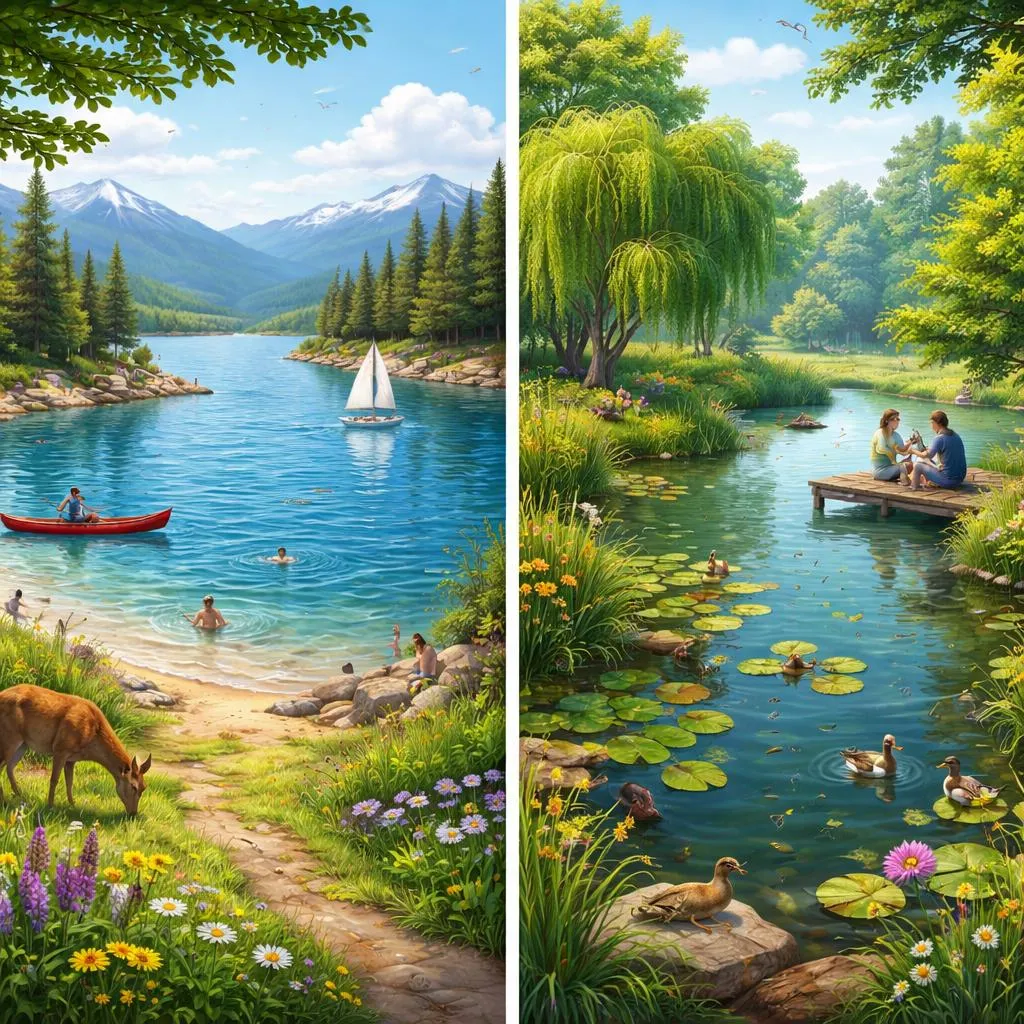

Hello, water explorer! You see a big, wide lake. You see a small, still pond. Both hold water. But are they the same thing? They are two different sizes of still water. One is like a huge, deep stage. One is like a cozy, small puddle. Let's discover their secret! Today, we explore the word pair "lake" and "pond". Knowing the difference makes you a word expert. Let's begin.
First, let's be Language Listeners. Listen at home. Here are two sentences. "We went fishing on the big lake last summer." "We have a small frog pond in our backyard." Both talk about still water. Big for fishing. Small in backyard. Do they sound the same? One sounds large and open. One sounds small and close. Can you sense the difference? Great listening! Now, let's look closer.
Adventure! Into the World of Still Water
Welcome to understanding quiet water. A "lake" and a "pond" are both bodies of still water. But their size and feel are different. Think of a "lake" as a huge, deep stage. It is a large body of water. It is surrounded by land. It is deep and often has waves. Think of a "pond" as a cozy, small puddle. It is a very small body of still water. It is often shallow and calm. Both are water. But one is the "huge stage". One is the "cozy puddle". Let's learn about each one.
A Huge Stage vs. A Cozy Puddle Think about the word "lake". A "lake" is a large inland body of water. It is bigger and deeper. You can see waves on a lake. Now, think about "pond". A "pond" is a small area of still water. It is smaller and shallower. Ducks swim on the pond. The lake was great for sailing. The garden pond has fish. "Lake" is the huge stage. "Pond" is the cozy puddle.
Big and Deep vs. Small and Shallow Let's compare their size. A "lake" is usually big and deep. It can be miles across. The Great Lakes are enormous. A "pond" is small and shallow. Sunlight often reaches its bottom. The frog pond is tiny. Many fish live in the lake. The pond freezes fast. One is big and deep. One is small and shallow.
Their Special Word Partners and Common Uses Words have best friends. "Lake" often partners with large names, activities, and features. Great Salt Lake. Lake shore. Across the lake. Lake house. "Pond" often partners with small, gentle features. Frog pond. Garden pond. Pond life. In the pond. Note: "Lake" is used for large, named bodies of water. "Pond" is used for small, often man-made water features. You swim in a lake. You skip stones on a pond.
Let's visit a school scene. In geography, we learned about the formation of a glacial lake. This is about a large, natural water body. In science, we observed insects in a small pond. The word "lake" fits the large geographical feature. The word "pond" fits the small habitat for insects. One is a big landform. One is a small ecosystem.
Now, let's go to the playground. The large splash pool felt like a small lake. This compares the big pool to the size of a lake. The little water feature was like a pond. The word "lake" fits a comparison to a large water area. The word "pond" fits a comparison to a very small water feature. One implies bigger size. One implies smaller size.
Our Little Discovery So, what did we find? A "lake" and a "pond" are both still water. But a "lake" is a large, deep body of water. It is often natural. A "pond" is a very small, shallow body of water. It can be natural or man-made. You can boat on a lake. You can build a pond. Lake Superior is a huge lake. Our frog pond is fun. "Lake" is the huge stage. "Pond" is the cozy puddle.
Challenge! Become a Word Champion
Ready for a nature test? Let's try your new skills!
"The Best Choice" Challenge Let's imagine a natural scene. The family rented a cabin by the large, clear lake. This describes a big water body suitable for a vacation spot. The tadpoles swam in the muddy garden pond. The word "lake" is the champion for the large, clear water by a vacation cabin. The word "pond" is the best choice for the small, muddy water in a garden with tadpoles. One is large and clear. One is small and muddy.
"My Sentence Show" Your turn to create! Here is your scene: A peaceful water scene. Can you make two sentences? Use "lake" in one. Use "pond" in one. Try it! Here is an example: "We watched the sunset over the calm lake." This describes a large, scenic water view. "The dragonflies hovered above the still pond." This describes a small, still water body with insects. Your sentences will show a big view versus a small scene!
"Eagle Eyes" Search Look at this sentence. Can you find the word that could be better? Let's check a home context. "We put a small rowboat on the tiny, garden lake behind our house." Hmm. A "tiny" water body in a garden is usually a "pond". Using "lake" here sounds too big. A better sentence is: "We put a small rowboat on the tiny, garden pond behind our house." Using "pond" correctly describes a very small water feature. "Lake" is better for much larger bodies of water. Did you spot it? Super thinking!
Harvest and Action! Turn Knowledge Into Your Superpower
Great exploring! We started thinking "lake" and "pond" were just still water. Now we know they are different in size and feel. A "lake" is a large, often deep body of still water. A "pond" is a very small, shallow body of still water. You can now talk about still water with perfect clarity.
What you can learn from this article: You can now see that a "lake" is a large body of water surrounded by land. It is deep enough for boats and can have waves. You can now understand that a "pond" is a very small body of still water. It is often shallow. Sunlight can reach the bottom of a pond. You know that you can go swimming in a lake. You can look for frogs in a pond. You learned to match the word to the idea: "lake" for the large, deep water stage; "pond" for the small, shallow water puddle.
Life practice application: Try your new skill today! Be a water detective. Look at a map or visit a park. Is the water very big and wide? That's likely a lake. Is it small, maybe in a garden or park? That's likely a pond. Remember, lake is the huge stage, pond is the cozy puddle. Use "lake" when you talk about a large, named body of water. Use "pond" when you talk about a small water feature. You will describe the world's water like a real geographer!