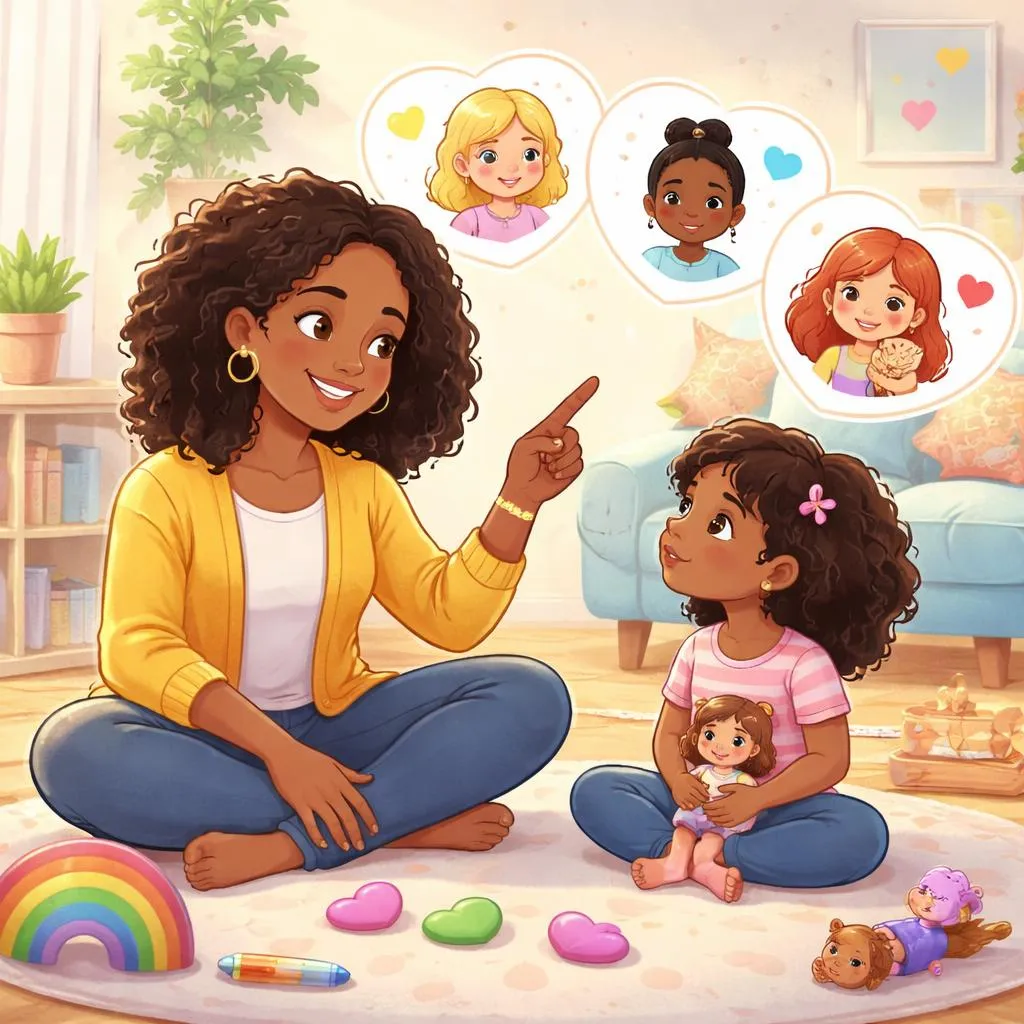

What Does “Same Word, Different Forms” Mean? English words like to change their shape. The meaning often stays the same. But the form shifts to fit the sentence. “She, her, hers” all point to one person. That person is female or a girl. Each form has a unique job. Learning these jobs helps children speak smoothly. You can teach this with simple daily examples.
Personal Pronouns Change Their Form “She, her, hers” are personal pronouns. They replace a female person’s name. Use “she” when the girl does the action. Example: “She dances in the living room.” Use “her” when something happens to the girl. Example: “Dad hugs her.” Use “her” also to show ownership before a noun. Example: “That is her doll.” Use “hers” alone to show ownership. Example: “That doll is hers.”
From Verb to Noun to Adjective to Adverb – One Family, Many Words “She, her, hers” are not verbs or nouns. But they follow a similar family pattern. The root meaning is “a specific female person.” “She” works as a subject. “Her” works as an object. “Her” also works as a possessive adjective. “Hers” works as a possessive pronoun. Each form answers a different question. Who does? She. Who receives? Her. Who owns? Her or hers.
One Root, Many Roles – How Words Grow from Actions to Qualities Think of a girl named Mia. “She reads books every night.” “I see her at the library.” “Her bag is full of stories.” “The red bag is hers.” The root stays Mia. The role changes with each sentence. Children learn this best through stories. Not through memorizing grammar rules.
Same Meaning, Different Jobs – Is It a Verb or a Noun? “She, her, hers” are pronouns. But the idea of changing jobs is the same. “She” acts like a subject noun. “Her” acts like an object noun or an adjective. “Hers” acts like a noun. This is similar to “paint” as a verb. And “painter” as a noun. Same family. Different sentence jobs. One pattern helps children understand many words.
Adjectives and Adverbs – When Do We Add -ly? “She, her, hers” never add -ly. That rule belongs to adjectives becoming adverbs. Example: soft becomes softly. Pronouns change their whole form instead. No extra letters. Just a new word shape. This shows children two types of word change. Some add endings. Some swap sounds completely. Both are normal in English.
Watch Out for Tricky Spelling Changes (Double Letters, y to i, and More) “She, her, hers” have simple spelling. No double letters. No y to i changes. But young learners often mix “she” and “her.” A useful trick: ask a question. “Who does the action?” If the girl does it, use “she.” “Who receives the action?” If the girl receives it, use “her.” Another common mix-up is “her” and “hers.” Use “her” before a noun: “her pencil.” Use “hers” alone: “The pencil is hers.” Show your child both forms side by side.
Let’s Practice – Can You Choose the Right Form? Try these sentences with your child. Fill in the blank with she, her, or hers.
_______ sings beautifully in the morning.
Please pass the crayon to _______.
That is _______ bicycle.
The purple jacket is _______.
_______ mother bakes delicious cookies.
Can you help _______ find her shoe?
_______ and I are in the same class.
I wrote a letter for _______.
Answers:
She
her
her
hers
Her
her
She
her
Go through each answer slowly. Ask your child why the word fits. Praise every good try. Keep practice light and short.
Tips for Parents – Help Your Child Learn Word Families in a Fun Way You do not need a classroom to teach “she, her, hers.” Use everyday moments as learning tools.
At breakfast, talk about a family member. “She likes eggs. Her cup is blue.” Then ask “Who likes eggs? Whose cup?”
During play, describe a doll or toy figure. “She has a pink dress. Her shoes are shiny.” Ask “Can you give the brush to her?”
While reading a picture book, pause. Point to a girl character. Say “She is jumping. Her dog follows her.” Let your child point to each word.
Use two stuffed animals. Make one say “She is my friend.” Make the other say “Give this to her.”
Play a guessing game. Think of a girl your child knows. Say “She loves apples. Her bag is red.” Ask “Who is she?”
Draw three circles on paper. Label them “she,” “her,” “hers.” Say a short sentence. Let your child point to the correct circle. “She runs.” Point to she. “Her hat.” Point to her. “The hat is hers.” Point to hers.
Keep each session under five minutes. Repeat the same games on different days. Children learn through playful repetition. Not through pressure or tests.
When your child makes a mistake, smile gently. Say the correct sentence naturally. Example: child says “Her is playing.” You say “Oh, she is playing. Yes, she looks happy.” Then continue the activity.
No need for long explanations. No need for worksheets. Just warm, consistent examples. Soon your child will use “she, her, hers” without thinking. That confidence will grow with every small conversation. And you will both enjoy the journey.