
Children talk about amounts every day. A little juice. A few crackers. Some time. Two common phrases describe small quantities. “A little bit” and “A small amount.” Both mean “not much.” But they feel different in conversation. Parents and kids can learn together. Describing size helps others understand you. The right words make your meaning clear. Let us explore these two useful expressions.
What Do These Expressions Mean? “A little bit” means a small, imprecise amount. You cannot measure it exactly. The size is tiny but flexible.
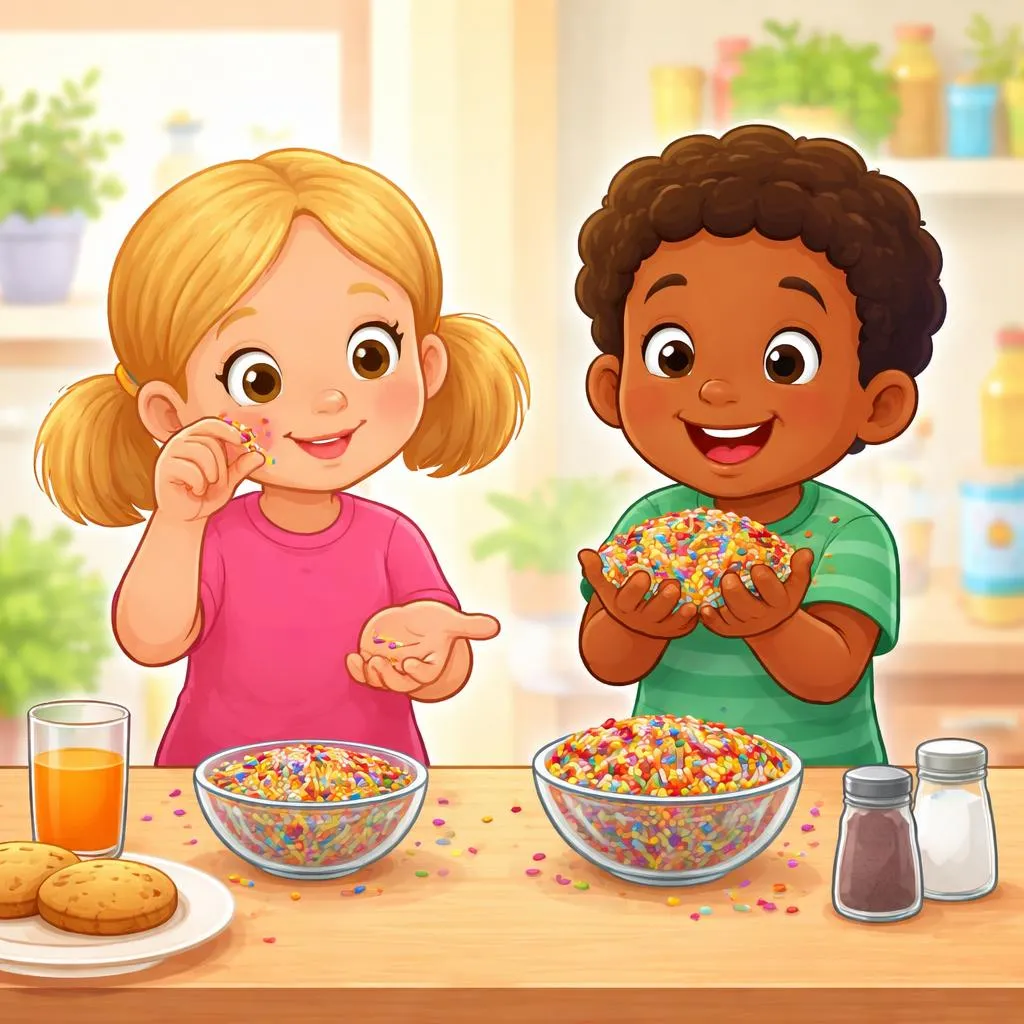
For a child, think of a pinch of salt. “A little bit” says “Not much. Just a tiny part.”
“A small amount” also means not much. But it sounds more exact. It suggests you could measure it if you wanted.
For a child, think of three raisins on a plate. “A small amount” says “This is a specific small number or size.” Both phrases describe small quantities. Both say “less than half.” They seem similar because people use both when they want a little of something. Yet one is loose and friendly. The other is more precise.
What’s the Difference? The main difference is precision. “A little bit” is vague and casual. You use it when exact numbers do not matter.
“A small amount” sounds more specific. It suggests you know roughly how much. You could put a number on it.
Another difference is formality. “A little bit” works in everyday talk. With family. With friends. At the dinner table.
“A small amount” sounds more formal. It fits school reports. Science projects. Cooking recipes. Adult conversations.
One more difference is feeling. “A little bit” feels soft and friendly. It often pairs with “just” or “only.” “Just a little bit” sounds gentle.
“A small amount” feels neutral. It does not add softness. It just states a fact.
Also, “a little bit” can describe feelings. “I am a little bit sad.” “A small amount” does not work for feelings. You would not say “a small amount of sad.”
Teach children that both are useful. One paints a picture. One gives a fact.
When Do We Use Each One? Use “A little bit” for daily talking. How much syrup on pancakes? Say “A little bit.” How long to wait? Say “A little bit longer.”
Use “A little bit” for feelings. “I am a little bit tired.” “I feel a little bit shy.” Emotions need soft words.
Use “A little bit” when exact size does not matter. How much sand in the bucket? “A little bit.” How much glue on the paper? “A little bit.”
Use “A small amount” for instructions. A recipe says “Add a small amount of salt.” A science experiment needs “a small amount of vinegar.”
Use “A small amount” in school work. “We need a small amount of water for this plant.” “A small amount of force moves the toy.”
Use “A small amount” when comparing. “A small amount of sugar is better than a large amount.” This sounds clear and correct.
Parents can model both. Say “a little bit” for feelings and casual talk. Say “a small amount” for facts and school topics.
Example Sentences for Kids Here are simple sentences children can say.
A little bit:
I ate a little bit of my broccoli.
Can I have a little bit more milk?
I am a little bit nervous about the test.
The movie was a little bit scary.
Just a little bit of paint went on my shirt.
A small amount:
Add a small amount of soap to the water.
A small amount of dust fell on the table.
You only need a small amount of glue.
A small amount of rain fell yesterday.
The doctor said to take a small amount of medicine.
Read these aloud. Notice how “a little bit” sounds warm and everyday. Notice how “a small amount” sounds more exact and factual.
Common Mistakes to Avoid Children often mix these phrases. Here are common errors.
Mistake 1: Using “a small amount” for feelings. Example: “I have a small amount of sadness.” This sounds strange. Feelings do not use “amount.” Correct: Say “I am a little bit sad.”
Mistake 2: Using “a little bit” for very exact measurements. Example: A science teacher asks for 2 milliliters of liquid. A child says “a little bit.” The teacher needs exact numbers. Correct: Say “a small amount” or give the exact number.
Mistake 3: Saying “a little bit” too many times. Using it in every sentence sounds repetitive. People get bored. Correct: Sometimes say “a little” or “a small amount” instead.
Mistake 4: Forgetting that “a small amount” sounds formal. Saying it to a friend at lunch feels stiff. “Hey, I need a small amount of your chips.” Correct: Say “a little bit of your chips” to a friend.
Mistake 5: Pronouncing “a little bit” as “alittlebit.” Children rush the words. It becomes one messy sound. Correct: Say each word clearly. “A lit-tle bit.”
Easy Memory Tips Here are simple memory tricks.
Memory tip 1: Think of a pinch and a teaspoon. “A little bit” is a pinch. You use your fingers. It is loose. “A small amount” is a teaspoon. You measure it. It is exact.
Memory tip 2: Use your hands. Pinch your fingers together for “a little bit.” Show a small space between your thumb and finger for “a small amount.”
Memory tip 3: Think about feelings versus facts. Feelings = “a little bit.” Facts = “a small amount.”
Memory tip 4: Draw two jars. One jar has a squiggle at the bottom. Label it “a little bit” (not exact). One jar has a line at 1 inch. Label it “a small amount” (measured).
Memory tip 5: Use the “cooking test.” If you are cooking with a recipe, say “a small amount.” If you are pouring cereal, say “a little bit.”
Practice these tips during daily activities. Measure things together. Use both phrases.
Quick Practice Time Try these exercises. Parents read aloud. Children answer.
Exercise 1: Choose the best phrase.
You are telling a friend how much ketchup you want on your burger. Exact size does not matter. Do you say: a) A little bit b) A small amount
A baking recipe says “Add 5 grams of sugar.” You explain to your little brother. Do you say: a) A little bit b) A small amount
You feel slightly nervous before a show. Do you say: a) A little bit b) A small amount
Answers: 1(a), 2(b), 3(a)
Exercise 2: Fill in the blank.
“I only need __________ of help with my homework. Then I will get it.” (feeling, casual)
“The instructions say to use __________ of baking soda.” (recipe, factual)
Answers: 1. a little bit, 2. a small amount
Bonus: Play the “Measure It” game. Take a cup of rice or beans. Ask your child to show “a little bit” and then “a small amount.” Talk about the difference. Which one was smaller? Which one was more exact?
Wrap-up Use “a little bit” for casual talk and feelings. Use “a small amount” for facts, instructions, and exact measurements. Both describe small quantities. Choose based on who you are talking to and how precise you need to be.