
Children make sound. They laugh. They shout. They bang toys. Two common words describe big sounds. “Loudly” and “Noisily.” Both mean “with much sound.” But one focuses on volume. The other focuses on unpleasantness. Parents and kids can learn together. Understanding sound words helps children adjust their volume. The right words describe what others hear. Let us explore these two noisy expressions.
What Do These Expressions Mean? “Loudly” means “with high volume” or “strong sound.” It describes the power of the sound. A loud sound can be good or bad.
For a child, think of a fire truck siren. “Loudly” says “The sound fills the room. It is strong.”
“Noisily” means “with unwanted or messy sound.” “Noise” often means sound you do not want. Noisily suggests the sound is annoying or chaotic.
For a child, think of pots and pans crashing to the floor. “Noisily” says “That sound is not pleasant. It is too much.” Both phrases describe big sounds. Both say “not quiet.” They seem similar because people use both when children are too loud. Yet one is about volume. One is about annoyance.
What’s the Difference? The main difference is judgment. “Loudly” is neutral. It just states the volume. A band plays loudly. That can be good. “Noisily” carries a negative feeling. It means the sound is bothersome.
Another difference is intention. “Loudly” describes how someone does something. You can speak loudly on purpose. “Noisily” describes chaotic, often accidental sound. A drawer closes noisily because it is broken.
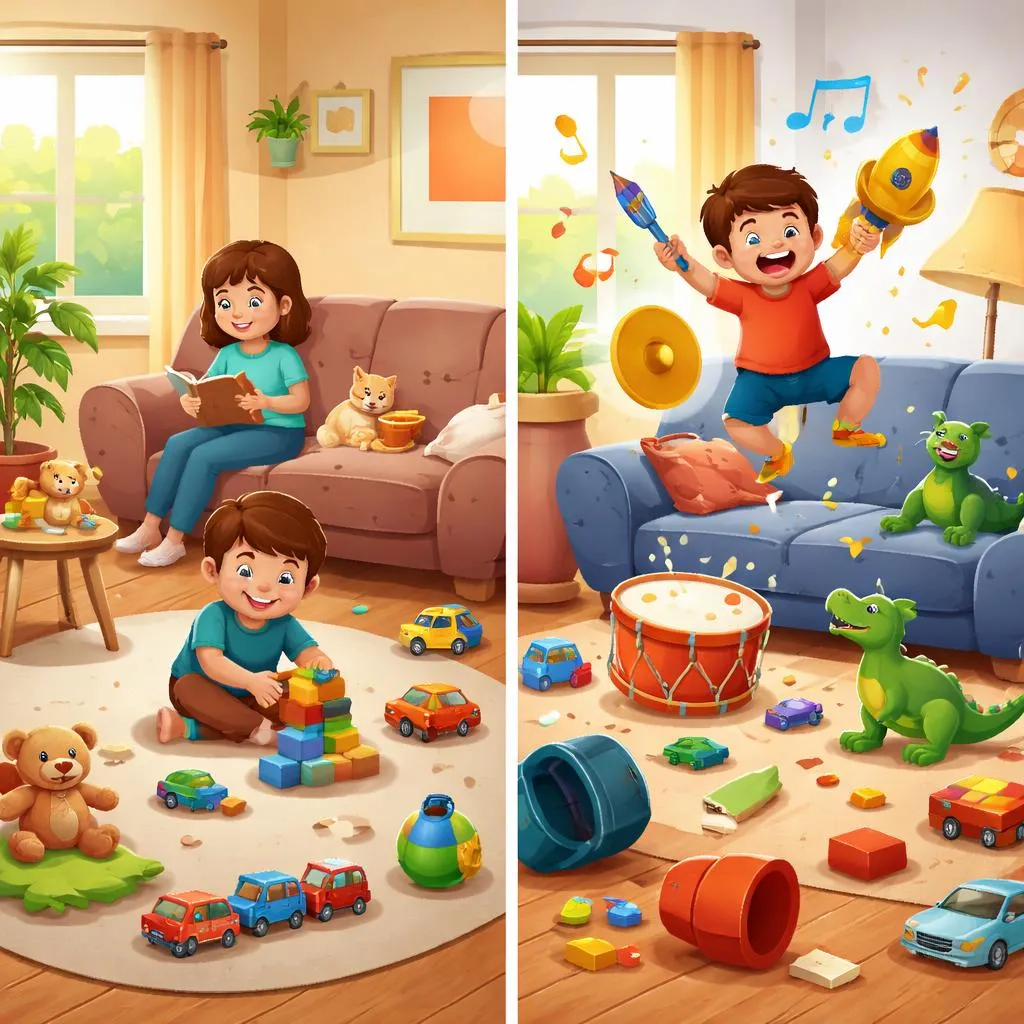
One more difference is what sounds get which word. Music can be loud but not noisy. A construction site is loud and noisy. Crying can be loud but not noisy. Banging is noisy.
Also, “noisily” often describes multiple sounds at once. Chaos. “Loudly” can describe one sound.
Teach children that both mean much sound. One is about power. One is about unpleasantness.
When Do We Use Each One? Use “Loudly” to describe volume without judging. “The teacher spoke loudly so everyone could hear.” “The baby laughed loudly.” “He plays the drums loudly.”
Use “Loudly” for positive or neutral loud sounds. “The crowd cheered loudly for the winner.” “She sang loudly in the shower.” Loud can be joyful.
Use “Loudly” when you need to ask for volume change without blame. “Please do not talk so loudly. The baby is sleeping.” This is clear and kind.
Use “Noisily” when the sound is annoying or chaotic. “The children ate noisily, smacking their lips.” “The old fan rattled noisily.”
Use “Noisily” for sounds that disrupt. “He noisily crunched his chips during the movie.” “The dog noisily scratched the door all night.”
Use “Noisily” to show that the sound is a problem. “Please do not close the cabinet so noisily. It wakes the baby.”
Parents can model both. Say “loudly” for volume facts. Say “noisily” when the sound causes trouble.
Example Sentences for Kids Here are simple sentences children can say.
Loudly:
The thunder boomed loudly.
He laughed loudly at the funny joke.
Please do not shout so loudly in the library.
She plays her music loudly in her room.
The bell rang loudly at noon.
Noisily:
The dog ate his food noisily.
They noisily opened their candy wrappers during the test.
Please do not tap your pencil noisily.
The old heater clanked noisily all night.
He noisily slurped his soup.
Read these aloud. Notice how “loudly” describes strong sound. Notice how “noisily” describes messy or annoying sound.
Common Mistakes to Avoid Children make mistakes with these words. Here are common errors.
Mistake 1: Using “noisily” for pleasant loud sounds. Example: “The band played noisily at the concert.” The band might be great. “Noisily” sounds negative. Correct: Say “The band played loudly” for neutral or positive loud sounds.
Mistake 2: Using “loudly” for annoying sounds. Example: “He loudly chewed with his mouth open.” This is fine, but “noisily” better shows the annoyance. Correct: Use “noisily” when you want to show the sound is bothersome.
Mistake 3: Forgetting that “noisily” comes from “noise.” Noise means unwanted sound. So “noisily” almost always means bad sound. Correct: Remember the rule: loud = volume. Noisy = annoying.
Mistake 4: Using “loudly” for every big sound. Sometimes “strongly” or “powerfully” works better. “The wind blew loudly” is fine but “strongly” might be better. Correct: Use “loudly” for sounds made by people or animals. For nature sounds, other words may fit.
Mistake 5: Saying “noisily” when the sound is actually quiet but annoying. A dripping faucet is quiet but annoying. It is not “noisily.” Correct: Say “annoyingly” or “constantly” for quiet annoying sounds.
Easy Memory Tips Here are simple memory tricks.
Memory tip 1: Think of a volume knob and a garbage can. “Loudly” turns up the volume knob. More sound. No judgment. “Noisily” throws the sound into a garbage can. Bad sound.
Memory tip 2: Use your hands. Cup your hands around your ears for “loudly” (volume). Cover your ears and make a gross face for “noisily” (annoying).
Memory tip 3: Ask “is the sound good or bad?” Neutral or good = “loudly.” Bad or annoying = “noisily.”
Memory tip 4: Draw two pictures. A child blowing a trumpet with a smile = “loudly.” A child banging pots with a messy face = “noisily.”
Memory tip 5: Use the “cheering test.” If you would cheer for the sound, say “loudly.” If you would cover your ears, say “noisily.”
Practice these tips during daily sounds. Name sounds as “loud” or “noisy.”
Quick Practice Time Try these exercises. Parents read aloud. Children answer.
Exercise 1: Choose the best phrase.
The marching band played at the parade. People loved it. Do you say: a) The band played loudly b) The band played noisily
Your little brother smacks his cereal. The sound is gross. Do you say: a) You are eating loudly b) You are eating noisily
The teacher spoke so the back row could hear. Do you say: a) She spoke loudly b) She spoke noisily
Answers: 1(a), 2(b), 3(a)
Exercise 2: Fill in the blank.
“The cheering crowd shouted __________ when the team won.” (positive, strong volume)
“Please chew __________. I cannot hear the movie.” (annoying, messy sound)
Answers: 1. loudly, 2. noisily
Bonus: Play the “Loud or Noisy” game. One person makes a sound. The other person decides if it is “loud” or “noisy.” A cheer = loud. Scratching nails on a board = noisy. Talk about the difference.
Wrap-up Use “loudly” to describe strong volume without judgment. Use “noisily” to describe annoying or messy sound. Both mean much sound. One is about power. One is about unpleasantness. Teach children that loud can be good. Noisy is usually not. And sometimes, quiet is the kindest sound of all.