
Children look up often. At birds. At stars. At shelves. Two common words describe higher places. “Up there” and “Above.” Both mean “in a higher position.” But one is casual and pointed. One is more exact. Parents and kids can learn together. Talking about where things are helps children understand space. The right words show exactly where to look. Let us explore these two upward expressions.
What Do These Expressions Mean? “Up there” means “in that higher place that I can show you.” The word “up” means higher. “There” means away from the speaker. Together they point to a specific higher spot.
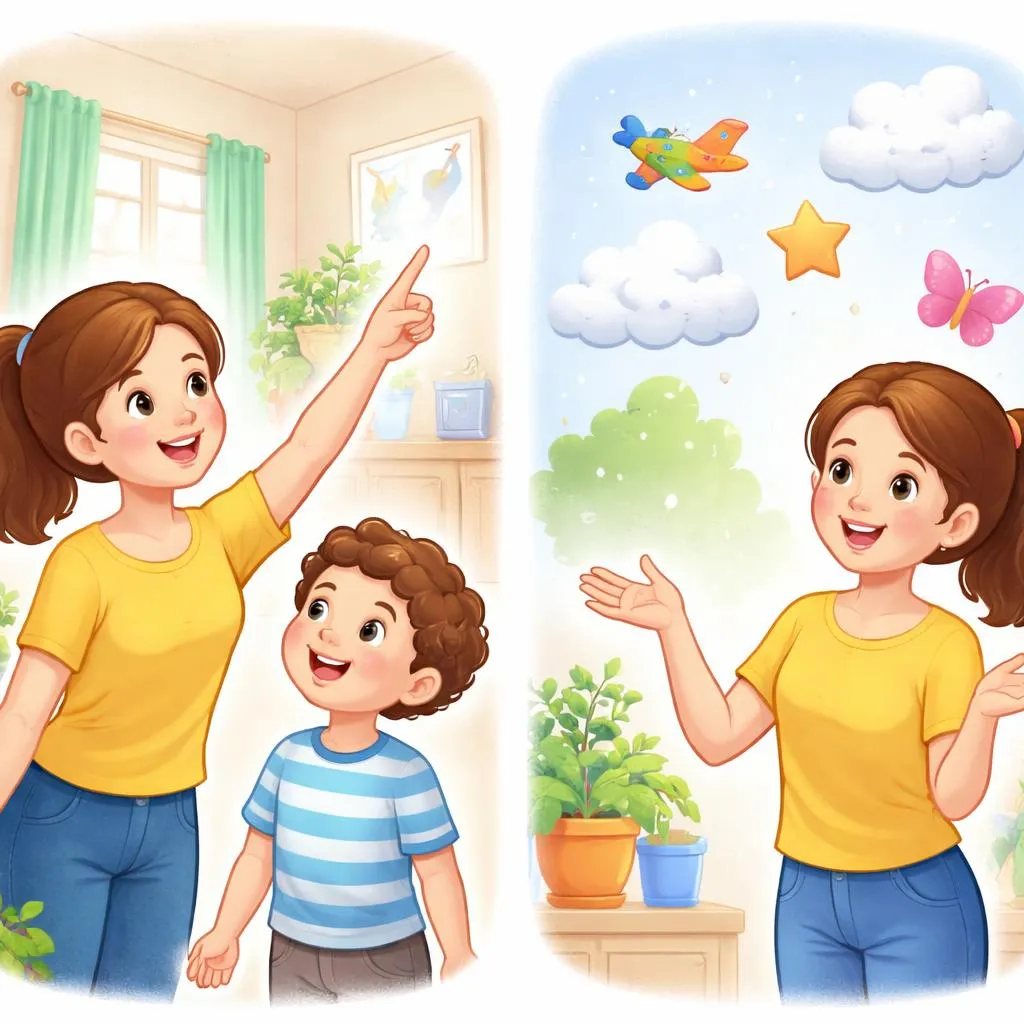
For a child, think of pointing at a bird on a branch. “Up there” says “Look where my finger goes. High up. That spot.”
“Above” means “in a higher position than something else.” It compares two things. Something is above another thing. It does not need pointing.
For a child, think of a shelf over a desk. “Above” says “The shelf is higher than the desk. Not touching. Higher.” Both phrases mean higher. Both say “not down.” They seem similar because people use both for things up high. Yet one needs a point. One needs a comparison.
What’s the Difference? The main difference is pointing. “Up there” almost always needs a point or a nod. You show the spot. “Above” does not need pointing. It compares two things. “The light is above the table.”
Another difference is precision. “Up there” is vague. It points to a general high area. “Above” is more precise. It tells you one thing is higher than another.
One more difference is grammar. “Up there” stands alone. “Look up there.” “Above” usually needs a second thing. “Above the door.” “Above my head.”
Also, “up there” works for very high things. The sky. The ceiling. A tall tree. “Above” works for any height comparison. A book above another book. A hand above a table.
Teach children that both mean higher. One points. One compares.
When Do We Use Each One? Use “Up there” when you can point. “Look up there at the plane.” “The cat is up there on the roof.” “Up there! On the top shelf.”
Use “Up there” for things that are high and far. Stars. Clouds. Kites. Birds. The thing is away from you and up.
Use “Up there” in casual talk. With friends. At home. Outside. It is easy and natural.
Use “Above” when comparing two things. “The clock is above the door.” “Your room is above the garage.” One thing is higher than another.
Use “Above” for exact instructions. “Write your name above the line.” “Hang the picture above the couch.”
Use “Above” in writing and school. “The temperature is above zero.” “The bird flew above the trees.”
Parents can model both. Point and say “up there.” Compare and say “above.”
Example Sentences for Kids Here are simple sentences children can say.
Up there:
Look up there at the moon.
My balloon floated up there.
Up there on the closet shelf is my game.
The spider is up there in the corner.
Up there! I see the eagle.
Above:
The sun is above the clouds.
Please hang your coat above the hook.
A light hangs above the table.
The temperature is above freezing.
She lives in the apartment above us.
Read these aloud. Notice how “up there” points to a spot. Notice how “above” compares two things.
Common Mistakes to Avoid Children make mistakes with these words. Here are common errors.
Mistake 1: Using “above” without a second thing. Example: “Look above.” Above what? The sentence is incomplete. Correct: Say “Look above the door” or “Look up there.”
Mistake 2: Using “up there” without pointing. “It is up there.” Without a point, the listener does not know where. Correct: Always point or gesture when you say “up there.”
Mistake 3: Using “up there” for something right above you. If the thing is directly over your head, say “above me” or “overhead.” Correct: “The light is above me” not “up there.”
Mistake 4: Forgetting that “up there” is two words. “Upthere” is not a word. Write two words. Correct: Always write “up there” with a space.
Mistake 5: Using “above” for very high things without comparison. “The stars are above” is okay but vague. “The stars are above the clouds” is better. Correct: Add the second thing for clarity.
Easy Memory Tips Here are simple memory tricks.
Memory tip 1: Think of a pointing finger and a measuring stick. “Up there” needs a pointing finger. “Above” needs a measuring stick to compare heights.
Memory tip 2: Use your hand. Point up with one finger for “up there.” Hold one hand above the other for “above” (one above the other).
Memory tip 3: Ask “can I point?” If you can point, say “up there.” If you are comparing two things, say “above.”
Memory tip 4: Draw two pictures. A child pointing at a star = “up there.” A shelf above a desk with an arrow = “above.”
Memory tip 5: Use the “second thing” test. If you can name a second thing, say “above.” If not, say “up there.”
Practice these tips during walks. Look up. Name things using both phrases.
Quick Practice Time Try these exercises. Parents read aloud. Children answer.
Exercise 1: Choose the best phrase.
You see a hot air balloon far up in the sky. You point. Do you say: a) Up there b) Above
You want to say the light is higher than the table. Do you say: a) The light is up there b) The light is above the table
You want your child to look at a bird on a high branch. You point. Do you say: a) Look up there b) Look above
Answers: 1(a), 2(b), 3(a)
Exercise 2: Fill in the blank.
“The moon is __________ in the sky tonight.” (pointing, casual)
“Please write your name __________ the line on the paper.” (comparison, exact)
Answers: 1. up there, 2. above
Bonus: Play the “Higher or Lower” game. One person names two things. “The lamp and the table.” The other person says which is above the other. Then switch. Then practice “up there” by pointing to things in the room.
Wrap-up Use “up there” with a point for general high places far from you. Use “above” to compare one thing higher than another. Both mean higher. One points. One compares. Teach children that looking up is wonderful. Using the right words makes sharing discoveries even better.