
Children put things on surfaces. Books on tables. Toys on shelves. Hats on heads. Two common phrases describe higher placement. “On top of” and “Above.” Both mean “higher than.” But one means touching. One means not touching. Parents and kids can learn together. Describing where things are helps children understand space. The right words tell if something is resting or floating. Let us explore these two upward expressions.
What Do These Expressions Mean? “On top of” means “touching the upper surface of something.” The object rests directly on the thing below. There is no space between them.
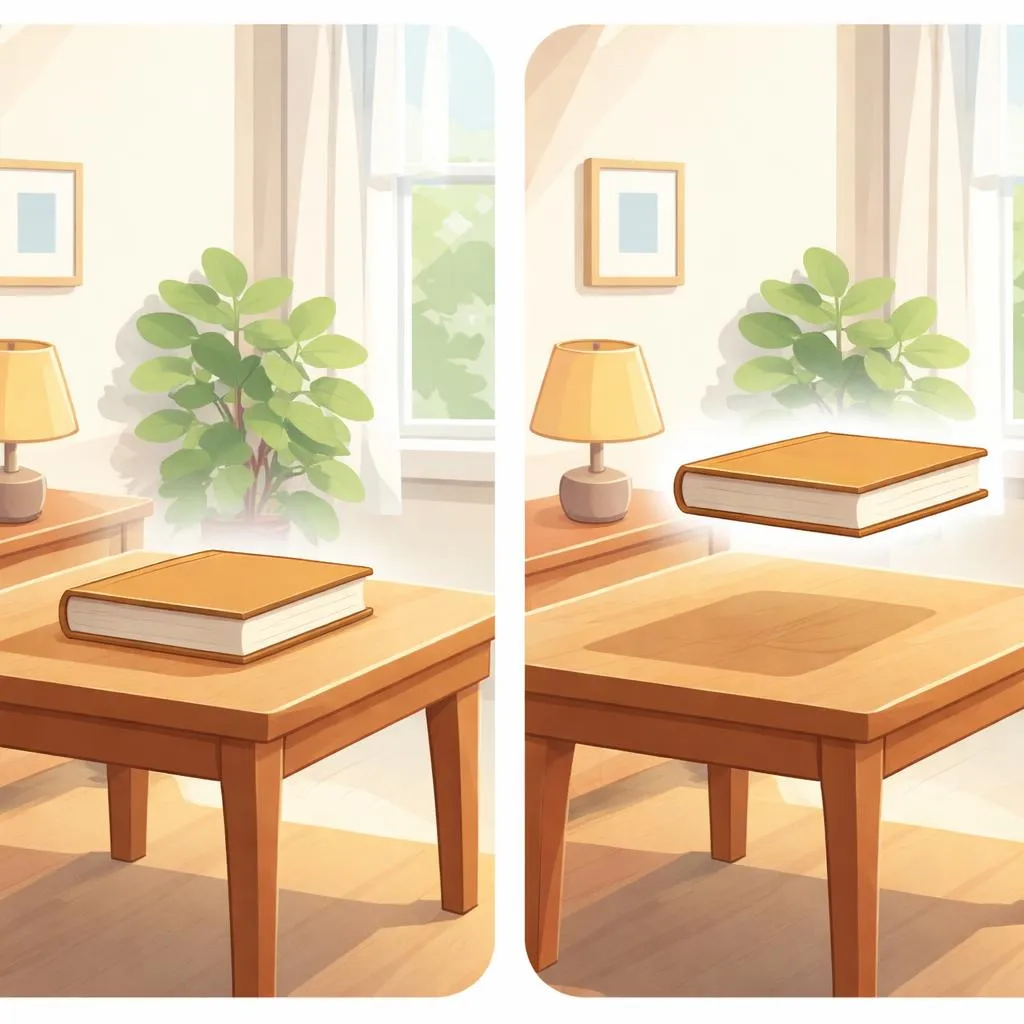
For a child, think of a plate on a table. “On top of” says “The plate touches the table. It sits there.”
“Above” means “in a higher position than something.” The object does not touch the thing below. There is space between them.
For a child, think of a bird flying over a house. “Above” says “The bird is higher than the house. They do not touch.” Both phrases mean higher. Both say “not below.” They seem similar because people use both for things up high. Yet one means touching. One means “hovering” or “up in space.”
What’s the Difference? The main difference is touching. “On top of” requires the object to touch the surface below. “Above” requires no touching. There is air or space between.
Another difference is support. “On top of” means the bottom thing supports the top thing. The table holds the book. “Above” does not mean support. A cloud above a hill is not supported by the hill.
One more difference is gravity. “On top of” works for things that fall without support. Put a cup on a table. It stays. “Above” works for things that float or fly. A balloon above a house.
Also, “above” can mean higher in number or rank. “Above 100 degrees.” “On top of” cannot.
Teach children that both mean higher. One touches. One does not.
When Do We Use Each One? Use “On top of” for resting objects. “Put your book on top of the desk.” “The cat is sleeping on top of the couch.” “The lid is on top of the jar.”
Use “On top of” for stacking. “Place the red block on top of the blue one.” “I put a cherry on top of the cake.”
Use “On top of” for covering. “Snow sat on top of the roof.” “Dust settled on top of the shelf.”
Use “Above” for things that do not touch. “The light hangs above the table.” “A plane flew above our house.” “The sun is above the clouds.”
Use “Above” for writing and drawing. “Draw a cloud above the tree.” “Write your name above the line.”
Use “Above” for numbers and ranks. “The temperature is above freezing.” “She is above me in line.”
Parents can model both. Say “on top of” for touching. Say “above” for hovering or higher without touching.
Example Sentences for Kids Here are simple sentences children can say.
On top of:
Put the cap on top of the bottle.
The kitten slept on top of the warm blanket.
My glass is on top of the coaster.
There is a star on top of the Christmas tree.
The bird feeder is on top of the pole.
Above:
A helicopter hovered above the field.
The moon is above the mountains.
Please hang the picture above the couch.
The temperature is above 90 degrees.
He raised his hands above his head.
Read these aloud. Notice how “on top of” means touching. Notice how “above” means higher with space.
Common Mistakes to Avoid Children make mistakes with these phrases. Here are common errors.
Mistake 1: Using “on top of” when the thing does not touch. Example: “The balloon is on top of the house.” The balloon floats. It does not rest on the house. Correct: Say “The balloon is above the house.”
Mistake 2: Using “above” when the thing touches. Example: “The book is above the table.” If the book sits on the table, it touches. “Above” is wrong. Correct: Say “The book is on top of the table.”
Mistake 3: Forgetting the “of” in “on top of.” “On top the table” is missing “of.” This is wrong. Correct: Say “on top OF the table.”
Mistake 4: Using “above” for numbers with “on top of.” “The score is on top of 100” is wrong. Use “above” for numbers. Correct: Say “The score is above 100.”
Mistake 5: Saying “above” when “over” is better. “Above” and “over” are similar. “Over” often means directly above and can imply covering. “Above” is more general. Correct: Both work. “Over” is more common for directly above.
Easy Memory Tips Here are simple memory tricks.
Memory tip 1: Think of a hand and a bird. “On top of” is a hand resting on a table. Touching. “Above” is a bird in the sky. Not touching.
Memory tip 2: Use your hands. Place one hand on top of the other for “on top of” (touching). Hold one hand above the other with space for “above.”
Memory tip 3: Ask “does it touch?” If yes, say “on top of.” If no, say “above.”
Memory tip 4: Draw two pictures. A cup on a table labeled “on top of.” A balloon over a house labeled “above.”
Memory tip 5: Use the “gravity test.” If you let go and it falls onto the thing, say “on top of.” If you let go and it floats or stays in air, say “above.”
Practice these tips during daily activities. Place things. Point to floating things.
Quick Practice Time Try these exercises. Parents read aloud. Children answer.
Exercise 1: Choose the best phrase.
Your child puts a hat on their head. The hat touches their hair. Do you say: a) The hat is on top of your head b) The hat is above your head
A bird is flying higher than a tree. They do not touch. Do you say: a) The bird is on top of the tree b) The bird is above the tree
A picture is hanging on a wall. The nail is higher than the picture frame. They touch. Do you say: a) The nail is on top of the frame b) The nail is above the frame
Answers: 1(a), 2(b), 3(b — the nail is higher and touches the wall, not the frame. But the nail is above the frame in position.)
Exercise 2: Fill in the blank.
“Please put the bowl __________ the counter.” (touching, resting)
“The clouds are __________ the mountains today.” (higher, no touching)
Answers: 1. on top of, 2. above
Bonus: Play the “Touch or Not Touch” game. One person names two things. “The lamp and the table.” The other person says “on top of” (touching) or “above” (not touching). Use real objects in the room. Test each one.
Wrap-up Use “on top of” when one thing touches and rests on another thing from above. Use “above” when one thing is higher but does not touch. Both mean higher. One touches. One floats. Teach children that small differences in words change meaning. A book on top of a table is ready to read. A book above a table is falling. Words matter.