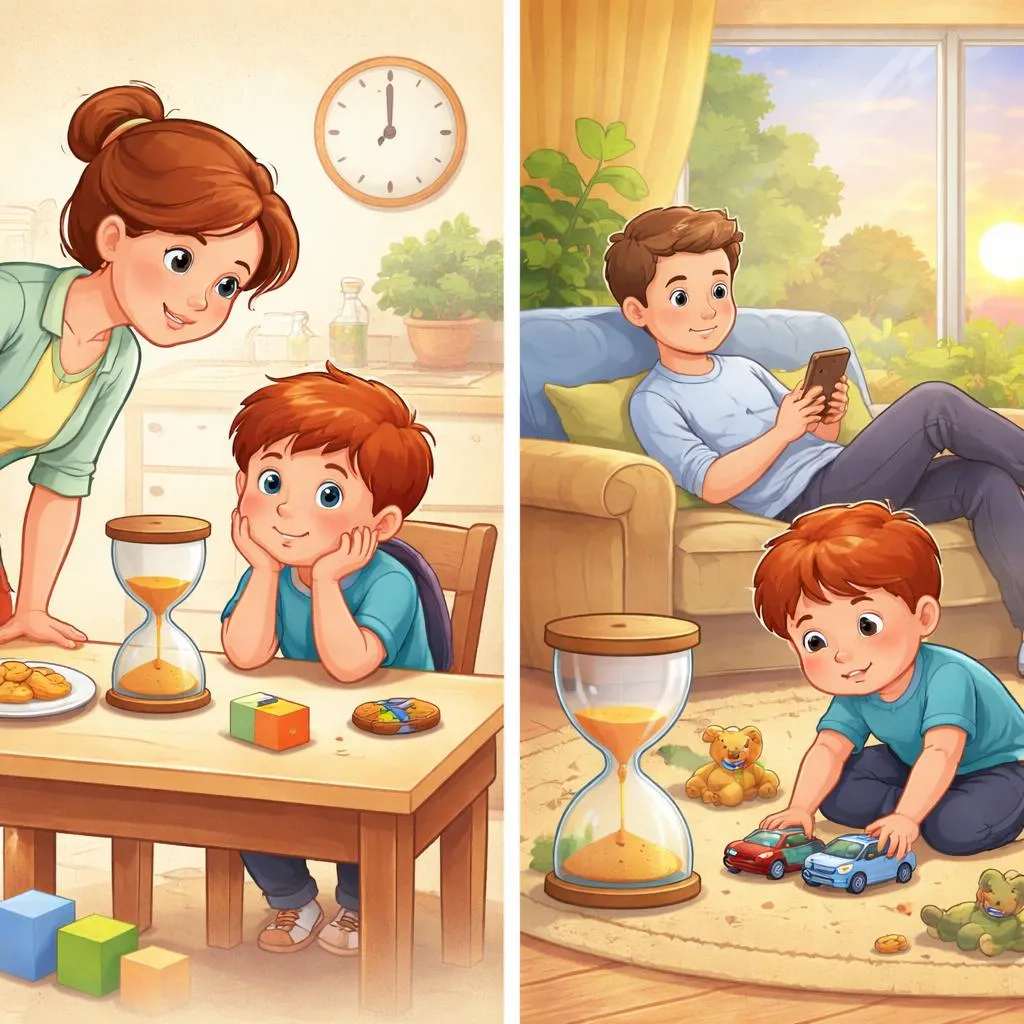

Children wait for many things. Dinner. A turn on the swing. A promised treat. Two common phrases describe short waiting times. “Soon” and “In a little while.” Both mean “not now, but not long from now.” But one is shorter. One feels softer. Parents and kids can learn together. Telling a child to wait takes kindness. The right words set honest expectations. Let us explore these two short-time expressions.
What Do These Expressions Mean? “Soon” means “in a short time from now.” It is vague but suggests minutes, not hours. The word is quick and direct.
For a child, think of a timer set for five minutes. “Soon” says “The wait will be short. Keep watching.”
“In a little while” also means “in a short time.” But “little while” feels softer. It suggests a slightly longer wait than “soon.” It gives more comfort.
For a child, think of a sand timer with soft sand. “In a little while” says “You will wait a bit. But it will not be too long.” Both phrases promise a short wait. Both mean “not immediately.” They seem similar because parents use both to calm impatient children. Yet one promises a very short time. One promises a gentle, slightly longer pause.
What’s the Difference? The main difference is length of wait. “Soon” suggests a very short time. One to five minutes. “In a little while” suggests a slightly longer time. Five to fifteen minutes.
Another difference is urgency. “Soon” can sound more urgent or eager. “Dinner will be ready soon.” “In a little while” sounds more relaxed. “We will leave in a little while.”
One more difference is formality. “Soon” works in any setting. “In a little while” sounds more conversational and gentle. Parents use it to soothe children.
Also, “soon” can be more precise in some contexts. “The bus will come soon” means any minute. “In a little while” is looser.
Teach children that both mean not long. One means very short. One means a little longer.
When Do We Use Each One? Use “Soon” for very short waits. “The pizza will be ready soon.” “I will be there soon.” “Soon, the movie will start.”
Use “Soon” when you mean “any moment now.” “The baby will wake up soon.” “The rain will stop soon.” The event is about to happen.
Use “Soon” for urgency. “We need to leave soon.” It pushes gently.
Use “In a little while” for gentle waiting. “We will go to the park in a little while.” It promises a break but not too long.
Use “In a little while” when the child needs comfort. “Daddy will be home in a little while.” The soft words help.
Use “In a little while” for transitions. “We will clean up now. In a little while, we will have a snack.” It shows two steps.
Parents can model both. Say “soon” for very short waits. Say “in a little while” for slightly longer, gentler waits.
Example Sentences for Kids Here are simple sentences children can say and hear.
Soon:
The cookies will be done soon.
Soon, it will be your turn.
Grandpa is coming soon.
Soon, the sun will set.
I will feel better soon.
In a little while:
We will eat dinner in a little while.
In a little while, we can play outside.
The movie will start in a little while.
I will read you a story in a little while.
In a little while, your friend will arrive.
Read these aloud. Notice how “soon” sounds faster and more direct. Notice how “in a little while” sounds softer and more patient.
Common Mistakes to Avoid Parents and children make mistakes with these phrases. Here are common errors.
Mistake 1: Saying “soon” when the wait will be long. Example: “We will go to Disney World soon.” If the trip is in six months, “soon” is wrong. Children will be disappointed. Correct: Say “later this year” or “not for a while.”
Mistake 2: Saying “in a little while” but meaning right now. If you mean one minute, “soon” is better. “In a little while” suggests a slightly longer wait. Correct: Use “soon” for one minute. Use “in a little while” for five to fifteen minutes.
Mistake 3: Repeating the phrases without action. “Soon. Soon. Soon.” After the third time, the child stops believing. Correct: Only promise a short wait if you can keep the promise. Then follow through.
Mistake 4: Using a vague voice without a reason. “Soon” without context leaves the child confused. Soon for what? Correct: Say “Dinner soon” or “We will leave soon.” Give the event.
Mistake 5: Forgetting that young children have no sense of time. To a four-year-old, “in a little while” could mean anything. Correct: Use timers or visual cues. “When the timer rings, we will go.” This is clearer.
Easy Memory Tips Here are simple memory tricks.
Memory tip 1: Think of a bunny and a turtle. “Soon” is a bunny. Fast. Very short wait. “In a little while” is a turtle. Slow but steady. A bit longer.
Memory tip 2: Use your hands. Snap your fingers for “soon” (fast, immediate feeling). Move your hand slowly forward for “in a little while.”
Memory tip 3: Think about minutes. 1-5 minutes = “soon.” 5-15 minutes = “in a little while.”
Memory tip 4: Draw two clocks. One clock with a minute hand moved one tick = “soon.” One clock with a minute hand moved five ticks = “in a little while.”
Memory tip 5: Use the “count to 60” trick. If you can count to 60 before the event, say “soon.” If you can count to 300 (five minutes), say “in a little while.”
Practice these tips during waiting times. Use a timer to match your words.
Quick Practice Time Try these exercises. Parents read aloud. Children answer.
Exercise 1: Choose the best phrase.
The microwave has one minute left. The popcorn will pop very soon. Do you say: a) Soon b) In a little while
You are driving home. You will arrive in ten minutes. Your child is hungry. Do you say: a) We will be home soon b) We will be home in a little while
Your friend is coming over. They will be there in seven minutes. Do you say: a) They will come soon b) They will come in a little while
Answers: 1(a), 2(b — ten minutes is a little while, not soon), 3(b — seven minutes fits “in a little while”)
Exercise 2: Fill in the blank.
“The bath is almost ready. __________, you can get in.” (very short wait, 1-2 minutes)
“We will have dessert __________, after we clear the table.” (gentle, slightly longer wait)
Answers: 1. Soon, 2. in a little while
Bonus: Play the “Timer Game.” Set a timer for various times: one minute, five minutes, ten minutes. For each, say either “soon” or “in a little while” before starting the timer. When the timer rings, see if your guess matched the time. This builds a sense of time.
Wrap-up Use “soon” for very short waits of one to five minutes. Use “in a little while” for gentle, slightly longer waits of five to fifteen minutes. Both promise short waiting times. One is fast like a bunny. One is soft like a turtle. Be honest about time. And when you say “soon,” be soon. Trust matters.